Fumed Silica: What It Is, How Much to Add to Epoxy, and How to Use It

16 June 2026
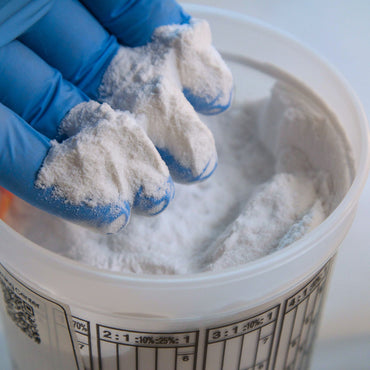
Fumed silica is the white powder that turns runny epoxy into a paste that stays where you put it. When a fillet recipe says "add cabosil," this is what it means. Here is what it is, how much to add for each consistency, how it compares with the other fillers, and what the safety data sheet says about breathing it.
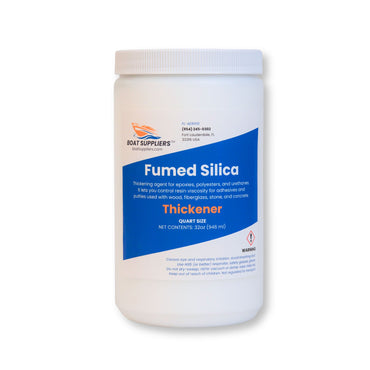
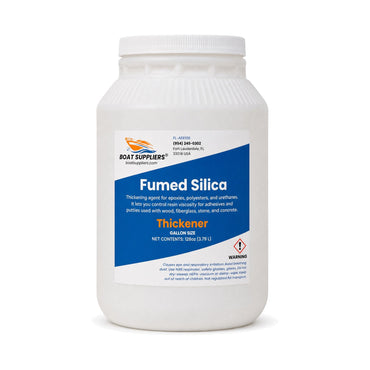
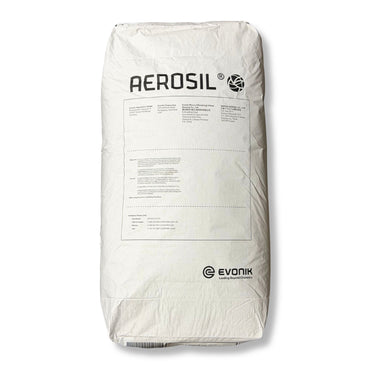
Need a number for the batch in front of you? The Fairing and Filler Calculator works it out by volume and suggests a jar size. We stock Aerosil 200 type fumed silica, from an 8 oz jar to a 10 lb bag.
What fumed silica is
Fumed silica is amorphous silicon dioxide made in a flame. Silicon tetrachloride burns in a hydrogen and oxygen flame, and the silica comes out as particles around 12 nanometers across, fused into branched chains. That gives it a huge surface area for almost no weight, which is why a full quart jar holds only about 2 ounces.
Cab-O-Sil is Cabot's brand, Aerosil is Evonik's and HDK is Wacker's; most boat shops just say "cabosil." West System sells it as 406 Colloidal Silica. Aerosil 200 and Cab-O-Sil M-5 are the grades you'll see most at composites suppliers, both untreated 200 m²/g grades. Our Aerosil 200 vs Cab-O-Sil M-5 comparison puts the spec sheets side by side.
| Property (Aerosil 200 type) | Typical value |
|---|---|
| Chemistry | Amorphous silicon dioxide, SiO₂ 99.8% or higher, untreated (hydrophilic) |
| BET surface area | 175 to 225 m²/g |
| Tapped (bulk) density | About 50 g/L (roughly 3 lb per cubic foot) |
| True density | About 2.2 g/cm³ |
| pH, 4% in water | 3.7 to 4.5 |
| CAS numbers | 112945-52-5, 7631-86-9 |
| Transport | Not regulated as a dangerous good |
What fumed silica is not
- Silica fume is a byproduct of silicon smelting sold as a concrete additive. Different material.
- Colloidal silica in the chemical trade is a liquid, silica suspended in water. In boat shops it usually means the dry thickener, after West System's 406. Check that you are buying a powder.
- Crystalline silica, the quartz dust from cutting stone and concrete, is the silicosis hazard OSHA regulates. Fumed silica is amorphous.
How fumed silica thickens resin
Untreated fumed silica is covered in silanol (Si-OH) groups. In resin the particles hydrogen-bond to each other and build a loose network that holds the liquid in place. Spread the mix and the network shears apart so it flows and wets out; stop and it rebuilds, so the paste stays on a vertical transom instead of running for the bilge. That behavior is thixotropy.
- Disperse it, don't just wet it. Dry lumps don't join the network and leave soft pockets. Fold it in, then stir hard and scrape the sides and bottom of the cup.
- It loses some grip as epoxy cures. Published technical guidance on Aerosil in epoxy explains that hydrophilic grades get solvated by the hydroxyl groups the cure produces, so viscosity drops. Mix vertical and overhead work to the stiff side.
- Cold resin is thick, not thixotropic. Epoxy at 60°F (16°C) feels like honey and runs again once it warms. Only the silica keeps it on a vertical surface.

How much fumed silica to add to epoxy
Mix resin and hardener completely to ratio first, then add the silica. West System's instructions say the same: mix resin and hardener thoroughly before adding fillers. Thicken first and you can't tell whether you hit the ratio.
Volumes below are loose powder scooped from the jar into mixed epoxy at room temperature. Weights are for anyone with a gram scale, the more repeatable method, since fumed silica weighs only about 50 grams per liter.
| Consistency | What it looks like | Use it for | Loose powder per cup (8 fl oz) of mixed epoxy | Per quart of mixed epoxy | By weight |
|---|---|---|---|---|---|
| Ketchup | Drips slowly off the stick | Coating, sealing, bonding large flat panels | 3/4 cup (5.6 fl oz) | 2 3/4 cups (about 1.1 oz) | About 3% (3.1 g per 100 g epoxy) |
| Mayonnaise | Holds a soft peak | General bonding, bedding hardware, gap filling on flat work | 1 cup (8 fl oz) | 1 quart (about 1.6 oz) | About 4.5% (4.4 g per 100 g epoxy) |
| Peanut butter | Holds a sharp peak, no sag | Fillets, gap filling, vertical and overhead work | 1 3/4 cups (14 fl oz) | 1 3/4 quarts (about 2.8 oz) | About 7.5% (7.6 g per 100 g epoxy) |
Add about two thirds, mix it in completely, then add the rest a little at a time. Fumed silica looks like more than it is and thickens quickly near the end, so slow down on the last third. The same numbers are on the calculator page as the epoxy filler consistency chart, and the printable laminate, cloth weight and MEKP charts are on our composites reference charts page.

Printable version: download the Epoxy Filler Consistency Chart (PDF). More free shop charts: composites reference charts.
The makers land in the same place. US Composites publishes the rule that a quart of resin takes about a quart of Aerosil to reach mayonnaise. West System's 406 data sheet says a 5.5 oz package thickens about 1.1 gallons of mixed epoxy to catsup, 3 quarts to mayonnaise or 1.7 quarts to peanut butter, roughly 3.4, 5.0 and 8.8 percent by weight. Our starting amounts sit slightly leaner on purpose: another scoop is easy to add and impossible to take out. The 1 to 2 percent figures you'll see online describe light sag control in a laminating resin, not a paste.
How far a jar goes
One ounce of fumed silica thickens roughly 28 fl oz of mixed epoxy to ketchup, 20 fl oz to mayonnaise or 11 fl oz to peanut butter. Powder packs down in a jar, so by net weight a jar covers a little more than its volume suggests.
| Size (net weight) | Ketchup | Mayonnaise | Peanut butter |
|---|---|---|---|
| 8 oz jar (0.5 oz) | About 14 fl oz of epoxy | About 10 fl oz | About 6 fl oz |
| Quart jar (2 oz) | About 1 3/4 quarts | About 1 1/4 quarts | About 23 fl oz |
| Gallon jar (6.4 oz) | About 1.4 gallons | About 1 gallon | About 2 1/4 quarts |
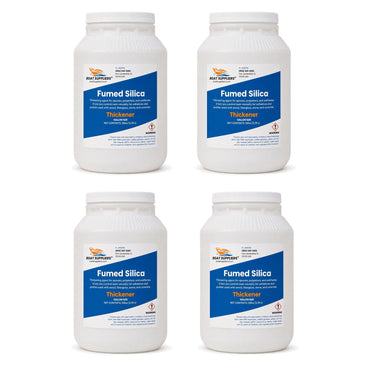
| 4 gallon case (1.7 lb) | About 6 gallons | About 4 1/4 gallons | About 2 1/2 gallons |
| 10 lb bag | About 36 gallons | About 25 gallons | About 14 gallons |
Mixing it without a dust cloud
Scoop it, don't pour from height, and keep the lid on between scoops. Use a cup big enough for both the resin and the powder; the finished putty ends up around the resin volume plus half the powder volume. Fold the powder in with a flat mixing stick until it is wet before you stir hard.
Fumed silica vs microballoons, Q-Cells and cotton flock
The split is strength against sanding. Fumed silica and cotton flock make hard, strong bonding pastes that fight a sanding block. Microballoons, Q-Cells and glass bubbles make light putties that sand easily but don't belong in load-bearing joints. Amounts are the mayonnaise row from our calculator.
| Filler | What it is | Per cup of epoxy for mayonnaise | Sanding | Use it for |
|---|---|---|---|---|
| Fumed silica | Amorphous silica powder | 1 cup | Hard | Bonding paste, structural fillets, sag control, thickening gelcoat |
| Phenolic microballoons | Hollow phenolic spheres, reddish brown | 1 3/4 cups | Easy | Fairing and shaping |
| Q-Cells | Lightweight hollow off-white filler | 1 3/4 cups | Easy | Economical fairing putty |
| 3M glass bubbles | Hollow glass microspheres, white | 1 3/4 cups | Easy | Light fairing putty above the waterline |
| Cotton flock | Short cotton fibers | 1/2 cup | Hard | Tough structural bonds and gap filling |
Most repairs use two: silica or flock underneath where the load is, a microballoon or glass bubble putty on top where the sanding block goes. If a fillet will be faired, thicken with silica for body, then work in microballoons until it sands. If a fairing putty sags on a hull side, a small scoop of silica stops it. For fillets that carry real load, add 1/32 in. milled fiber alongside the silica. Our microballoons vs cabosil guide goes job by job, and how to thicken epoxy covers the other thickeners.

Fumed silica in epoxy vs polyester and vinyl ester
Untreated fumed silica thickens epoxy, polyester and vinyl ester the same way, so one jar covers all three.
- Epoxy: resin and hardener first, silica last. A thick mass holds heat, so a full cup of putty kicks faster than the same resin spread thin. Mix what you can use inside the pot life.
- Polyester and vinyl ester: nothing cures until the MEKP goes in, so stir the silica into the resin, get it smooth, then catalyze. Dose MEKP on the resin, not the resin plus filler; the MEKP catalyst calculator keeps you in the 1 to 2 percent band. Silica also stiffens gelcoat for a vertical patch.
Our chart was built for epoxy, so treat it as a starting point in polyester and adjust by eye. And polyester putty does not bond well to cured epoxy; see our guide to secondary bonding.
Hydrophilic vs hydrophobic fumed silica
| Hydrophilic (untreated) | Hydrophobic (surface treated) | |
|---|---|---|
| Examples | Aerosil 200, Cab-O-Sil M-5 | Aerosil R 202, R 805, R 972; Cab-O-Sil TS-720 |
| Surface | Silanol groups that attract water | Silanols reacted with a silane or silicone treatment, so it repels water |
| Typical user | Shops thickening a batch right before use | Formulators making pre-thickened adhesives, coatings and sealants |
A pre-thickened product that sits in a can and then cures in place needs stable viscosity, and the same Aerosil guidance recommends treated grades such as R 202, R 208 or R 805 for those epoxy formulations. At the bench, where you thicken a cup and use it inside the pot life, the untreated 200 grade is the standard and it is what we stock.
Is fumed silica dangerous?
The safety data sheet on our product page is Evonik's sheet for Aerosil 200 (read the full SDS). In plain terms:
- Not classified as hazardous under OSHA's hazard communication standard (29 CFR 1910.1200). No signal word, no pictogram.
- If dust is released, breathing it can cause coughing and sneezing. First aid is fresh air.
- It is amorphous silica. The repeated-dose data in the sheet shows no indication of silicosis, and the product contains no substances listed as carcinogens by NTP, IARC or OSHA.
- The sheet lists an exposure limit of 6 mg/m³ for the dust and calls for respiratory protection where that can be exceeded, safety glasses (goggles when dust forms) and impermeable gloves.
- Not regulated as a dangerous good for ground, air or sea transport.
It is light enough that one careless scoop puts it in the air, so we wear a fitted respirator with P100 filters when we open a bag or jar, and nitrile gloves once resin is involved. Sanding cured putty makes resin dust, so the respirator stays on for that too. See protective gear.
How to store fumed silica
- Dry, cool, closed. That is the SDS instruction, and untreated silica picks up moisture from humid air.
- Mind static. The SDS calls for precautions against static discharge, so don't scoop from a big bag next to open acetone or styrene.
- Expect settling. A jar filled by weight arrives looking part empty. Check the net weight on the label and fluff the powder before measuring by volume.
Which size to buy
Use the coverage table. An 8 oz jar handles a few small fillets, a quart jar a little over a quart of epoxy at mayonnaise, and a gallon jar about a gallon, which makes it the easy pairing with a gallon epoxy kit. The 10 lb bag covers about 25 gallons of epoxy at mayonnaise for shops that mix putty every week.
For a typical stringer or bulkhead fillet: mix the epoxy, stir in fumed silica to peanut butter (1 3/4 cups of loose powder per cup of epoxy, or about 7.5 grams per 100 grams), lay the fillet, and cut in microballoons only if you plan to fair it. For bonding a flat panel, stop at mayonnaise. For anything bigger than a couple of cups, run the filler calculator first.
Tools and materials for this job
- Fumed silica, Aerosil 200 type, 8 oz jar to 10 lb bag
- West System 406 colloidal silica
- All fillers and additives
- Guides: marine filler types, mixing and applying fillers with resin
Frequently asked questions
How much fumed silica do I add to epoxy?
Stir it into fully mixed epoxy by volume: about 3/4 cup of loose powder per cup of epoxy for ketchup, 1 cup for mayonnaise and 1 3/4 cups for peanut butter. By weight that is roughly 3, 4.5 and 7.5 percent of the epoxy weight. Add about two thirds, mix it in, then add the rest slowly until the mix holds.
Is fumed silica the same as cabosil?
Yes. Cab-O-Sil is Cabot's brand name for fumed silica, Aerosil is Evonik's and HDK is Wacker's, and West System sells it as 406 Colloidal Silica. Untreated 200-grade products such as Aerosil 200 and Cab-O-Sil M-5 are interchangeable for thickening resin at the bench.
Is fumed silica dangerous to breathe?
Evonik's safety data sheet for Aerosil 200 does not classify it as hazardous, and it is amorphous silica, not the crystalline silica that causes silicosis. The dust can still make you cough and sneeze, so wear a fitted respirator with P100 filters when you scoop or mix it.
Do I add fumed silica before or after the hardener?
After, for epoxy. Mix resin and hardener completely to the correct ratio, then stir in the silica. With polyester and vinyl ester you can thicken the resin first and add the MEKP last, dosing the catalyst on the resin amount, not the putty.
Can you sand epoxy thickened with fumed silica?
You can, but it is hard work. Fumed silica putty cures hard and dense, so use it for bonds and fillets and fair over it with a microballoon, Q-Cells or glass bubble putty. If a silica fillet has to be faired, work microballoons into the mix.
What is the difference between silica and fumed silica?
Silica is silicon dioxide in any form, including quartz sand and crystalline dust. Fumed silica is an amorphous form made in a flame, with tiny particles and a very high surface area that let it thicken liquids. Silica fume and precipitated silica are different products again.
Can I use fumed silica in polyester resin and gelcoat?
Yes. Untreated fumed silica thickens polyester, vinyl ester and gelcoat as well as epoxy. Stir it into the resin or gelcoat until it stops sagging, then catalyze with MEKP at the normal dose for the amount of resin.
Where can I buy fumed silica?
Composites suppliers, marine stores and online marketplaces sell it as cabosil, Aerosil or colloidal silica. We sell hydrophilic Aerosil 200 type fumed silica in 8 oz, quart and gallon jars, a 4 gallon case and a 10 lb bag, with the net weight listed for each size.
Prev post

Spring Boat Fiberglass Repair: The Complete Inspection and Repair Checklist
Updated on 19 June 2026
Next post

Secondary Bonding: Which Resin Sticks to Cured Laminate (and Which Won't)
Updated on 16 June 2026