

Epoxy vs Polyester vs Vinyl Ester: Best Resin for Fiberglass

21 February 2026
For most repairs on an existing fiberglass boat, use epoxy. It bonds to cured polyester, wood and metal, shrinks less than 2% as it cures and keeps water out. Use polyester for new layups, mold work and anything you will finish in gelcoat, and vinyl ester when you want the polyester workflow with more strength and better blister resistance, as on hulls and decks. The table below compares all three, and the sections after it show where each one earns its place.
The three resins compared here
-


Marine-Grade Polyester Layup Resin with Hardener
Regular price From $34.95 USDSale price From $34.95 USD Regular priceUnit price $1.09 per floz -
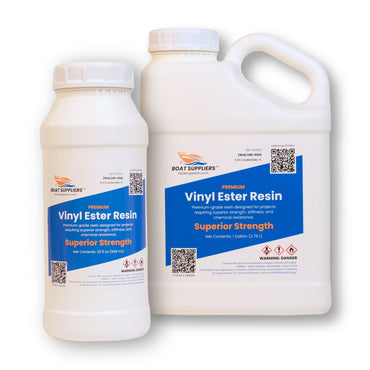
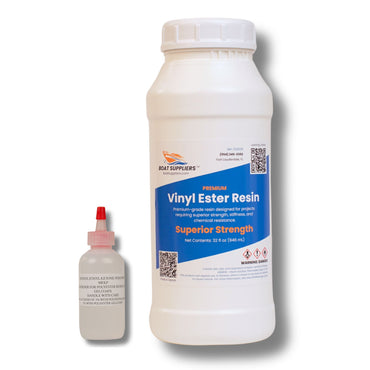
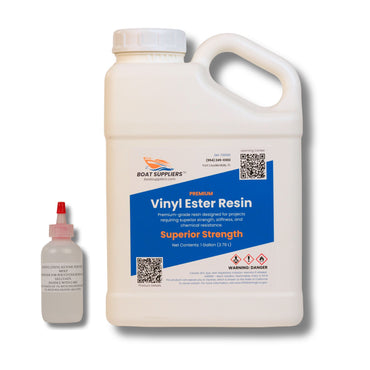

Premium Vinyl Ester Resin with Hardener
Regular price From $39.95 USDSale price From $39.95 USD Regular priceUnit price $1.25 per floz -

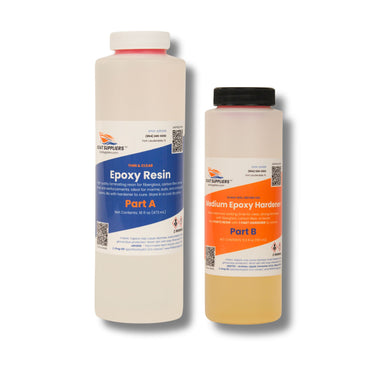


Boat Suppliers Epoxy Resin Kit – Thin, Clear, with Hardener
Regular price From $17.95 USDSale price From $17.95 USD Regular priceUnit price $1.46 per floz -
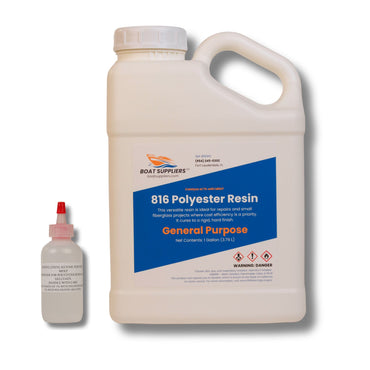
General Purpose Polyester Resin with Hardener
Regular price From $59.95 USDSale price From $59.95 USD Regular priceUnit price $0.47 per floz


Quick reference: best resin for fiberglassing, polyester vs vinyl ester vs epoxy
| What matters | Polyester | Vinyl ester | Epoxy |
|---|---|---|---|
| Cost | Cheapest of the three | More than polyester, less than epoxy | Most expensive of the three |
| Cure | Fast, with MEKP | MEKP at a precise ratio | Slower, hardener at system ratio |
| Strength and flex | Brittle, prone to cracking | Stronger, more flexible than polyester | Maximum strength, less prone to cracking |
| Water resistance | Can absorb water over time | Less absorbent than polyester | Excellent resistance to water absorption |
| Bond to cured polyester, sanded | Fair | Good | Strong |
| Bond to bare wood and plywood | Poor | Fair | Strong |
| Chopped strand mat | Yes | Yes | Yes, stiffer in epoxy |
| Gelcoat over it | Yes | Yes | No |
| Best for | Large projects on a budget | Boat hulls and decks | Structural repairs, bonding to various materials |
Bond ratings assume a clean, dry, sanded surface free of wax and amine blush.
How each resin cures, and why it matters
Polyester and vinyl ester both cure by styrene cross-linking, started with MEKP catalyst. That is where the sharp styrene smell comes from, and it is why polyester shrinks as it cures, typically 4 to 8% by volume. On a new laminate laid up in one session the shrinkage is manageable. On a repair bonded over cured polyester, it pulls against the bond line.
Epoxy cures when an amine hardener reacts with the resin at a fixed ratio. It shrinks less than 2%, gives off far fewer fumes, and bonds hard to almost any clean, sanded surface, cured polyester included. That last point decides most repair jobs.
Start from what is under the repair
The surface you are bonding to decides the resin more often than the price does. If there is any chance the area was repaired with epoxy before, if it is wood, or if it is old laminate you cannot grind fully clean, use epoxy. If it is a production polyester hull and you can grind it back to bright, clean glass with a 36 grit disc, polyester or vinyl ester will bond and costs less.
Epoxy vs polyester vs vinyl ester, property by property
Adhesion and secondary bonding
This is where epoxy wins outright, and it matters most on repairs. Polyester bonds well to itself only while the layer underneath is still green, partly cured. Once that layer has fully cured, new polyester is sticking to a hard, styrene-depleted surface and the bond is only fair. Vinyl ester does better on cured, sanded polyester, and epoxy does best of all: it bonds to cured polyester, cured epoxy, fiberglass, wood, aluminum and steel, as long as the surface is clean, dry and sanded with 36 to 80 grit.
The rule runs one way only. Epoxy over polyester works. Polyester resin and gelcoat over cured epoxy do not bond reliably, because the amine surface of cured epoxy interferes with the polyester cure. If a repair has to be finished in gelcoat, laminate it with vinyl ester or polyester.

Printable version: download the Resin Compatibility Chart (PDF). More free shop charts: composites reference charts.
Strength and flexibility
Epoxy laminate runs roughly 7,000 to 8,000 psi in tensile strength against 5,000 to 6,000 psi for polyester, and it is tougher in flex and impact. Vinyl ester sits between the two: stronger than polyester and less prone to cracking. That margin matters at a keel joint, a chainplate reinforcement or a heavily loaded deck fitting. On a cosmetic fill or a gelcoat chip, it does not.
Water resistance and blisters
Cured polyester lets water through over time, and water moving through the laminate by osmosis is the root cause of blisters on older fiberglass hulls. Vinyl ester absorbs less, which lowers the risk of blisters and delamination. Epoxy is far less permeable than either, which is why epoxy barrier coats go over polyester hulls to keep blisters from coming back.
Working time and cold weather
Polyester gels fast. In warm conditions you get about 15 to 25 minutes of working time, and it reaches handling strength in a few hours, a pace that suits production layup. Vinyl ester cures the same way and needs its MEKP measured just as carefully. Epoxy's pot life and cure time depend on the hardener you pick, slow, medium or fast, which gives you more control but asks for more planning.
In the cold the gap widens. Polyester cures poorly below 60°F, while epoxy with the right hardener keeps working. The cold weather fiberglass repair guide covers hardener choice in detail.
Fumes and safety
Polyester and vinyl ester give off heavy styrene vapor, so work outdoors or with strong ventilation and wear a respirator with organic vapor cartridges. Epoxy fumes are much milder, but repeated skin contact can sensitize you, so wear nitrile gloves every time. In a closed bilge or below decks, epoxy is the easier resin to breathe around.
Cost
Polyester is the cheapest of the three, vinyl ester costs more, and a quality marine epoxy costs the most per ounce. Across a production hull that difference adds up. On a small repair it rarely decides anything.
Strengths and weaknesses of each resin
Polyester resin
- Strengths: the lowest cost, a fast cure with MEKP, good wet-out of mat and cloth, and easy sanding and finishing. It takes gelcoat on top.
- Weaknesses: more brittle and prone to cracking under stress, a weaker bond to cured surfaces, and water absorption over time that can lead to blisters and delamination.
- Good to know: laminating resin stays tacky on the surface so the next ply bonds to it. The last coat needs surfacing wax, PVA or gelcoat over it to cure hard.
Shop polyester resins.
Epoxy resin
- Strengths: the strongest bond to fiberglass, wood and metal, the best water resistance, more flexibility under impact, and better resistance to fuel and solvents.
- Weaknesses: the highest cost, a slower cure that takes planning, and polyester resin and gelcoat will not bond reliably over it. It also chalks in sunlight, so it always needs paint or a UV-stable topcoat.
Shop epoxy resin.
Vinyl ester resin
- Strengths: stronger and more flexible than polyester, less water absorption, a better bond to cured polyester, and better heat and chemical resistance. It works with chopped strand mat and takes gelcoat, which makes it the usual pick for blister repair, below-waterline patches, fuel tank areas, transoms and stringers.
- Weaknesses: it costs more than polyester, it needs its MEKP measured as precisely as polyester does, and it has a short shelf life of about 3 months, so buy it when you are ready to use it.
Shop vinyl ester resin.
Which resin for which job
Repairing an existing fiberglass hull
Use epoxy. Whether the hull was built with polyester or epoxy, epoxy bonds to it reliably, while polyester over fully cured polyester is a gamble on a structural repair. For a small job, the West System Fiberglass Handy Repair Pack has 105 resin and 205 fast hardener in a size that suits a single repair.
Repairs you will finish in gelcoat
Laminate with vinyl ester or polyester, because gelcoat does not bond reliably over cured epoxy. Vinyl ester bonds better to the cured, sanded hull than polyester does, so it is the stronger pick when the finish has to be gelcoat.
Transom rebuild
On a production outboard boat, with the inner skin ground to clean glass and a new plywood or composite core, vinyl ester with 1708 biaxial is the standard boatyard answer. If the old skin was ever epoxied, or you want the strongest possible bond to the core, use epoxy. Either way, run 3 to 4 plies of 1708 over the core and tab them into the hull sides.
Stringers and floors
Polyester or vinyl ester with 1708 over the stringer caps, with 1.5 oz chopped strand mat as the first ply against the ground glass. The mat gives 1708 the resin-rich bed it wants underneath.
Holes below the waterline
Use vinyl ester. Grind a 12:1 scarf around the hole, alternate mat and 1708 to rebuild the thickness, and finish with gelcoat or a barrier coat.
New construction and molds
Production boats have long been laid up in polyester because it is fast and economical in volume, and it is the standard resin for molds and parts finished in gelcoat. Vinyl ester is the step up for hulls and decks that need more strength and water resistance with the same gelcoat workflow. Performance and one-off builds where weight and stiffness come first, such as racing hulls and light tenders, go to epoxy. The guide to orthophthalic and isophthalic polyester covers the polyester grades.
Carbon fiber and Kevlar
Use epoxy. Carbon and Kevlar fabrics wet out and bond poorly in polyester. The Boat Suppliers thin epoxy kit is a 600 cps laminating epoxy that saturates the fibers quickly.
Structural bonding
For bulkheads, stringers and through-hull fittings, epoxy is the answer. West System Six10 puts thickened, gap-filling West System epoxy in a cartridge, so there is no batch to mix.
Wood boats, canoes and kayaks
Sheath wood with epoxy and 6 oz cloth. Polyester will not hold on wood over the long term.
Clear finishes over bare wood
For brightwork, interior joinery and wooden boat restoration, use a hardener made to stay clear and resist blush: West System 105 resin with 207 Special Clear hardener, which mixes 3:1 and needs its own 3:1 pump set. Epoxy will not bond to oiled wood, so strip or sand down to bare wood first.
Color-matched cosmetic repairs
Both resins take pigment. Liquid colored pigments work in epoxy, polyester and gelcoat. Use no more than about 1 fl oz per quart, and stir until the color is completely streak-free.
Kits sized for these jobs
- A single transom or a couple of stringers: the 1708 Biaxial Fiberglass & Resin Kit, 5 yards of 50 in 1708 with a gallon of polyester or vinyl ester.
- A full transom plus stringers and a floor: the 1708 Fiberglass & Resin Kit with 10 yards and 5 gallons of polyester, or the 1708 Fiberglass & Epoxy Kit with 10 yards, 4 gallons of thin epoxy and 2 gallons of slow hardener for the 2:1 mix.
- Jobs that want a mat bed under every ply: the Boat Building Fiberglass Kit, 5 yards of 1708 and 5 yards of 1.5 oz mat with 5 gallons of resin.
- Sheathing and finish work: the Fiberglass Cloth & Resin Kit, 5 yards of 6 oz cloth with polyester, vinyl ester or a half gallon epoxy kit.
- Molds and buildup: the Fiberglass Mat & Resin Kit, 5 yards of 1.5 oz mat with a gallon of resin. Mat takes much more resin than 1708, so budget for it.
Quick picks
- Structural repair on an existing hull: epoxy
- Repair that will be finished in gelcoat: vinyl ester or polyester
- Transom rebuild: vinyl ester, or epoxy if the old skin was ever epoxied
- Hole below the waterline or blister repair: vinyl ester
- Sheathing a wood boat, canoe or kayak: epoxy
- New production layup and molds: polyester
- Hulls and decks that need more strength and water resistance: vinyl ester
- Performance or one-off builds: epoxy
- Carbon fiber or Kevlar: epoxy only
- Structural bonding: epoxy
- Blister barrier coat over a polyester hull: epoxy
- Work in a bilge or below decks: epoxy, for the lower fumes
- Large, budget-driven layup and fill: polyester
Common mistakes
- Polyester or gelcoat over cured epoxy. Epoxy over polyester works; the reverse does not.
- Skipping surface prep. No resin sticks to a dirty, oily or glossy surface. Sand, wipe with solvent and let it dry before you laminate or bond.
- Extra catalyst to speed up polyester. Too much MEKP leaves a brittle, discolored laminate. Stay between 1% and 2%; the MEKP catalyst calculator gives the dose for your shop temperature.
- Less hardener to slow down epoxy. Epoxy cures at a fixed ratio, and off-ratio epoxy stays soft. Use a slower hardener instead.
To work out how much resin a layup needs, run it through the resin calculator.
Frequently asked questions
Can I use epoxy to repair a polyester boat?
Yes. Epoxy makes a strong secondary bond to cured polyester laminate once it is clean, dry and sanded with 36 to 80 grit, which polyester itself does not. The rule that matters runs the other way: polyester resin and gelcoat do not bond reliably over cured epoxy, so if the repair has to be gelcoated, laminate it with vinyl ester or polyester.
Is epoxy stronger than polyester resin?
Yes. Epoxy laminate runs roughly 7,000 to 8,000 psi in tensile strength against 5,000 to 6,000 psi for polyester, shrinks less than 2% as it cures against 4 to 8% for polyester, and handles impact better. Vinyl ester falls between the two.
What resin should I use for a transom rebuild?
On a production outboard boat with the inner skin ground to clean glass and a new plywood or composite core, vinyl ester with 1708 biaxial is the standard choice. Use epoxy instead if the old skin was ever repaired with epoxy, or if you want the strongest possible bond to the core. Either way, run 3 to 4 plies of 1708 over the core and tab them into the hull sides.
Which resin should I choose for a structural repair?
Epoxy, for the strongest bond to cured laminate, wood and metal, the best water resistance and more flexibility under impact. It costs more and cures more slowly, so plan the job around the hardener you pick. If the repair has to be finished in gelcoat, use vinyl ester instead.
Is vinyl ester worth the extra cost over polyester?
For hulls, decks and below-waterline work, often yes. Vinyl ester is stronger and more flexible than polyester, absorbs less water, which lowers the risk of blisters and delamination, and bonds better to cured polyester. It costs more than polyester but less than epoxy, and it keeps the polyester workflow: MEKP catalyst, chopped strand mat and gelcoat on top.
What's the difference between catalyst and hardener when mixing resin?
They are not interchangeable. Polyester and vinyl ester cure with MEKP catalyst, added at 1% to 2% of the resin volume. Epoxy cures with a hardener mixed at the system's fixed ratio. Never swap them: MEKP in epoxy, or epoxy hardener in polyester, will not cure correctly and can ruin the laminate.
When is polyester resin the right call?
For new layups, molds, large budget-driven projects and anything finished in gelcoat. Polyester is the most affordable of the three, cures fast, wets out mat and cloth well and sands easily. Its weaknesses are brittleness, a weaker bond to cured surfaces and water absorption over time, so use epoxy for structural repairs on an existing hull.
Prev post

How to Choose Your Fiberglass Chop Mat Size
Updated on 21 February 2026
Next post

How Is Fiberglass Chopped Strand Mat Made?
Updated on 15 August 2025


