

Transom Repair Kit - Complete Fiberglass & Epoxy System for Boat Transoms
Transom Repair Kit - Complete Fiberglass & Epoxy System for Boat Transoms
Share
SKU:SK-TRK001
17 in stock
Couldn't load pickup availability
Everything except the plywood for rebuilding a soft or rotted boat transom the right way. Epoxy, not polyester, because a transom rebuild is a secondary bond to cured laminate and wood, and epoxy holds where polyester lets go. No shrink, superior adhesion, and a long enough working time to wet out heavy 1708 without racing the clock.
What is in the kit:
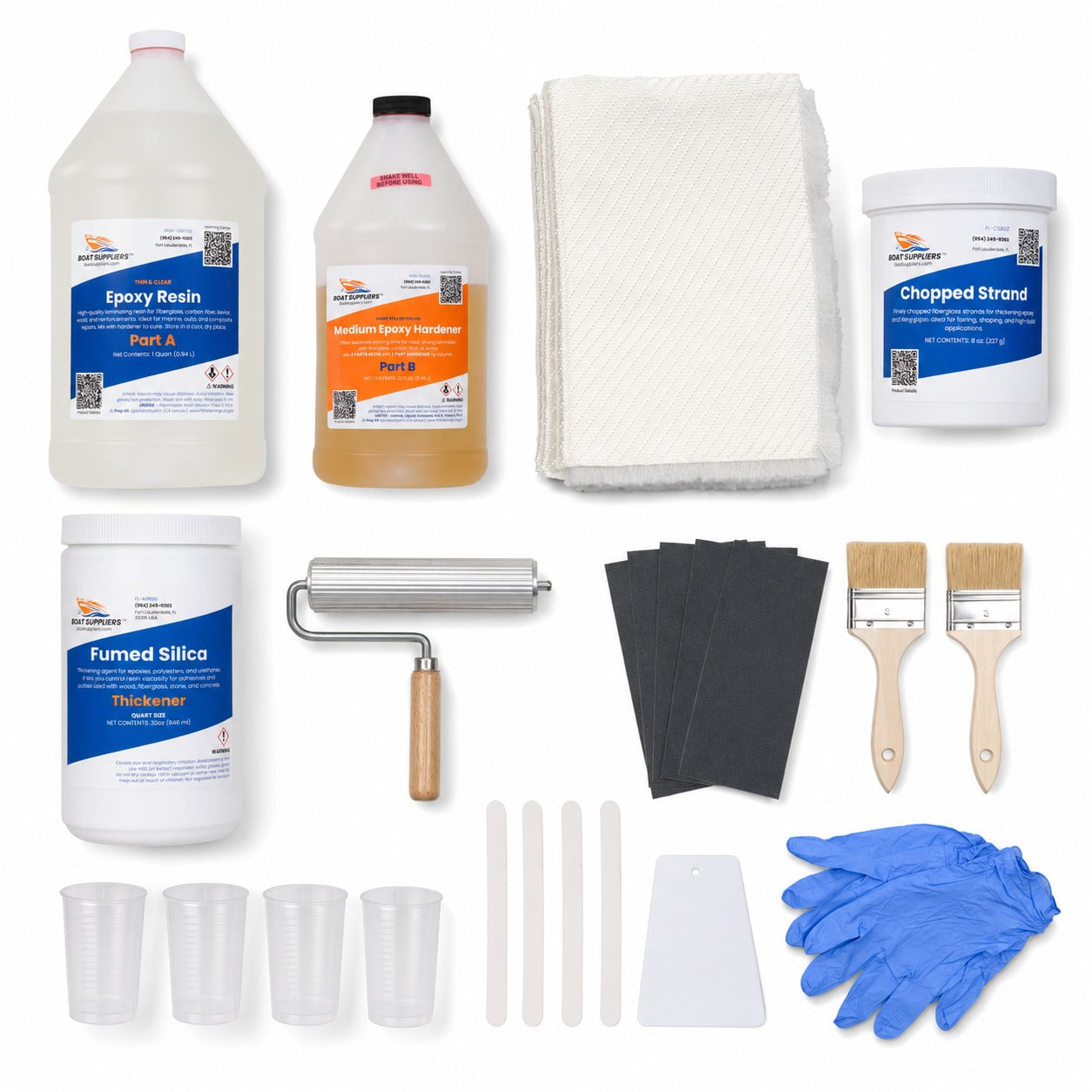
- Quart epoxy resin kit with medium 3:1 hardener (42.7oz mixed)
- 3 yards x 50" of 1708 biaxial fiberglass, the standard transom laminating fabric
- 1 LB of 1/4" chopped strand fiberglass for structural bonding putty
- 1 Quart fumed silica thickener for fillets and gap filling
- Fiberglass laminating roller for driving out air between layers
- Prep & Fair wet/dry sandpaper 6-pack (120 through 400)
- 2 chip brushes, 4 mixing cups, 4 mixing sticks, plastic spreader, nitrile gloves
How the repair works: cut out the rotted core, bond new marine plywood (sized locally to your boat, not included) with thickened epoxy, then laminate 1708 over the new core in multiple layers, rolling out air between each. The chopped strand and silica mix into the epoxy for the structural putty and fillets the job needs.
Covers a typical outboard transom rebuild on boats up to about 20 feet. For bigger transoms, add a second epoxy kit and more 1708 from our by-the-yard listings.
Specifications
How to use this kit
Complete epoxy and 1708 system for rebuilding a soft boat transom. Every kit ships with this same sheet printed and in the box.
What is in the kit
- 1 qt Epoxy resin kit, medium 3:1 hardener42.7 oz mixed, 32 oz resin plus 10.7 oz hardener
- 3 yd 1708 biaxial fiberglass, 50 in widethe standard transom laminating fabric
- 1 lb 1/4 in chopped strand fiberglassmixes into epoxy for structural bonding putty
- 1 qt Fumed silica thickenerfillets and gap filling
- 1 Fiberglass laminating rollerdrives air out between layers
- 6 Prep & Fair wet/dry sandpaper120 / 150 / 180 / 240 / 320 / 400 grit
- 2 / 4 / 4 Chip brushes, mixing cups, mixing sticks
- 1 / 1 pr Plastic spreader, nitrile gloves
You supply: marine plywood cut to your transom, acetone, a grinder, a respirator, clamps or screws, and masking tape.
Mixing epoxy (3:1 by volume)
| Ratio | 3 parts resin to 1 part hardener |
| Small batch | 6 oz resin + 2 oz hardener |
| Full kit | 32 oz resin + 10.7 oz hardener |
Measure by volume in the graduated cups. Epoxy is not like polyester: off-ratio does not cure slower, it never fully cures. Confirm the ratio printed on your hardener bottle.
Stir 2 minutes scraping the sides and bottom, then pour into a second cup and stir again. Unmixed resin on the cup wall is the number one cause of soft spots.
The job, start to finish
Open it up and gut it
Cut the inner skin off the transom and dig out every bit of wet or rotted core. If a screwdriver sinks into it, it goes. Grind the inside of the outer skin back to clean glass and wipe with acetone. Take a template off the old core before you throw it away.
Mix and butter
Mix epoxy 3 to 1, then stir in chopped strand and fumed silica until it holds a peak like thick peanut butter. Butter the outer skin and both faces of your new plywood. Leave no dry spots: a void here becomes the next rot pocket.
Bond the new core
Set the plywood into the putty and clamp or screw it tight until squeeze-out appears all the way around. Tool the squeeze-out into a fillet at every edge. If you are laminating two plywood layers, bond them together at the same time. Cure overnight.
Laminate the inner skin
Sand the cured putty, wipe it clean, then laminate 1708 over the new core in multiple layers, wet on wet, carrying each layer a few inches onto the surrounding hull. Roll air out of every layer with the roller before the next goes on.
Fair and seal
Fill the weave with silica-thickened epoxy and sand fair through 120 to 400. Seal every bolt hole you drill by overdrilling, filling with thickened epoxy, and redrilling through the cured plug, so water can never reach the wood again.
If something goes wrong
Soft or greasy patches
Off-ratio or under-stirred epoxy. Scrape it out, wash with soap and water, relaminate.
Cloudy waxy film
Amine blush from humid curing. Wash with warm soapy water and scuff, or nothing sticks.
Nothing cured at all
Resin and hardener swapped or badly off ratio. It will not fix itself. Remove and redo.
Putty slumped out
Not enough chopped strand and silica. Thicken until it holds a peak on the stick.
Cure crawled overnight
Under 60 F. Epoxy stalls in the cold. Warm the space, do not add more hardener.
Bigger transom? Add a second epoxy kit and more 1708 by the yard. Epoxy needs a topcoat for UV: paint or gelcoat over it, at boatsuppliers.com.
Blog posts

Best Fiberglass Cutting Tools for Clean Edges...
Best Fiberglass Cutting Tools for Clean Edges...

Kevlar Fabric for Boats: A Fabricator's Guide...
Kevlar Fabric for Boats: A Fabricator's Guide...
