Boat Suppliers

Premium Vinyl Ester Resin with Hardener

Premium Vinyl Ester Resin with Hardener

SKU:SM700025

Regular price $34.95 USD
Sale price $34.95 USD Regular price
Sale Sold out
Shipping calculated at checkout.

32 in stock

Size: 1 Quart
Earn 34 Boat Points Learn More
Ships Today if ordered before 4pm Learn More
Free Shipping on orders over $99 Learn More

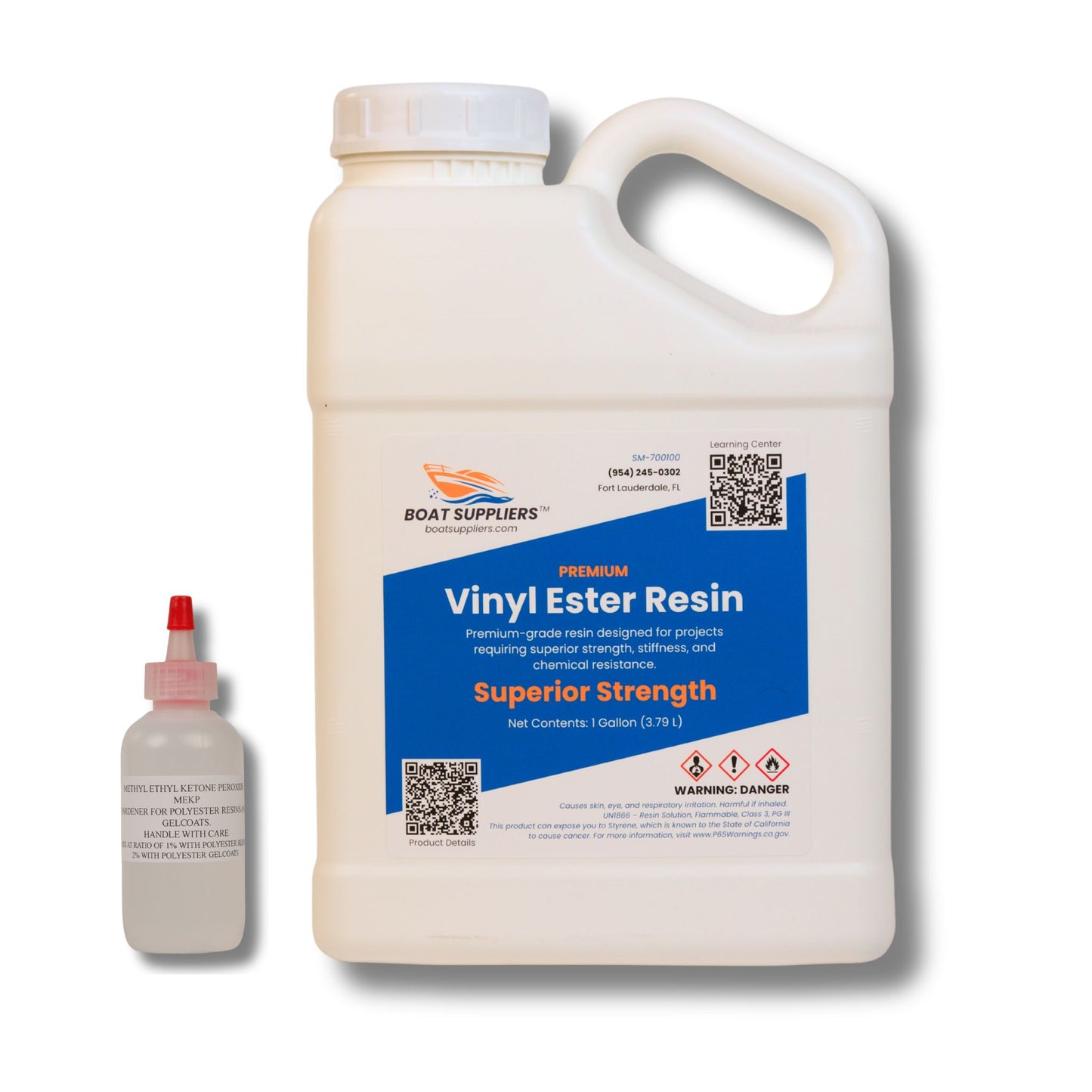
700 Vinyl Ester Resin is a premium-grade resin designed for projects requiring superior strength, stiffness, and chemical resistance. Unlike polyester resins, this vinyl ester offers exceptional thermal tolerance and durability, making it the preferred choice for boat building, automotive, industrial, and high-performance composite applications.

Supplied with MEKP catalyst, this resin cures with reliability and consistency.

  • Resin Type: Vinyl Ester
  • Color: Amber
  • Usage: Hand layup, spray-up, structural laminates, marine skin coats
  • Catalyst: MEKP (1.0–2.0% by weight/volume)

Liquid Properties (25°C / 77°F)

  • Appearance: Amber
  • Non-Volatile Material (NVM): 55%
  • Viscosity: 525 cps (Brookfield LVF #3 @ 60 RPM)
  • Thix Index: 3.0
  • Specific Gravity: 1.08 g/cm³

Cure Profile (1.25% MEKP)

  • Gel Time: 23 minutes
  • Gel-to-Peak: 16 minutes
  • Peak Exotherm: 177°C / 350°F

Mechanical Properties (Typical, Fully Cured)

  • Barcol Hardness: 43
  • Tensile Strength: ~12,100 psi
  • Tensile Modulus: ~5.5 × 10⁵ psi
  • Elongation at Break: ~3%
  • Flexural Strength: ~21,200 psi
  • Flexural Modulus: ~5.8 × 10⁵ psi

Thermal & Water Resistance

  • Heat Distortion Temperature (HDT): 123°C / 253°F
  • Water Absorption (24 hrs @ 25°C): 0.16%

Water Absorption (2 hrs @ 100°C): 0.51%

  • Superior Strength & Heat Resistance – Outperforms polyester resin in demanding marine, auto, and industrial applications.
  • Epoxy-Like Performance – Similar in strength to epoxies but with added stiffness and improved chemical resistance.
  • Includes Catalyst – Each container ships with the correct amount of MEKP hardener for reliable curing.
  • Versatile Use – Ideal for fiberglass layups, boat building, automotive parts, industrial composites, and high-heat environments.
  • Available in Multiple Sizes – Choose Quart, Gallon, or 5-Gallon containers to match your project needs.
View full details

Technical Specifications


Mix MEKP ~1 oz/gal - included; increase below 75°FWorks with Fiberglass cloth, CSM, woven roving, 1708/1208 biaxial - not for carbon/Kevlar structural work
Resin TypeVinyl ester - premium strength & chemical resistance (unwaxed)
Mix RatioMEKP ~1 oz/gal - included; increase below 75°F
Wax ContentUnwaxed (laminating) - add surfacing wax to the final coat to sand/polish
CatalystMEKP included; cures slower than polyester - more MEKP in cold weather
Works With (Fabrics)Fiberglass cloth, CSM, woven roving, 1708/1208 biaxial - not for carbon/Kevlar structural work
Works With (Fillers)All BS fillers - fumed silica, glass bubbles, Q-Cells, microballoons, milled fiber, chopped strand, cotton flock
Apply OverPolyester/VE laminate, bare fiberglass, wood - never over epoxy
Best ForFuel tanks, chemical exposure, blister-resistant hulls

Compare Resins


ProductPremium Vinyl Ester Resin with HardenerPremium Vinyl Ester Resin with HardenerYou're viewingfrom $34.95 Marine-Grade Polyester Layup Resin with HardenerMarine-Grade Polyester Layup Resin with Hardenerfrom $29.99 General Purpose Polyester Resin with HardenerGeneral Purpose Polyester Resin with Hardenerfrom $22.99 Isophthalic Polyester Tooling Resin with HardenerIsophthalic Polyester Tooling Resin with Hardenerfrom $29.95
TypeVinyl ester - premium strength & chemical resistance (unwaxed)Polyester - standard marine laminating (unwaxed)Polyester - general purpose, non-structural (unwaxed)Isophthalic polyester - tooling & laminating (unwaxed)
Mix RatioMEKP ~1 oz/gal - included; increase below 75°FMEKP ~1.25% (≈1 oz/gal) - includedMEKP ~1 oz/gal - includedMEKP 1.25% (≈1 oz/gal) - included
Viscosity325-525 cps (Brookfield), thixotropic
Pot Life15-20 min @ 80°F15-20 min @ 80°FGel time 20-24 min @ 1.25% MEKP
WaxUnwaxed (laminating) - add surfacing wax to the final coat to sand/polishUnwaxed (laminating) - add surfacing wax to the final coat to sand/polishUnwaxed (laminating) - add surfacing wax to the final coat to sand/polishUnwaxed - add surfacing wax to the final coat to sand/polish
Max TempHDT 223°F (106°C) - highest of our polyesters
FabricsFiberglass cloth, CSM, woven roving, 1708/1208 biaxial - not for carbon/Kevlar structural workFiberglass cloth, CSM, woven roving, 1708/1208 biaxial - not for carbon/Kevlar structural workFiberglass cloth, CSM, woven roving, 1708/1208 biaxial - not for carbon/Kevlar structural workFiberglass cloth, CSM, woven roving, 1708/1208 biaxial - not for carbon/Kevlar structural work
Best ForFuel tanks, chemical exposure, blister-resistant hullsMarine construction & structural repairBudget repairs & small projects - not for structural workMolds & tooling, high-heat, low-shrink laminates
SelectedViewViewView

Vinyl Ester Resin is a premium-grade resin designed for projects requiring superior strength, stiffness, and chemical resistance. Unlike polyester resins, this vinyl ester offers exceptional thermal tolerance and durability, making it the preferred choice for boat building, automotive, industrial, and high-performance composite applications.

Choose vinyl ester when you need more strength, stiffness, and water and chemical resistance than polyester but do not want the cost of epoxy. It is the standard for blister-resistant hull skins, below-waterline repairs, and tanks. Vinyl ester bonds to polyester laminates better than epoxy does and catalyzes with MEKP like polyester, so it drops straight into a polyester layup schedule.

Catalyze polyester and vinyl ester resin at about 1% to 2% MEKP by volume, with 1.25% to 1.5% a common starting point near 70°F, or roughly 1.5 to 2 ounces per gallon. Use less in heat and more in cold, and stay between about 1% and 3%. Too little leaves it soft and undercured; too much cracks the resin and cures it too fast to work.

Epoxy resin provides better adhesion, moisture resistance, and flexibility compared to polyester resin. While polyester is more economical and widely used in mass production, epoxy is preferred for high-performance applications, repairs, and situations requiring a strong bond.

Yes, resin has a shelf life. Unopened epoxy resin and hardener usually last one to several years stored cool and sealed, though hardener may darken without losing strength. Polyester resin and gelcoat are shorter lived, often six months to a year, because the styrene and promoters break down. MEKP also weakens over time, so old catalyst can leave resin undercured.