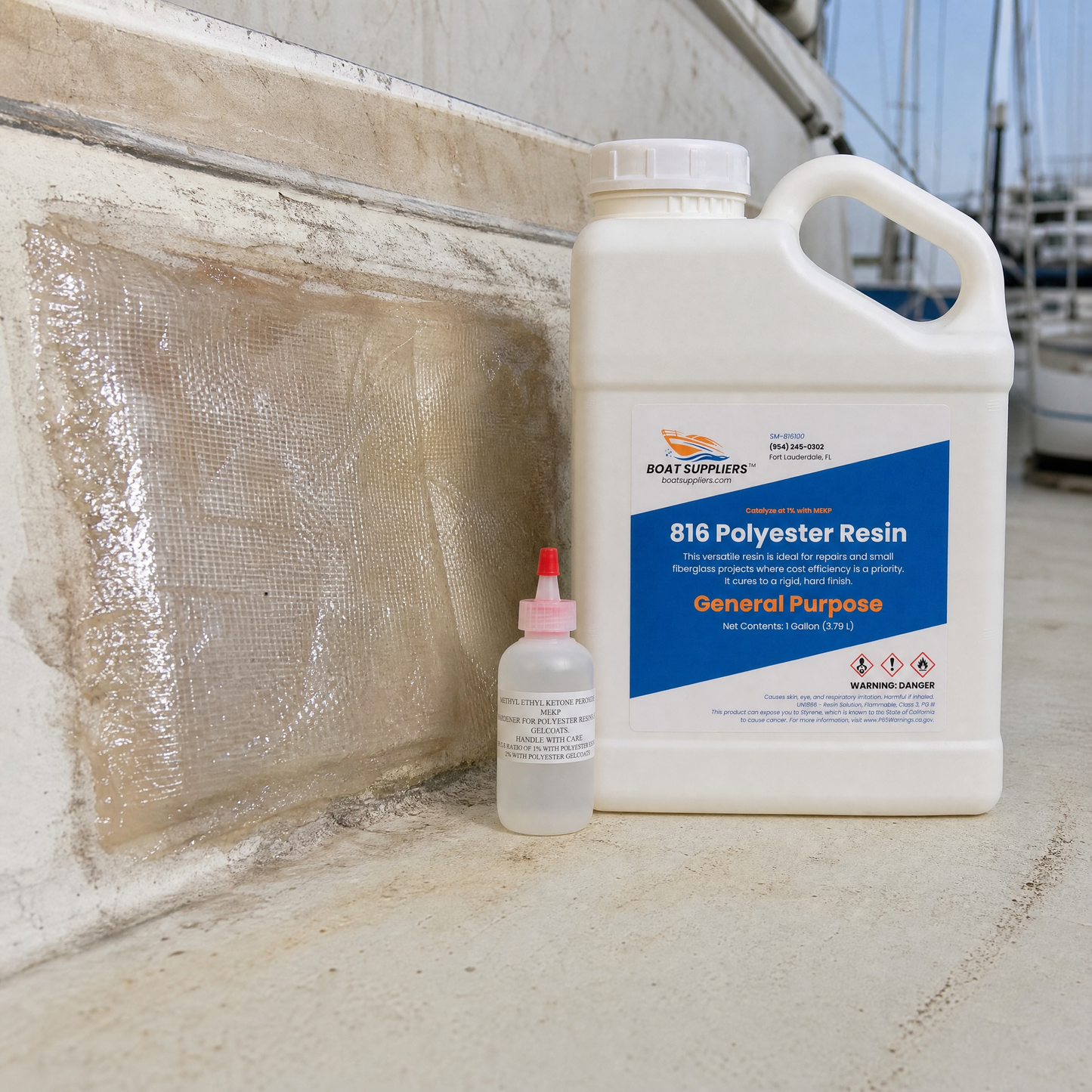
General Purpose Polyester Resin with Hardener

General purpose, non-structural15 to 20 min pot lifeUnwaxed

Boat Suppliers
General Purpose Polyester Resin with Hardener

General Purpose Polyester Resin with Hardener

SKU:SM-816100

Regular price $59.95 USD
Sale price $59.95 USD Regular price USD
Unit price $0.47  per  floz
Sale Sold out
Shipping calculated at checkout.

In stock

Size: Gallon

Key Specs

Mix Ratio
MEKP ~1.25% (about 1.6 fl oz/gal) - included
Pot Life
15-20 min @ 80°F
Tack-Free
Recoat in ~1.5 hr when laminating
Works With (Fabrics)
Fiberglass cloth, CSM, woven roving, 1708/1208 biaxial - not for carbon/Kevlar structural work
Resin Type
Polyester - general purpose, non-structural (unwaxed)
Wax Content
Unwaxed (laminating) - add surfacing wax to the final coat to sand/polish

General Purpose Polyester Resin is an economical, easy-to-use laminating resin designed for repairs, small fiberglass projects, and non-structural applications where cost efficiency is important. This resin cures hard and rigid like standard polyester resin and is suitable for use with fiberglass mat, fiberglass cloth, and similar reinforcements. Comes with MEKP Catalyst

This resin is not recommended for structural applications or projects requiring high mechanical strength, we instead recommend our Marine-Grade Polyester Layup Resin. 

Need a drum? We supply this resin in 500 lb drums by quote. Drums ship by freight to a commercial address with a forklift or loading dock, so pricing depends on your delivery point. Contact Us with your zip code and we will come back with a landed price.

Resin Properties

  • Resin Type: General purpose polyester laminating resin
  • Color: Amber-Brown
  • Cures To: Hard, rigid polyester finish
  • Usage: Small repairs, patching, mold repairs, hobby fiberglass work
  • Compatibility: Works with fiberglass mat, cloth, and other polyester-compatible materials
  • Catalyst: MEKP (included with all sizes)
  • Viscosity: Medium (typical of GP polyester)
  • Odor: Typical polyester/styrene odor during cure

Application Notes

  • Designed for non-critical repairs and small fiberglass builds
  • Applies well by brush, roller, or squeegee
  • Good wet-out characteristics on mat and cloth
  • Cure time, color, and working time may vary slightly between batches
  • Ideal when keeping project costs low is a priority
  • Not intended for high-load or structural laminations

Cure Information

(Exact times vary based on catalyst percentage, temperature, and humidity.)

  • Catalyst: MEKP
  • Typical Working Temperature: ~70–80°F
  • Cure Characteristics: Rigid cure similar to standard polyester resin
    Notes: Cooler temperatures slow the cure; warmer temperatures accelerate

Sizes come with corresponding MEKP catalyst:

  • 1 Quart ≈ 1 oz catalyst
  • 1 Gallon ≈ 2 oz catalyst
  • 5 Gallon ≈ 6 oz catalyst

Safety

  • Use only in a well-ventilated area
  • Polyester resin contains styrene — avoid inhalation
  • Wear gloves and eye protection
  • Keep away from sparks, flames, and heat sources
  • Follow all MEKP handling and storage recommendations
  • Designed for non-critical repairs and small fiberglass builds
  • Applies well by brush, roller, or squeegee
  • Good wet-out characteristics on mat and cloth
  • Cure time, color, and working time may vary slightly between batches
  • Ideal when keeping project costs low is a priority
  • Not intended for high-load or structural laminations
View full details

Technical Specifications


Mix MEKP ~1.25% (about 1.6 fl oz/gal) - includedWorks with Fiberglass cloth, CSM, woven roving, 1708/1208 biaxial - not for carbon/Kevlar structural work
Resin TypePolyester - general purpose, non-structural (unwaxed)
Mix RatioMEKP ~1.25% (about 1.6 fl oz/gal) - included
Pot Life15-20 min @ 80°F
Tack-FreeRecoat in ~1.5 hr when laminating
Wax ContentUnwaxed (laminating) - add surfacing wax to the final coat to sand/polish
CatalystMEKP included; adjust ±50% for temp; halve above 90°F
Works With (Fabrics)Fiberglass cloth, CSM, woven roving, 1708/1208 biaxial - not for carbon/Kevlar structural work
Works With (Fillers)All BS fillers - fumed silica, glass bubbles, Q-Cells, microballoons, milled fiber, chopped strand, cotton flock
Apply OverPolyester/VE laminate, bare fiberglass, wood - never over epoxy
Best ForBudget repairs & small projects - not for structural work

Compare Resins


ProductGeneral Purpose Polyester Resin with HardenerGeneral Purpose Polyester Resin with HardenerYou're viewingfrom $59.95 Marine-Grade Polyester Layup Resin with HardenerMarine-Grade Polyester Layup Resin with Hardenerfrom $34.95 Isophthalic Polyester Tooling Resin with HardenerIsophthalic Polyester Tooling Resin with Hardenerfrom $32.95 Premium Vinyl Ester Resin with HardenerPremium Vinyl Ester Resin with Hardenerfrom $39.95
TypePolyester - general purpose, non-structural (unwaxed)Polyester - standard marine laminating (unwaxed)Isophthalic polyester - tooling & laminating (unwaxed)Vinyl ester - premium strength & chemical resistance (unwaxed)
Mix RatioMEKP ~1.25% (about 1.6 fl oz/gal) - includedMEKP ~1.25% (about 1.6 fl oz/gal) - includedMEKP 1.25% (about 1.6 fl oz/gal) - includedMEKP ~1.25% (about 1.6 fl oz/gal) - included; increase below 75°F
Viscosity——325-525 cps (Brookfield), thixotropic—
Pot Life15-20 min @ 80°F15-20 min @ 80°FGel time 20-24 min @ 1.25% MEKP—
WaxUnwaxed (laminating) - add surfacing wax to the final coat to sand/polishUnwaxed (laminating) - add surfacing wax to the final coat to sand/polishUnwaxed - add surfacing wax to the final coat to sand/polishUnwaxed (laminating) - add surfacing wax to the final coat to sand/polish
Max Temp——HDT 223°F (106°C) - highest of our polyesters—
FabricsFiberglass cloth, CSM, woven roving, 1708/1208 biaxial - not for carbon/Kevlar structural workFiberglass cloth, CSM, woven roving, 1708/1208 biaxial - not for carbon/Kevlar structural workFiberglass cloth, CSM, woven roving, 1708/1208 biaxial - not for carbon/Kevlar structural workFiberglass cloth, CSM, woven roving, 1708/1208 biaxial - not for carbon/Kevlar structural work
Best ForBudget repairs & small projects - not for structural workMarine construction & structural repairMolds & tooling, high-heat, low-shrink laminatesFuel tanks, chemical exposure, blister-resistant hulls
SelectedViewViewView

Epoxy resin provides better adhesion, moisture resistance, and flexibility compared to polyester resin. While polyester is more economical and widely used in mass production, epoxy is preferred for high-performance applications, repairs, and situations requiring a strong bond.

Polyester resin is widely used for building and repairing fiberglass boats. It is ideal for laminating fiberglass cloth, molding parts, and creating gelcoat finishes. It’s cost-effective and works well for general-purpose repairs.

At the standard 1.25% MEKP dose and about 77°F, polyester resin gels in roughly 15 to 30 minutes and cures hard over several hours. Warmer temperatures, thicker pours and more catalyst shorten that, and cold lengthens it, so adjust the MEKP dose for your shop temperature.

The standard dose is 1.25% MEKP by volume at 77°F, about 12 cc per quart or 47 cc (1.6 fl oz) per gallon. Use more when it is cold and less in heat, but stay between 1% and 2%: below 1% the resin can stay soft, and above 2% it can crack, smoke or kick before you can work it. Measure in cc with a dispenser, not drops.

Laminating (layup) resin stays slightly tacky as it cures so the next layer of glass bonds chemically without sanding. Finishing resin has a wax or surfacing agent that rises to the top, sealing out air so the last coat cures hard and sands clean. Most marine polyester is laminating resin, so add surfacing wax to the final coat when you are ready to sand and finish.

Yes, polyester resin can be tinted using compatible pigments. This is often done to match gelcoat colors or create custom finishes.

No, you should not use polyester resin on EPS foam (expanded polystyrene). Polyester resin contains styrene, a solvent that dissolves EPS foam on contact. This reaction will ruin your foam core and release harmful fumes. If you're working with EPS foam, for example, in surfboard shaping or foam core laminates, you should instead use epoxy resin, which is chemically compatible and safe for EPS.

Yes. Unopened epoxy resin and hardener usually last one to several years stored cool and sealed, though hardener may darken without losing strength. Polyester resin and gelcoat are shorter lived, often three months to a year depending on the product, because the styrene and promoters break down. MEKP also weakens with age, and old catalyst can leave resin undercured, so check the label.