


1708 Fiberglass Repair Kit – 5 Yards with Marine Epoxy & Tools
1708 Fiberglass Repair Kit – 5 Yards with Marine Epoxy & Tools
Share
SKU:SK-FRK1708
In stock
Couldn't load pickup availability
Everything for a structural repair at project scale, matched so the resin volume actually covers the cloth. Five yards of 50 in 1708 biaxial and 1.33 gallons of marine epoxy, which is the pairing for transom skins, stringer tabbing and hull repairs rather than a patch-size fix.
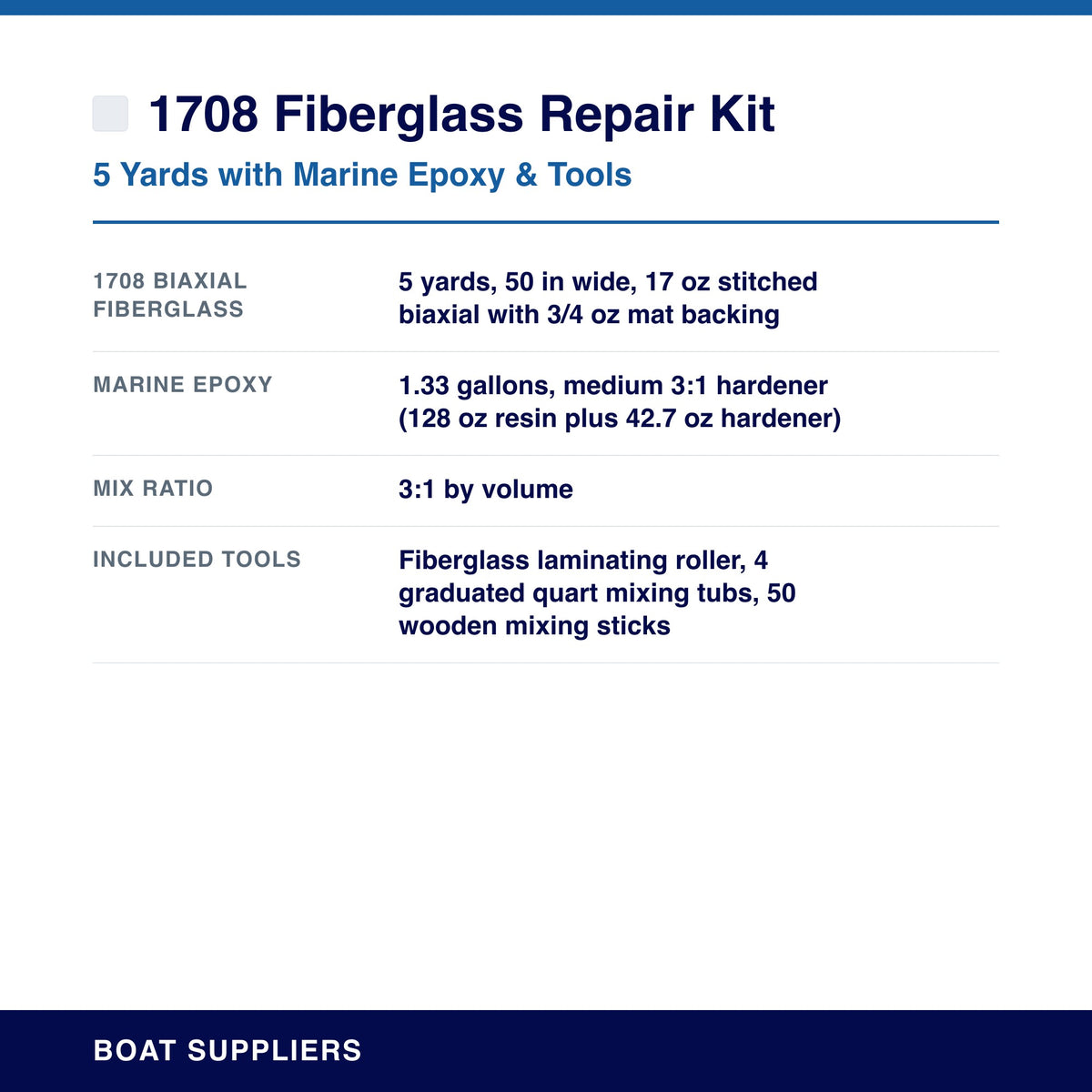
- 5 yd of 1708 biaxial, 50 in wide. 17 oz stitched double bias with a 3/4 oz mat backing.
- 1.33 gal marine epoxy kit with medium 3:1 hardener. 128 oz resin plus 42.7 oz hardener.
- Fiberglass laminating roller to drive air out between plies.
- 4 graduated quart mixing tubs and a pack of 50 wooden mixing sticks.
- Medium hardener splits the difference between working time and turnaround for a multi-ply layup.
You supply nitrile gloves, acetone or denatured alcohol for surface prep, sandpaper, and a respirator. Grind back to sound laminate and scuff the bond area before the first ply goes down.
Long, narrow wear along a keel or strake? The Keel & Strake Repair Kit uses 6 inch 1708 tape and includes the fillers for that job.
Specifications
Includes

How to use this kit
Five yards of 1708 biaxial with 1.33 gallons of marine epoxy and tools.
What is in the kit
- 5 yd 1708 biaxial fiberglass, 50 in wide17 oz stitched biaxial with 3/4 oz mat backing
- 1.33 gal Marine epoxy kit, medium 3:1 hardener128 oz resin plus 42.7 oz hardener
- 1 Fiberglass laminating rollerdrives air out between layers
- 4 / 1 pk Graduated quart mixing tubs, wooden mixing sticks
You supply: nitrile gloves, acetone or denatured alcohol, an angle grinder, a respirator, fumed silica or fairing filler for fairing, sandpaper, masking tape and plastic sheet.
Mixing epoxy (3:1 by volume)
| Ratio | 3 parts resin to 1 part hardener |
| Working batch | 12 oz resin + 4 oz hardener |
| Full kit | 128 oz resin + 42.7 oz hardener |
Measure by volume. Off-ratio epoxy never fully cures. Confirm the ratio printed on your hardener bottle.
Coverage: 1708 is heavy fabric. 1.33 gallons wets out about 5 yards at 50 in in a single layer with margin for fill coats.
The job, start to finish
Grind the bevel
Cut out anything soft or delaminated back to solid glass, then grind a 12 to 1 bevel around the repair. A half inch skin needs a 6 inch taper. Wipe with acetone and mask off the surrounding area.
Cut the stack dry
Cut every 1708 piece before you mix. Smallest first at the bottom of the bevel, each next piece about an inch larger, stepping out to the full taper. Cut with a sharp blade against a straightedge so the stitching does not pull.
Wet out
Brush epoxy onto the bevel, lay the first 1708 down mat side against the old laminate, and stipple until the fabric goes translucent. Work wet on wet through the stack rather than waiting for cures between plies.
Roll out the air
Run the laminating roller firmly in both directions over every layer until the white flecks disappear. White is dry glass or trapped air, and both are weak spots you cannot fix after cure. This step is what makes the laminate as strong as the numbers say.
Fair and topcoat
Once hard, wash off any amine blush with warm soapy water, scuff, then fill the weave with thickened epoxy. Sand fair and topcoat: epoxy has no UV resistance, so it must be painted or gelcoated before it lives outside.
If something goes wrong
White flecks in the layup
Dry glass or trapped air. Roll it out while wet; after cure it has to be ground out.
Cloudy waxy film
Amine blush from humid curing. Wash with warm soapy water and scuff before the next layer.
Soft or greasy patches
Off-ratio or under-stirred epoxy. Grind it out and relaminate with double-potted mix.
Cure crawled overnight
Under 60 F. Epoxy stalls in the cold. Warm the space, do not add more hardener.
Fabric frayed at the cut
Cut against a straightedge with a fresh blade, or tape the line first.
Epoxy must be topcoated for UV. Fairing filler, fumed silica, sandpaper and gelcoat are all at boatsuppliers.com.
Guides for this product

Fiberglass Keel and Skeg Repair: Grind Back, ...
Fiberglass Keel and Skeg Repair: Grind Back, ...

Fiberglass Kayak Build and Repair: Layup Sche...
Fiberglass Kayak Build and Repair: Layup Sche...

How to Repair a Fiberglass Boat Transom: A St...
How to Repair a Fiberglass Boat Transom: A St...
Calculators and charts:Epoxy & Resin CalculatorResin Compatibility Chart