Boat Suppliers

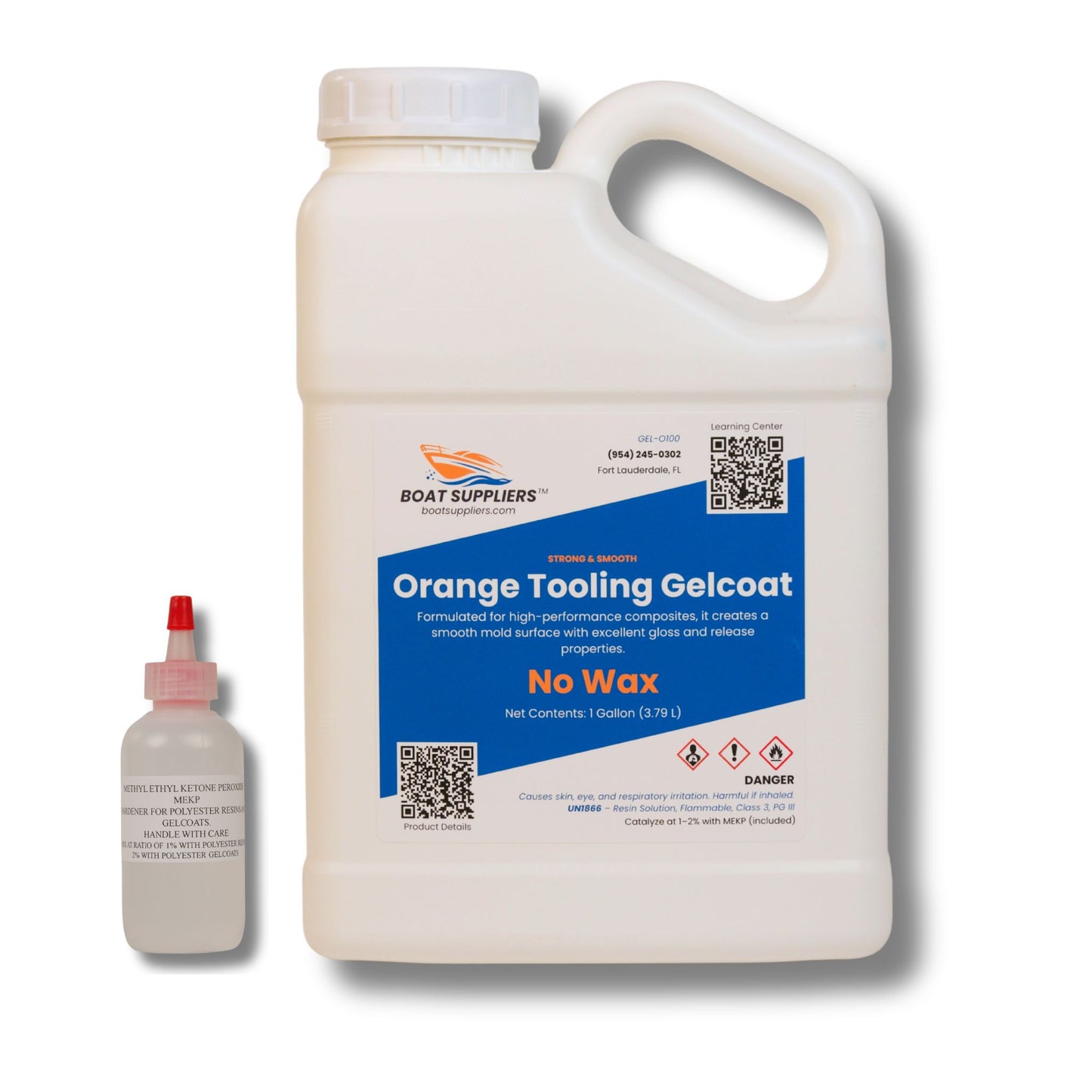
Orange Tooling Gelcoat with Hardener - No Wax

Orange Tooling Gelcoat with Hardener - No Wax

SKU:GEL-OR025

Regular price $42.95 USD
Sale price $42.95 USD Regular price
Sale Sold out
Shipping calculated at checkout.

23 in stock

Size: Quart
Earn 42 Boat Points Learn More
Ships Today if ordered before 4pm Learn More
Free Shipping on orders over $99 Learn More

Orange Tooling Gelcoat is a professional-grade surface coating designed for fiberglass molds. It provides durability, smooth release, and high gloss for mold surfaces. Backed with 404 Tooling Resin and fiberglass reinforcement, this gelcoat ensures long-lasting performance in demanding composite applications. Includes MEKP Catalyst

Recommended Applications

  • Fiberglass and composite molds
  • Marine tooling and part fabrication
  • Automotive body panel and aftermarket component molds
  • General industrial tooling requiring a durable, easy-to-see surface
  • Shelf Life: 3-6 months unopened
  • Pot life at 70–75°F: 15–20 minutes depending on catalyst %
  • Storage Temperature: 60–75°F
  • High-Contrast Orange Color – Enhances visibility during layup, finishing, and mold inspection.
  • Durable Mold Surface – Hard, polishable finish with excellent scratch and wear resistance.
  • Excellent Print Blocking – Reduces telegraphing of underlying fiberglass reinforcements.
  • Ideal for High-Cycle Molds – Maintains gloss and dimensional stability over time.
  • Catalyst Included – Each size includes MEKP for proper curing.
  • Brush or Spray Application – Smooth flow and strong resistance to sagging.
View full details

Technical Specifications


Mix MEKP ~2% (1 oz/qt, 2 oz/gal) - included
Resin TypePolyester tooling gelcoat - orange, unwaxed
Mix RatioMEKP ~2% (1 oz/qt, 2 oz/gal) - included
Pot Life~15-20 min @ 80°F; up to 2x MEKP below 85°F
Cured ColorOrange - high visibility against laminate
Wax ContentNo wax by design - the mold's backup laminate bonds chemically
CatalystMEKP included
Apply OverInto waxed/PVA-prepped molds; back with 404 tooling resin + mat/cloth
Best ForMold surface coat - orange shows thin spots while laminating

Compare Resins


ProductOrange Tooling Gelcoat with Hardener - No WaxOrange Tooling Gelcoat with Hardener - No WaxYou're viewingfrom $42.95 Black Tooling Gelcoat with Hardener - No WaxBlack Tooling Gelcoat with Hardener - No Waxfrom $42.95 Pure White Gelcoat with Hardener - No WaxPure White Gelcoat with Hardener - No Waxfrom $34.95
TypePolyester tooling gelcoat - orange, unwaxedPolyester tooling gelcoat - black, unwaxedPolyester gelcoat - pigmented white, unwaxed
Mix RatioMEKP ~2% (1 oz/qt, 2 oz/gal) - includedMEKP ~2% (1 oz/qt, 2 oz/gal) - includedMEKP ~2% (1 oz/qt, 2 oz/gal) - included
Pot Life~15-20 min @ 80°F; up to 2x MEKP below 85°F~15-20 min @ 80°F; up to 2x MEKP below 85°F~15-20 min @ 80°F
Cured ColorOrange - high visibility against laminateBlack - shows mold-surface defects while polishingWhite
WaxNo wax by design - the mold's backup laminate bonds chemicallyNo wax by design - the mold's backup laminate bonds chemicallyUnwaxed - add surfacing wax 1/2 oz per qt on the final coat
Best ForMold surface coat - orange shows thin spots while laminatingMold surface coat - black reveals scratches & defectsHull & deck refinishing, repairs
SelectedViewView

Clean and sand the surface, then catalyze the gelcoat with MEKP and lay it down in two to three coats. Spray it at about 18 to 20 mils wet, or brush and roll thinner coats, letting each one flash before the next. Because polyester gelcoat is air-inhibited, the final coat needs surfacing wax (or a PVA film) to cure tack-free so you can sand and buff it.

Only if you are using unwaxed (sanding) gelcoat. Unwaxed gelcoat stays tacky on the surface because air stops polyester from curing, so you add surfacing wax to the final coat, or spray PVA over it, to seal out air and cure it hard for sanding. Gelcoat sold with wax already contains it and cures tack-free on its own.

Catalyze polyester gelcoat at about 1% to 2% MEKP by volume, with 1.25% a good starting point near 70°F. That works out to roughly 1.5 to 2.5 ounces of MEKP per gallon of gelcoat. Use a little less in hot weather and more when it is cold, and always follow the ratio printed on your MEKP. Do not exceed about 3%, which can crack or discolor the coat.

Waxed gelcoat has an additive that rises to the surface as it cures, sealing out air so the coat hardens tack-free and is ready to sand. Unwaxed (sanding) gelcoat has no additive, so it stays tacky until you add surfacing wax to the final coat or cover it with PVA. Use unwaxed when you plan to lay more coats, and use waxed for the last coat.

It is not recommended. Polyester gelcoat bonds well to polyester and vinyl ester laminates but adheres poorly to epoxy. If you must gelcoat over epoxy, let the epoxy fully cure, wash off any amine blush, sand it thoroughly, and expect a weaker bond. For epoxy repairs, a two-part polyurethane topcoat is usually the better finish.

Yes. For small repairs you can brush or roll gelcoat, though spraying gives the smoothest finish. Thin it about 5% to 10% with styrene so it flows out and self-levels, catalyze with MEKP, and add surfacing wax to the last coat. Work in thin coats to avoid runs, and plan to sand and buff afterward since some brush marks are normal.

A tacky surface almost always means air-inhibited cure, not too little catalyst. Unwaxed gelcoat will not harden on top until you add surfacing wax to the final coat or seal it with PVA. Other causes are too little MEKP, temperatures below about 60°F, or high humidity. Confirm your catalyst ratio, warm the shop, and wax or PVA the last coat.

As a rule of thumb, one gallon of gelcoat covers about 45 to 50 square feet at the 18 to 20 mil thickness a durable finish needs, so a quart covers roughly 12 square feet. Tooling and heavy color coats go thicker, and spraying loses some to overspray, so order 10% to 20% extra for the job.

Tooling gelcoat is a harder, more heat-resistant, high-gloss formula made for building fiberglass molds, not finished parts. Backed by tooling resin, it gives a mirror mold surface with excellent release and holds up to repeated part pulls. Orange and black are common because the strong color makes pinholes and thin spots easy to see. Standard gelcoat is for the finished part's exterior.

Thin polyester gelcoat with styrene, not acetone, at about 5% to 10% by volume. Styrene lowers viscosity so the gelcoat atomizes and flows out smoothly while keeping the resin chemistry intact, whereas acetone just flashes off and can leave the film weak and porous. Add the styrene before the MEKP, and stay at or below 10% so you do not weaken the cured coat.