Aerosil 200 vs Cab-O-Sil M-5: Same Fumed Silica, Different Label?

07 August 2026
Every fillet recipe and forum thread says "add cabosil." The bag you can actually get your hands on says Aerosil 200. So is Aerosil the same thing, a substitute, or something you need to re-test your mix around?
Short answer: they're the same class of material, hydrophilic fumed silica with a 200 m²/g surface area, made the same way, loaded the same way, and interchangeable at the laminating bench. "Cabosil" is Cabot's brand name that boatyards turned into a generic, the way every dust mask became a Kleenex. Aerosil is Evonik's name for the identical chemistry. If your putty recipe was developed with Cab-O-Sil M-5, Aerosil 200 drops in 1:1.
What fumed silica actually is
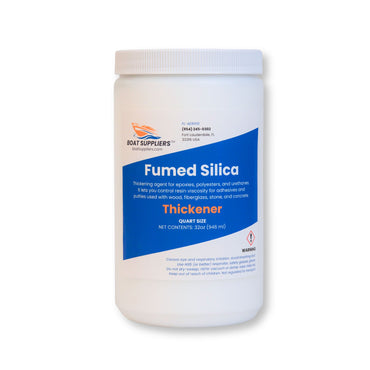
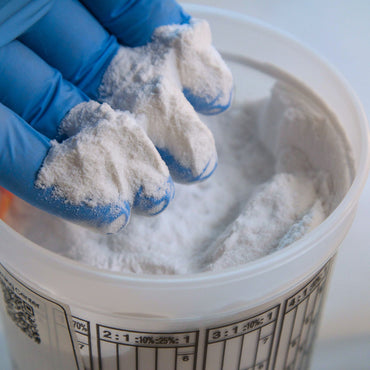
Both products come out of the same process: silicon tetrachloride burned in a hydrogen-oxygen flame (flame hydrolysis). The flame produces branched chains of amorphous silica particles that fuse into aggregates a few hundred nanometers across, with enormous surface area for almost no mass. A quart jar holds only about 2 oz (57 g) of it, depending on how hard it settles. That's not short fill; that's the material. Tapped density is around 50 g/L, which is why a 10 lb bag is the size of a hay bale.
The thickening mechanism is hydrogen bonding. The particle surfaces are covered in silanol (Si-OH) groups that grab each other through the resin and build a loose network. Stir or spread the mix and the network shears apart, so it flows off the stick and wets out fine. Stop working it and the network reforms in seconds, so it stays put on a vertical transom instead of running for the bilge. That shear-thinning behavior (thixotropy) is the whole reason the material exists in a boat shop.
Because the mechanism is hydrogen bonding, untreated hydrophilic grades like Aerosil 200 and M-5 work in polyester, vinyl ester, and epoxy alike. Same jar thickens all three. For a broader look at how fiberglass fillers mix and apply with resin, that guide covers the full picture.
Spec sheet, side by side
| Spec | Aerosil 200 (Evonik) | Cab-O-Sil M-5 (Cabot) |
|---|---|---|
| Chemistry | Amorphous fumed silica, untreated | Amorphous fumed silica, untreated |
| Surface treatment | Hydrophilic | Hydrophilic |
| BET surface area | 200 ±25 m²/g | ~200 m²/g |
| SiO₂ purity | ≥99.8% | ≥99.8% |
| Tapped density | ~50 g/L | ~50 g/L |
| pH (4% dispersion) | 3.7-4.5 | 3.7-4.3 |
| Thickening in PE / VE / epoxy | Yes, all three | Yes, all three |
Read that table again and you'll see the honest summary: within manufacturing tolerance, these are the same product. The grades were developed as direct competitors and every marine formulator treats them as equivalents.
Where a difference would actually matter
There are places the brand name on the bag matters. A boat shop isn't one of them, but so you know where the line is:
Spec'd industrial formulations. If you're making a product with a locked formula (a gelcoat line, an adhesive you sell), you qualify one supplier's grade and stick with it, because 200 ±25 vs 200 ±15 m²/g tolerance bands technically differ. For thickening resin at the bench, irrelevant.
Treated (hydrophobic) grades. Both companies also sell surface-treated silicas: Aerosil R972 and R202, Cab-O-Sil TS-720. Those are different animals, used where moisture pickup or long-term viscosity stability in storage matters. If a recipe calls specifically for TS-720, an untreated grade isn't the drop-in. Nobody's transom fillet calls for TS-720.
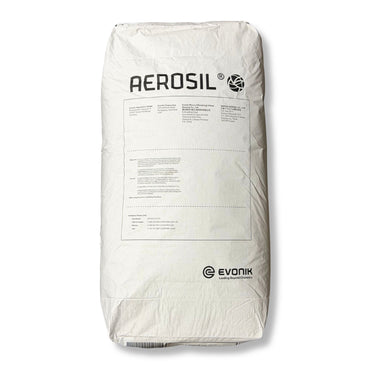
What's in the generic jar. The real gotcha isn't Aerosil vs Cabot, it's unbranded "fumed silica" of unknown grade and surface area. A 130 m²/g or 380 m²/g product thickens noticeably differently at the same loading. When the bag has a grade number from Evonik or Cabot on it, you know what you're getting. Everything in our jars comes out of factory-sealed Evonik Aerosil 200 bags, and we sell the unopened 10 lb Evonik bags outright if you'd rather scoop from the source.
Loading it: from sag control to structural putty
Aerosil 200 and M-5 load the same, so one chart covers both. Volumes are loose powder per cup of mixed resin; weights are a share of the resin weight. Our fumed silica guide has the full chart and how far each jar size goes.
| Consistency | Loose powder per cup of resin | By weight | The job |
|---|---|---|---|
| Slightly bodied, still brushable | 1/4 to 1/2 cup | About 1 to 2% | Sag control for resin on vertical surfaces, hot-coating overhead |
| Ketchup | 3/4 cup | About 3% | Coating, sealing, bonding large flat panels |
| Mayonnaise | 1 cup | About 4.5% | Bonding putty, bedding hardware |
| Peanut butter, holds a peak | 1 3/4 cups | About 7.5% | Structural fillets, stitch-and-glue seams, gap filling |
Three bench notes that save rework:
- Add silica to mixed resin, not resin to silica, and fold before you whip. With epoxy, mix resin and hardener completely first, then thicken. Thickening first throws off your read on the mix and can trap unmixed hardener.
- It cures hard and sands like a rock. Straight silica putty is for structural work you're not going to fair. For fairing, cut it with microballoons or Q-cells: a common blend is silica for non-sag plus balloons for sandability, somewhere around 1 part silica to 2-3 parts balloons by volume depending on how much strength the spot needs. Milled fiber goes in when the fillet is structural and you want more than the resin's own strength.
- Expect a little working-time compression at high loadings in polyester. Thick putty holds exotherm better than a thin film. Catalyze accordingly on hot days. If you're working in cooler conditions, the cold-weather repair guide has practical tips on managing cure times.
Wear a fitted P100 when you're scooping and mixing; this is amorphous silica, not the crystalline stuff, but there's no reason to breathe a cloud of it.
Which bag should you buy?
Buy whichever genuine branded 200-grade you can get at a sane price, and treat the names as interchangeable. What we stock is Evonik Aerosil 200 because we can get it in factory-sealed bags with the grade printed on them, and that's what goes in every jar we fill.
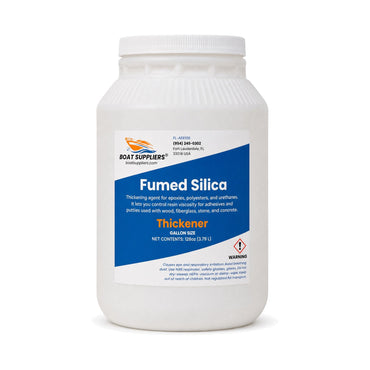
For a shop that goes through putty weekly, the sealed 10 lb bag is the move: it's roughly the material of 25 gallon jars in one bag, it stores fine sealed in a dry spot, and you'll stop thinking about running out mid-layup. For occasional repair work, a quart or gallon jar keeps the mess down and the lid does the storing.
Prev post

Is Silmar 249 a Laminating Resin?
Updated on 08 August 2026
Next post

Chopped Strand Mat Guide: Best Weights for Every Boat Size and Application
Updated on 07 August 2026