Polyester Gelcoat: Waxed vs Unwaxed, Tooling vs Repair, Which to Buy

26 September 2026
Polyester gelcoat is the pigmented, thixotropic polyester resin that becomes the outside of a fiberglass part, sprayed at 18 to 20 mils wet (0.45 to 0.5 mm) and catalyzed with MEKP at about 2% by volume at 77F (25C). Buying it comes down to four calls: waxed or unwaxed, isophthalic or orthophthalic, production or tooling grade, and a stock color versus a tintable neutral base. Get those four right and the can does the rest; get the wax call wrong and you either sand a surface that never hardens or laminate onto one that will not bond.
Waxed or unwaxed: the first decision
Polyester gelcoat is air-inhibited. The surface exposed to air stays tacky after the film has cured underneath, and that tack is a feature or a defect depending on what comes next. Unwaxed (no-wax) gelcoat leaves the surface chemically open, so a second gelcoat pass or the skin coat of a laminate bonds without sanding. Waxed gelcoat has surfacing wax blended in; the wax floats to the top, seals the film from air and gives a tack-free, sandable surface for a repair you are going to buff.
| Version | Surface after cure | Use it when | Do not use it when |
|---|---|---|---|
| Unwaxed (no wax) | Tacky, bondable | Spraying into a mold, first of two coats, base coat under a color coat | It is the last coat and you plan to sand and buff |
| Waxed (with wax) | Tack-free, sandable | Spot repairs, last coat over unwaxed, brush-on patches | Anything still needs to bond on top of it |
| Unwaxed plus surfacing wax additive | Tack-free once mixed in | You stock one can and add wax to the final coat only | You forget the wax on the last coat |
Every gelcoat we carry ships unwaxed with MEKP in the box except the repair kit. That is deliberate: you add surfacing wax (sanding aid) at the ratio on the wax bottle to the final coat only, or spray PVA over the wet last coat, and the same can covers both jobs. Do not add wax to a batch you intend to laminate over.
Isophthalic or orthophthalic
Ortho gelcoat is the cheaper general-purpose resin base; iso gelcoat uses isophthalic acid in the polyester backbone and buys you better water resistance, blister resistance, gloss retention and a tougher film. Below the waterline, and on any repair that has to survive a Florida summer, iso is the only sensible spec. The production, tooling and repair gelcoats in this guide are all isophthalic. For a deeper look at how these two resin chemistries compare, see our polyester resin selection guide.
Production, tooling or repair gelcoat
Production and repair grade
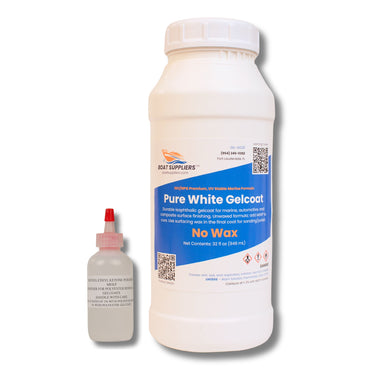
This is the gelcoat that ends up on a boat: Pure White Gelcoat with Hardener - No Wax is the stock repair and new-part color, sprayed with a gravity cup gun at 18 to 20 mils wet or brushed on for spot work in two thinner passes. It sands at 320 then 600 wet and buffs to full gloss once it has cured hard, usually 24 hours at 77F. For a small color-matched repair the Gelcoat Repair Kit - Pure White Gelcoat With Wax, Hardener and 6 Pigment Colors is the one waxed product in the lineup, because a repair is a last coat by definition.
Tooling grade
Tooling gelcoat is the surface of the mold itself. It is formulated harder and more heat resistant than production gelcoat so it holds gloss through repeated part pulls and the exotherm of thick laminates behind it. It goes on heavier, in two coats of 15 to 20 mils each, the second once the first has gelled to a tack that does not transfer to a glove. Orange Tooling Gelcoat with Hardener - No Wax shows thin spots against a white plug while you are still spraying and shows wear on a working mold later; Black Tooling Gelcoat with Hardener - No Wax does the same job where you want a dark mold surface to read the gloss of a white part against. Back either one with 404-type tooling resin and a skin coat of 0.75 oz mat, never straight with 1.5 oz mat, or the mat prints through.
White, neutral or clear
| Base | What you get | Best for |
|---|---|---|
| Pure white | Opaque stock white | New molds, most production hulls, repairs on white boats |
| Neutral | Translucent tintable base | Matching an off-white or colored hull with pigment dispersion |
| Clear | Unpigmented iso gelcoat | Barrier coat over a colored gelcoat, tinting to a translucent color, over a printed or carbon show surface |
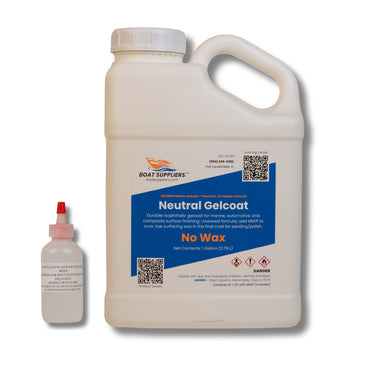
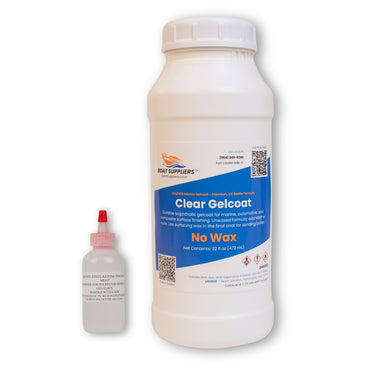
Matching a 20-year-old hull with stock white never works; the boat has yellowed and the white will glow. Neutral Gelcoat with Hardener - No Wax plus a few drops of black, yellow and brown pigment gets you there, mixed by weight and mixed as one batch to a single color before any of it is catalyzed. Keep pigment under the ceiling on the pigment label, which on most dispersions is 10% by weight; past that the film cures soft. Clear Gelcoat with Hardener - No Wax is the base for translucent tints and the clear barrier on a two-tone job.
How much polyester gelcoat to buy
A gallon of any liquid covers 1,604 sq ft at 1 mil. At the 20 mil wet film gelcoat wants, that is 80 sq ft per gallon in theory, and 55 to 65 sq ft through a cup gun once overspray and the cup bottom are counted. The gelcoat calculator runs that math with your part area and mil target.
| Size | Sprayed coverage at 20 mils | Typical job |
|---|---|---|
| Pint | 7 to 8 sq ft | Spot repairs, a run of dings |
| Quart | 14 to 16 sq ft | Transom face, a console, a hatch lid |
| Gallon | 55 to 65 sq ft | A 14 to 16 ft skiff hull, a small mold |
| 5 gallon | 275 to 325 sq ft | Production molds, a full cruiser hull |
Catalyzing and cure at 77F
Dose MEKP by volume at 2% for 77F (25C), which is 0.64 fl oz (19 mL) per quart. Below 70F push toward the top of the window printed on the can; above 85F back off, but never drop below the floor on the label or the film will undercure and alligator. Run the numbers for your shop temperature through the MEKP catalyst calculator rather than guessing.
| Stage at 77F, 2% MEKP | Time | Check |
|---|---|---|
| Gel | 10 to 20 min | Pot goes stringy |
| Ready for skin coat or second gelcoat pass | 45 to 90 min | Tacky, no transfer to a nitrile glove |
| Sand and buff (waxed or PVA) | 24 h | Sandpaper cuts powder, not gum |
Anything under 12 mils wet cures poorly and anything over 30 mils cracks in service, so measure with a wet film gauge on the first pass instead of judging by color. Styrene is the hazard here: a fitted P100 respirator with organic vapor cartridges, nitrile gloves and eye protection, and no MEKP anywhere near a rag soaked in acetone.
What we would put on the shelf: a gallon of pure white unwaxed for repairs and small molds, a quart of neutral for color matching, and orange tooling for any mold you expect to pull more than a few parts from. For a complete walkthrough of the repair process itself, see our step-by-step gelcoat repair guide.
Frequently asked questions
What is the difference between polyester gelcoat with wax and without wax?
Waxed gelcoat contains surfacing wax that rises to the surface, seals out air and cures tack-free so you can sand it at 24 hours. Unwaxed gelcoat stays tacky on top and remains bondable for the next coat or a laminate. Buy unwaxed for anything going into a mold or under another coat, and add wax or spray PVA on the final coat only.
How thick should polyester gelcoat be sprayed?
Aim for 18 to 20 mils wet (0.45 to 0.5 mm) in a mold, checked with a wet film gauge. Under 12 mils the film undercures and alligators when resin goes over it; over 30 mils it cracks and chips in service. Tooling gelcoat is the exception at two coats of 15 to 20 mils each, applied tack-to-tack.
How much MEKP do I add to gelcoat?
Two percent by volume at 77F (25C), which works out to 0.64 fl oz (19 mL) per quart or 2.6 fl oz (76 mL) per gallon. Stay inside the window printed on the can when the shop is cold or hot, and never go under the floor on the label. Use the MEKP catalyst calculator to adjust for temperature and batch size.
Can I brush polyester gelcoat instead of spraying it?
Yes for repairs. Brush two passes with a foam brush to reach about 20 mils total, since one heavy brushed coat sags and one thin coat undercures. For anything bigger than a hatch lid, a gravity cup gun with a 2.0 to 2.5 mm tip gives an even film and saves a day of sanding brush marks. Thin only with the amount of styrene the can allows.
Which gelcoat do I use to build a mold?
Tooling gelcoat, applied in two coats to 30 to 40 mils total, backed with tooling resin and a 0.75 oz mat skin coat before any 1.5 oz mat goes on. Orange is the standard choice because thin spots show against a white plug; black works when you want to read white parts against the mold. Production gelcoat softens under repeated exotherm and dulls after a few pulls.
What You Need For This Job
- Pure White Gelcoat with Hardener - No Wax: the stock repair and new-part gelcoat, unwaxed with MEKP included
- Neutral Gelcoat with Hardener - No Wax: tintable base for matching an aged or colored hull
- Clear Gelcoat with Hardener - No Wax: clear barrier coat or translucent tint base
- Gelcoat Repair Kit - Pure White Gelcoat With Wax, Hardener and 6 Pigment Colors: waxed quart with six pigments for spot repairs that get buffed
- Orange Tooling Gelcoat with Hardener - No Wax: mold surface coat that shows thin spots and wear
- Black Tooling Gelcoat with Hardener - No Wax: dark tooling surface for reading white parts
Next post

Fiberglass Kayak Build and Repair: Layup Schedule, Epoxy and Cloth
Updated on 25 September 2026