Fiberglass Kayak Build and Repair: Layup Schedule, Epoxy and Cloth

25 September 2026
A fiberglass kayak build and a kayak hull repair are the same laminate problem at two scales. A hand-laid touring kayak hull is roughly 1/8 in (3 mm) thick: two to three plies of light woven cloth in epoxy on a strip-built or stitch-and-glue boat, or gelcoat, 0.75 oz mat, 1.5 oz mat and cloth in polyester out of a female mold. A repair puts that stack back one ply at a time over a 12:1 scarf. Pick the resin first, because it decides the reinforcement, then size the plies to the boat.
Repair or build: decide the resin before the cloth
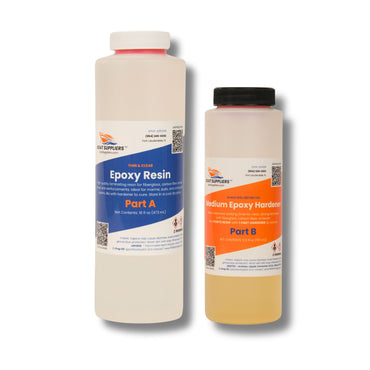
Chopped strand mat is held with a styrene-soluble binder. Polyester and vinyl ester dissolve it and the mat wets out; epoxy does not, so the mat stays stiff and traps air. That one fact splits every kayak job into two lanes. Understanding epoxy vs polyester resin for fiberglass is essential before you buy anything.
| Job | Resin | Reinforcement |
|---|---|---|
| Repair on any fiberglass kayak | Epoxy, West System 105 with 205 or 206 | 6 oz plain weave cloth; one ply of 1708 biaxial as a backer on holes |
| Strip-built or stitch-and-glue build | Epoxy | 4 oz or 6 oz plain weave, 50 in or 60 in wide |
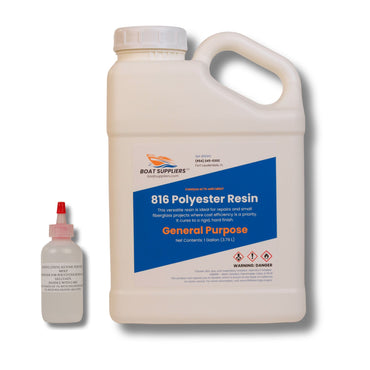
| Build in a fiberglass kayak mold | Polyester or vinyl ester with MEKP | Gelcoat, 0.75 oz CSM skin, 1.5 oz CSM, cloth in keel and ends |
Never run polyester over an epoxy repair. We did a keel strip on a 17 ft sea kayak where someone had gelcoated straight over an epoxy patch; it lifted in one sheet. Grind back to sound laminate first.
Kayak fiberglass repair by damage type
Gelcoat crazing and shallow gouges
If a fingernail catches but no fibers show, the laminate is fine. Grind to clean glass with 80 grit, fill with epoxy thickened to peanut butter with colloidal silica, sand flush at 24 hours and top with gelcoat. A West System Fiberglass Handy Repair Pack carries two 105/205 packet pairs and 406 Colloidal Silica, which is exactly one gouge.
Cracks with visible fibers, no hole
Grind a shallow dish 2 in (50 mm) wide centered on the crack, from inside if you can reach it, and lay two plies of 6 oz cloth, larger ply first, wet out until the weave goes translucent. A West System Fiberglass Boat Repair Kit, eight 105/205 packet pairs with cloth, 406 and 410, covers a season of this on a rental fleet.
Holes and crushed sections
Bevel the edge at 12:1; on a 1/8 in hull that is a 1.5 in (38 mm) taper all the way around. Tape a waxed polyethylene backer over the outside, work from inside: one ply of 1708 biaxial cut 1 in past the scarf as the structural backer, then two plies of 6 oz cloth stepping 1 in smaller each. After a hard cure, pull the backer, fair the outside and skin it with one ply of 4 oz or 6 oz cloth. The 1708 Fiberglass Repair Kit, 5 Yards with Marine Epoxy and Tools is more 1708 than one hole needs; it is the buy for a crushed keel line, a caved bow or several boats.
Custom fiberglass kayak build: mold or wood core
In a mold with polyester
Wax the mold, shoot gelcoat at 18 to 20 mils wet and let it go tacky with no transfer. Lay a skin coat of 0.75oz Fiberglass Chopped Strand Mat wetted thin, rolled and allowed to gel; it is the print blocker behind the gelcoat. Follow with 1.5oz Fiberglass Chopped Strand Mat over the whole hull, torn to shape so the feathered edges vanish in the overlaps, then 6 oz cloth or 1708 in the keel, stems and cockpit rim. Mat takes about 2:1 resin to glass by weight, cloth about 1:1. Catalyze at 1.25 to 2% MEKP by volume for 70 to 85F (21 to 29C). A 17 ft hull built this way lands at 40 to 55 lb (18 to 25 kg); race builders go to epoxy and cloth for that reason. For a full walkthrough of the mold process, see our guide on how to build a fiberglass boat from a mold.
Strip-built or stitch-and-glue with epoxy
This is the DIY fiberglass kayak most people build. Schedule for a 17 ft cedar strip sea kayak: one ply of 6 oz plain weave outside the hull, a second 6 oz ply on the bottom panel stem to stem, one ply of 4 oz or 6 oz inside, and 4 oz on the deck both sides. Squeegee until the cloth turns clear with no white spots, then two or three fill coats to bury the weave. Plan on 1.5 to 2 gal (5.7 to 7.6 L) of mixed epoxy for hull and deck including fill coats; check your own square footage in the resin calculator and buy the resin in one lot.
Epoxy choice and cure schedule
On the epoxy side of either lane, West System 105 Epoxy Resin is the base; pick the hardener by shop temperature and pot time. 205 and 206 run 5:1 by volume with 105; 207 and 209 run 3:1. Figures are West System published values at 72F (22C), 100 g pot.
| System | Ratio by weight | Pot life | Working time | Cure to solid |
|---|---|---|---|---|
| 105/205 Fast | 5.19:1 | 9 to 12 min | 60 to 70 min | 6 to 8 h |
| 105/206 Slow | 5.36:1 | 20 to 25 min | 90 to 110 min | 10 to 15 h |
| 105/207 Special Clear | 3:1 by volume; weight on the TDS | 22 to 27 min | 110 to 130 min | 10 to 15 h |
Full cure is 1 to 4 days in every case. Secondary bonds go on within 24 hours to skip sanding; past that, wash off the amine blush and sand 80 grit. Above 85F (29C), 205 kicks in the pot before a hull panel is done, so switch to 206 and mix 8 oz at a time in a tray. Wear a fitted P100 respirator with organic vapor cartridges for grinding and polyester, nitrile gloves and eye protection.
For a working shop: a Handy Repair Pack in every kayak, the 105-K kit for cracks and 1 in holes, and the 1708 kit plus a gallon of 105 with 206 for anything structural or a new build. A full composite layup schedule guide will help you plan ply counts and resin quantities before you cut the first piece of cloth.
Frequently asked questions
What weight fiberglass cloth for a kayak build?
Run 6 oz plain weave (203 g/m2) outside the hull, doubled on the bottom panel, and 4 oz (136 g/m2) on the deck and interior. One ply of 6 oz cloth with its resin weighs about 0.75 lb per square yard cured, so an outside ply on a 17 ft hull adds roughly 4 lb. Over 10 oz is wasted weight.
Can I repair a fiberglass kayak with polyester resin?
You can, but the secondary bond to an aged hull is far weaker than epoxy, and polyester will not bond to an earlier epoxy patch. On a hull under 1/4 in thick we recommend West System 105 with 205 or 206 every time; keep polyester for mold builds and gelcoat over a sanded repair.
How wide should the scarf be on a kayak hull repair?
Twelve times the laminate thickness, measured from the edge of the damage. On a 1/8 in (3 mm) hull that is a 1.5 in (38 mm) taper on every side, so a 2 in hole becomes a 5 in patch. Grind it with 36 or 60 grit on a 4.5 in grinder held flat, then feather with 80 grit.
How much epoxy does a DIY fiberglass kayak take?
Budget 1.5 to 2 gal of mixed epoxy for a 17 ft strip-built hull and deck, roughly 60% wet-out and 40% fill coats. Woven cloth takes roughly its own weight in resin, so a square yard of 6 oz cloth needs about 6 oz of mixed epoxy. Buy one 0.98 gal 105-B with matching hardener and check the area in the resin calculator.
Do I need chopped strand mat in an epoxy kayak layup?
No. Standard CSM uses a styrene-soluble binder that epoxy does not dissolve, so the mat stays stiff and traps air. Save the 0.75 oz and 1.5 oz mat for a polyester mold build, where the 0.75 oz skin ply behind 18 to 20 mils of gelcoat stops weave print. In epoxy use cloth, or 1708, whose stitched mat backer wets out fine.
What You Need For This Job
- West System 105 Epoxy Resin: base resin for every epoxy repair and wood-core build, with 205 fast or 206 slow
- 1708 Fiberglass Repair Kit, 5 Yards with Marine Epoxy and Tools: backer plies plus 1.33 gal of epoxy for crushed keels and multi-boat repair
- West System Fiberglass Boat Repair Kit: packets, cloth and fillers for cracks and holes up to 1 in
- West System Fiberglass Handy Repair Pack: two-packet gouge fix that lives in the day hatch
- 0.75oz Fiberglass Chopped Strand Mat: print-block skin ply behind gelcoat in a polyester mold build
- 1.5oz Fiberglass Chopped Strand Mat: bulk interlayer that tears to shape around stems
Prev post

Polyester Gelcoat: Waxed vs Unwaxed, Tooling vs Repair, Which to Buy
Updated on 26 September 2026
Next post

West System Epoxy: 105 With 205, 206 or 207 and When Each Applies
Updated on 24 September 2026