Boat Suppliers

Neutral Gelcoat with Hardener - No Wax

Neutral Gelcoat with Hardener - No Wax

SKU:GEL-NU025

Regular price $39.95 USD
Sale price $39.95 USD Regular price
Unit price $1.25  per  floz
Sale Sold out
Shipping calculated at checkout.

In stock

Size: Quart

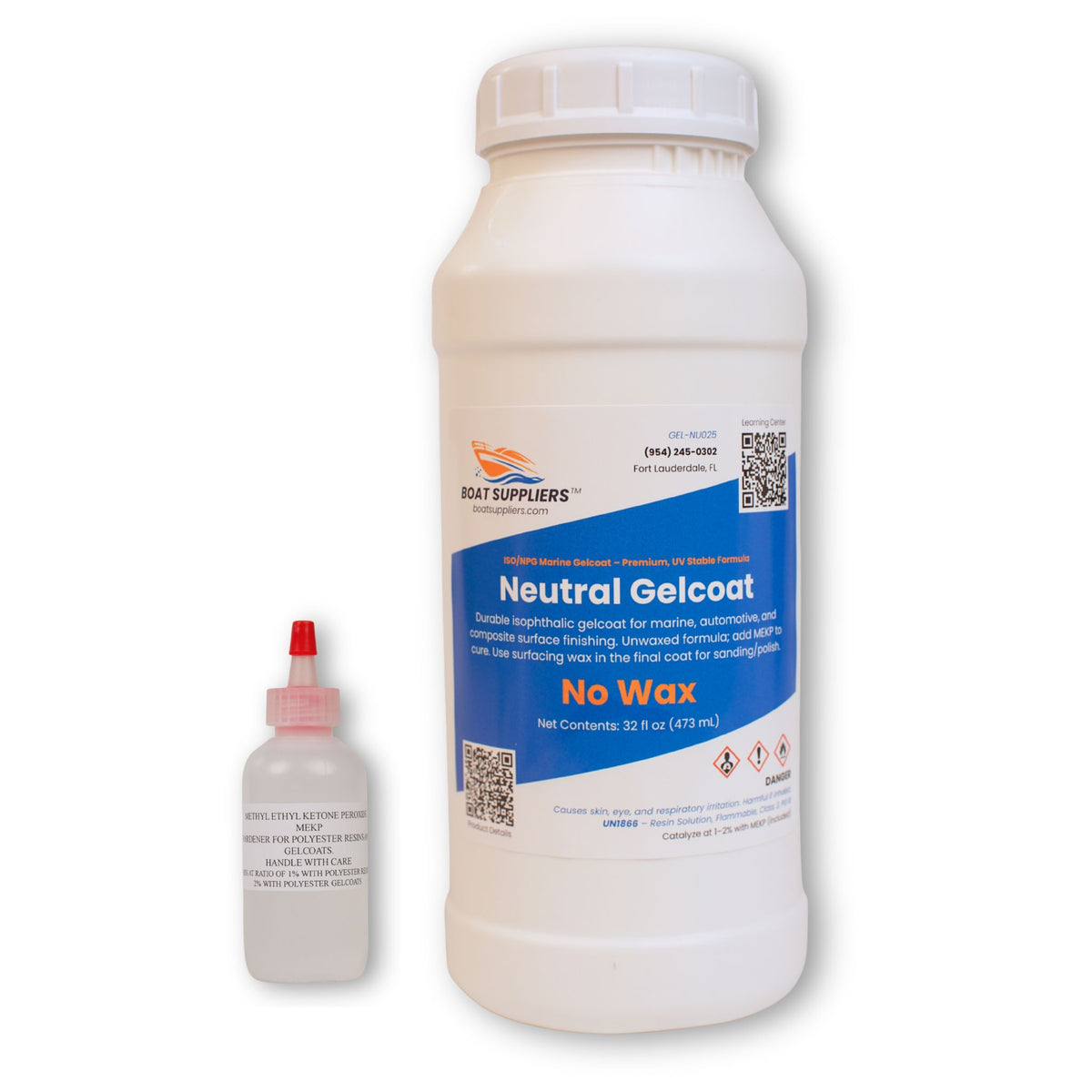
The tintable base version of our isophthalic gelcoat. It cures neutral and translucent, so you add pigment to hit the hull color you are matching instead of settling for the nearest stock white. That is the whole reason to run neutral: a color-matched repair disappears, a close-enough repair reads as a patch from twenty feet.

  • Tinting: about 1 oz of pigment per quart, 4 oz per gallon. Tint the whole batch at once so every coat is the same color.
  • Catalyst: MEKP at roughly 2 percent, included. Go up to about 2.5 percent in a cold shop or when the mix is heavily pigmented.
  • Pot life: about 15 to 20 minutes at 80 F.
  • Unwaxed. Add surfacing wax at 1/2 oz per quart to the final coat, or cover with PVA, so it cures tack-free and can be cut and polished.
  • Apply over sanded polyester or vinyl ester laminate or gelcoat, not over epoxy.

Mix a test batch and cure a sample before you commit to the hull.

Shelf life and storage: gelcoat has a short shelf life, so plan to use it within 3 months of delivery. Stored sealed and upright at 60 to 75°F, out of the sun, it often keeps up to about 6 months; catalyze a small test cup before using an older can on a big job. Heat ages it fastest, so keep it out of hot garages, sheds and truck beds; it does not need a refrigerator. If it has sat for a month or more, stir it well before use.

Technical specifications

  • Type: ISO/NPG polyester gelcoat, tintable neutral base, unwaxed
  • Cured color: neutral, translucent until tinted
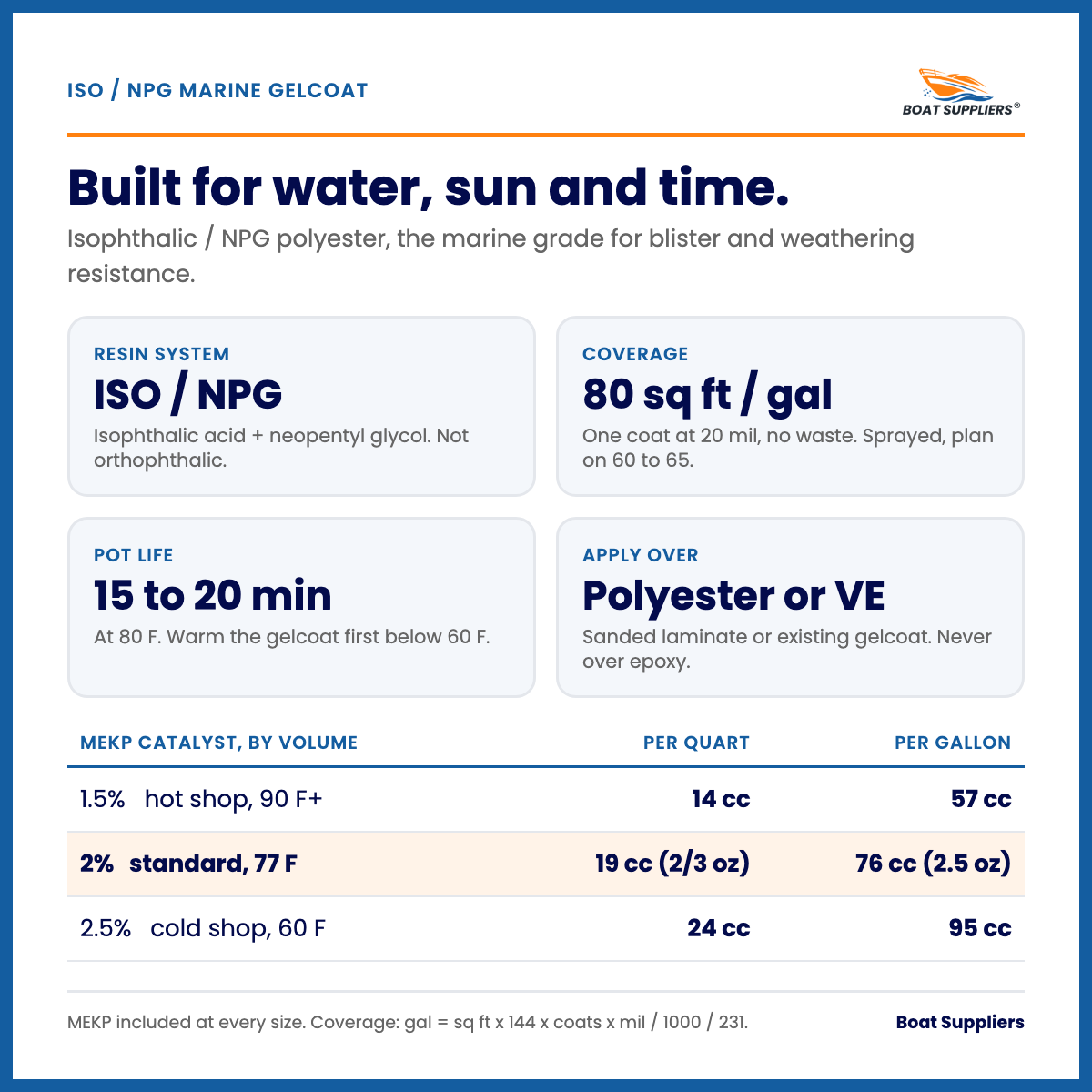
  • Resin system: isophthalic / NPG (neopentyl glycol) polyester, the marine grade for water, blister and weathering resistance
  • Catalyst: MEKP included at every size, 2% by volume: 19 cc (2/3 oz) per quart, 76 cc (2.5 oz) per gallon; 1.5% hot to 2.5% cold
  • Pot life: about 15 to 20 minutes at 80 F; warm the gelcoat first below 60 F
  • Apply over: sanded polyester or vinyl ester laminate or existing gelcoat, not over epoxy
  • Application: brush, roll or spray; thin 5 to 10% with styrene for spraying
  • Sizes: quart, gallon, 5 gallon (the 5 gallon ships as five 1-gallon jugs)
  • Ships: Ground only (Class 3 flammable)
  • Tintable ISO/NPG neutral base for color-matched hull and deck repairs
  • ISO/NPG marine gelcoat
  • Tints at about 1 oz liquid pigment per quart; use up to 2.5% MEKP when heavily pigmented
  • MEKP catalyst included in the price at every size
  • Unwaxed: build coats stay recoatable with no sanding between
  • Add surfacing wax to the final coat only for a tack-free, polishable finish
  • 5 gallon packed as five 1-gallon jugs
View full details

Technical Specifications


Mix MEKP 2% by volume: 19 cc (2/3 oz) per quart, 76 cc (2.5 oz) per gallon; 1.5% hot to 2.5% cold; tint with about 1 oz pigment per quart (4 oz per gallon)
Resin TypePolyester gelcoat - tintable neutral base, unwaxed
Mix RatioMEKP 2% by volume: 19 cc (2/3 oz) per quart, 76 cc (2.5 oz) per gallon; 1.5% hot to 2.5% cold; tint with about 1 oz pigment per quart (4 oz per gallon)
Pot Life~15-20 min @ 80°F
Tack-FreeFinal coat needs surfacing wax (or PVA) to cure tack-free
Cured ColorNeutral/translucent until tinted
Wax ContentUnwaxed - stir surfacing wax into the FINAL coat only, 1/2 to 1 oz per quart (2 to 4 oz per gallon)
CatalystMEKP included; about 2%, up to 2.5% in a cold shop or when heavily pigmented
Apply OverSanded polyester/VE laminate or gelcoat - not over epoxy
Best ForColor-matched repairs - tint to the exact hull color

Compare Resins


ProductNeutral Gelcoat with Hardener - No WaxNeutral Gelcoat with Hardener - No WaxYou're viewingfrom $39.95 Pure White Gelcoat with Hardener - No WaxPure White Gelcoat with Hardener - No Waxfrom $39.95 Clear Gelcoat with Hardener - No WaxClear Gelcoat with Hardener - No Waxfrom $39.95
TypePolyester gelcoat - tintable neutral base, unwaxedPolyester gelcoat - pigmented white, unwaxedPolyester gelcoat - clear, UV-inhibited, unwaxed
Mix RatioMEKP 2% by volume: 19 cc (2/3 oz) per quart, 76 cc (2.5 oz) per gallon; 1.5% hot to 2.5% cold; tint with about 1 oz pigment per quart (4 oz per gallon)MEKP 2% by volume: 19 cc (2/3 oz) per quart, 76 cc (2.5 oz) per gallon; 1.5% hot to 2.5% coldMEKP 2% by volume: 19 cc (2/3 oz) per quart, 76 cc (2.5 oz) per gallon; 1.5% hot to 2.5% cold
Pot Life~15-20 min @ 80°F~15-20 min @ 80°F~15-20 min @ 80°F
Cured ColorNeutral/translucent until tintedWhiteClear
WaxUnwaxed - stir surfacing wax into the FINAL coat only, 1/2 to 1 oz per quart (2 to 4 oz per gallon)Unwaxed - stir surfacing wax into the FINAL coat only, 1/2 to 1 oz per quart (2 to 4 oz per gallon)Unwaxed - stir surfacing wax into the FINAL coat only, 1/2 to 1 oz per quart (2 to 4 oz per gallon)
UV——UV inhibitors for outdoor & marine use
Best ForColor-matched repairs - tint to the exact hull colorHull & deck refinishing, repairsClear topcoat over laminates; tintable with pigments
SelectedViewView

Clean and sand the surface, then catalyze the gelcoat with MEKP and lay it down in two to three coats. Spray it at about 18 to 20 mils wet, or brush and roll thinner coats, letting each one flash before the next. Because polyester gelcoat is air-inhibited, the final coat needs surfacing wax (or a PVA film) to cure tack-free so you can sand and buff it.

Only with unwaxed gelcoat. Air stops the surface of polyester from curing, so unwaxed gelcoat stays tacky until you stir surfacing wax into the final coat, about 1/2 oz per quart (2 oz per gallon), or spray PVA over it. Leave the build coats unwaxed so they recoat without sanding, and wax only the last coat.

About 2% MEKP by volume at 77°F, which is about 19 cc per quart or 76 cc (about 2.5 fl oz) per gallon. Use a little more in a cold shop and a little less in heat, but stay between 1.5% and 2.5%. Measure with a graduated dispenser, since drops are not a reliable measure.

Waxed gelcoat has an additive that rises to the surface as it cures, sealing out air so the coat hardens tack-free and is ready to sand. Unwaxed (sanding) gelcoat has no additive, so it stays tacky until you add surfacing wax to the final coat or cover it with PVA. Use unwaxed when you plan to lay more coats, and use waxed for the last coat.

It is not recommended. Polyester gelcoat bonds well to polyester and vinyl ester laminates but adheres poorly to epoxy. If you must gelcoat over epoxy, let the epoxy fully cure, wash off any amine blush, sand it thoroughly, and expect a weaker bond. For epoxy repairs, a two-part polyurethane topcoat is usually the better finish.

Yes. For small repairs you can brush or roll gelcoat, though spraying gives the smoothest finish. Thin it about 5% to 10% with styrene so it flows out and self-levels, catalyze with MEKP, and add surfacing wax to the last coat. Work in thin coats to avoid runs, and plan to sand and buff afterward since some brush marks are normal.

A tacky surface almost always means air-inhibited cure, not too little catalyst. Unwaxed gelcoat will not harden on top until you add surfacing wax to the final coat or seal it with PVA. Other causes are too little MEKP, temperatures below about 60°F, or high humidity. Confirm your catalyst ratio, warm the shop, and wax or PVA the last coat.

At about 20 mil wet, one gallon of gelcoat covers about 80 square feet before losses. Allowing for overspray, plan about 60 square feet per gallon (about 15 per quart) when spraying, or about 70 square feet per gallon when brushing or rolling. Tooling and heavy color coats go thicker. The gelcoat calculator works it out for your job.

Neutral gelcoat is an unpigmented, tintable base: you add pigment to match a hull color instead of settling for a stock white. Tint at about 1 oz of pigment per quart (4 oz per gallon), tint the whole batch at once so every coat matches, and catalyze at about 2% MEKP, up to 2.5% when it is cold or heavily pigmented. Cure a test sample before you commit.

Thin polyester gelcoat with styrene, not acetone, at about 5% to 10% by volume. Styrene lowers viscosity so the gelcoat atomizes and flows out smoothly while keeping the resin chemistry intact, whereas acetone just flashes off and can leave the film weak and porous. Add the styrene before the MEKP, and stay at or below 10% so you do not weaken the cured coat.