

SKU:GEL-W032-W
Regular price
$39.95 USD
Sale price
$39.95 USD
Regular price
Unit price
$1.25
per
floz
Shipping calculated at checkout.
116 in stock
Couldn't load pickup availability
White gelcoat with the wax already in it, so the final coat cures hard in open air instead of staying tacky. That is the whole reason to buy the waxed version: for a repair or a refinish where there is no second coat coming, you spray or brush it, let it cure, and go straight to sanding and polishing without adding a surfacing additive or shooting PVA over the top.
- Catalyze at about 2% MEKP, roughly 1 oz per quart or 2 oz per gallon, included
- Pot life about 15 to 20 minutes at 80 F; up to double the MEKP below 85 F
- Cures tack-free, ready to sand and polish
- Apply over sanded polyester or vinyl ester laminate or gelcoat, not over epoxy
- Sizes: pint, quart, gallon and 5 gallon
If you do need a second coat, sand and acetone-wipe first. The same wax film that let it cure will block the next coat from sticking.
Includes

Technical Specifications
Mix MEKP ~2% (1 oz/qt, 2 oz/gal) - included
Resin TypePolyester gelcoat - pigmented white, waxed finish formula
Mix RatioMEKP ~2% (1 oz/qt, 2 oz/gal) - included
Pot Life~15-20 min @ 80°F
Tack-FreeCures tack-free - wax seals the surface from air
Cured ColorWhite
Wax ContentWaxed (finishing) - final-coat formula, sands and polishes without extra additives
CatalystMEKP included - still required with wax; up to 2x dose below 85°F
Apply OverSanded polyester/VE laminate or gelcoat - not over epoxy. Sand + acetone-wipe before any recoat (wax film).
Best ForOne-coat finish work - no separate wax additive needed
Compare Resins
| Product |  Pure White Gelcoat with Hardener - With WaxYou're viewingfrom $26.95 Pure White Gelcoat with Hardener - With WaxYou're viewingfrom $26.95
| 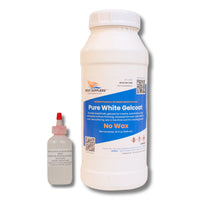 Pure White Gelcoat with Hardener - No Waxfrom $24.95 Pure White Gelcoat with Hardener - No Waxfrom $24.95
|  Neutral Gelcoat with Hardener - No Waxfrom $34.95 Neutral Gelcoat with Hardener - No Waxfrom $34.95
| 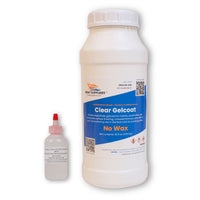 Clear Gelcoat with Hardener - No Waxfrom $24.95 Clear Gelcoat with Hardener - No Waxfrom $24.95
|
|---|---|---|---|---|
| Type | Polyester gelcoat - pigmented white, waxed finish formula | Polyester gelcoat - pigmented white, unwaxed | Polyester gelcoat - tintable neutral base, unwaxed | Polyester gelcoat - clear, UV-inhibited, unwaxed |
| Mix Ratio | MEKP ~2% (1 oz/qt, 2 oz/gal) - included | MEKP ~2% (1 oz/qt, 2 oz/gal) - included | MEKP ~2% - included; tint with 1 oz pigment per quart (4 oz/gal) | MEKP ~2% (1 oz/qt, 2 oz/gal) - included |
| Pot Life | ~15-20 min @ 80°F | ~15-20 min @ 80°F | ~15-20 min @ 80°F | ~15-20 min @ 80°F |
| Cured Color | White | White | Neutral/translucent until tinted | Clear |
| Wax | Waxed (finishing) - final-coat formula, sands and polishes without extra additives | Unwaxed - add surfacing wax 1/2 oz per qt on the final coat | Unwaxed - add surfacing wax 1/2 oz per qt on the final coat | Unwaxed - add surfacing wax 1/2 oz per qt on the final coat |
| UV | — | — | — | UV inhibitors for outdoor & marine use |
| Best For | One-coat finish work - no separate wax additive needed | Hull & deck refinishing, repairs | Color-matched repairs - tint to the exact hull color | Clear topcoat over laminates; tintable with pigments |
| View | View | View |
How do I apply polyester gelcoat?
Do I need to add wax to gelcoat?
How much MEKP do I add to gelcoat?
What's the difference between waxed and unwaxed gelcoat?
Can I use polyester gelcoat over epoxy resin?
Can I roll or brush gelcoat instead of spraying it?
Why is my gelcoat still tacky and not curing?
How much gelcoat do I need?
Blog posts

11 September 2026
Best Fiberglass Cutting Tools for Clean Edges...
11 September 2026
Best Fiberglass Cutting Tools for Clean Edges...

21 August 2026
Kevlar Fabric for Boats: A Fabricator's Guide...
21 August 2026
Kevlar Fabric for Boats: A Fabricator's Guide...

18 August 2026
Resin Mixing Mistakes That Ruin Your Composit...
18 August 2026