


SKU:GEL-CL016
Regular price
$24.95 USD
Sale price
$24.95 USD
Regular price
Unit price
$1.56
per
floz
Shipping calculated at checkout.
Hurry, only 4 left in stock
Couldn't load pickup availability
Earn 24 Boat Points Learn More
Ships Today if ordered before 4pm Learn More
Free Shipping on orders over $199 Learn More
Ships Today if ordered before 4pm Learn More
Free Shipping on orders over $199 Learn More
Durable isophthalic gelcoat for marine, automotive, and composite surface finishing. Unwaxed formula; add MEKP to cure. Use surfacing wax in the final coat for sanding/polish.
Clear gelcoat gives you a wax-free base you can shoot as a barrier coat or tint with pigment for custom color, then back up with a surfacing coat or add wax for a tack-free cure. Pick the right finish in our guide to choosing the right gelcoat.
Specifications
Includes
Features


Resin Calculator
Technical Specifications
Mix MEKP ~2% (1 oz/qt, 2 oz/gal) - included
Resin TypePolyester gelcoat - clear, UV-inhibited, unwaxed
Mix RatioMEKP ~2% (1 oz/qt, 2 oz/gal) - included
Pot Life~15-20 min @ 80°F
Tack-FreeFinal coat needs surfacing wax (or PVA) to cure tack-free
Cured ColorClear
Wax ContentUnwaxed - add surfacing wax 1/2 oz per qt on the final coat
CatalystMEKP included
UV ResistanceUV inhibitors for outdoor & marine use
Apply OverSanded polyester/VE laminate or gelcoat - not over epoxy
Best ForClear topcoat over laminates; tintable with pigments
Compare Resins
| Product | 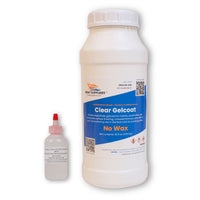 Clear Gelcoat with Hardener - No WaxYou're viewingfrom $24.95 Clear Gelcoat with Hardener - No WaxYou're viewingfrom $24.95
| 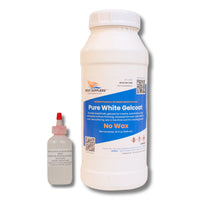 Pure White Gelcoat with Hardener - No Waxfrom $24.95 Pure White Gelcoat with Hardener - No Waxfrom $24.95
|  Neutral Gelcoat with Hardener - No Waxfrom $34.95 Neutral Gelcoat with Hardener - No Waxfrom $34.95
|
|---|---|---|---|
| Type | Polyester gelcoat - clear, UV-inhibited, unwaxed | Polyester gelcoat - pigmented white, unwaxed | Polyester gelcoat - tintable neutral base, unwaxed |
| Mix Ratio | MEKP ~2% (1 oz/qt, 2 oz/gal) - included | MEKP ~2% (1 oz/qt, 2 oz/gal) - included | MEKP ~2% - included; tint with 1 oz pigment per quart (4 oz/gal) |
| Pot Life | ~15-20 min @ 80°F | ~15-20 min @ 80°F | ~15-20 min @ 80°F |
| Cured Color | Clear | White | Neutral/translucent until tinted |
| Wax | Unwaxed - add surfacing wax 1/2 oz per qt on the final coat | Unwaxed - add surfacing wax 1/2 oz per qt on the final coat | Unwaxed - add surfacing wax 1/2 oz per qt on the final coat |
| UV | UV inhibitors for outdoor & marine use | — | — |
| Best For | Clear topcoat over laminates; tintable with pigments | Hull & deck refinishing, repairs | Color-matched repairs - tint to the exact hull color |
| View | View |
How do I apply polyester gelcoat?
Do I need to add wax to gelcoat?
How much MEKP do I add to gelcoat?
What's the difference between waxed and unwaxed gelcoat?
Can I use polyester gelcoat over epoxy resin?
Can I roll or brush gelcoat instead of spraying it?
Why is my gelcoat still tacky and not curing?
How much gelcoat do I need?
What is clear gelcoat used for?
How do I thin gelcoat for spraying?
Blog posts

21 August 2026
Kevlar Fabric for Boats: A Fabricator's Guide...
21 August 2026
Kevlar Fabric for Boats: A Fabricator's Guide...

18 August 2026
Resin Mixing Mistakes That Ruin Your Composit...
18 August 2026
Resin Mixing Mistakes That Ruin Your Composit...

14 August 2026
Chopped Strand Mat Comparison: 0.75oz vs 1.5o...
14 August 2026