Polyester Resin for Boat Repair: Orthophthalic vs Isophthalic Selection Guide

11 June 2026
Choosing polyester resin for boat repair comes down to three factors: structural requirements, water exposure, and working time. We've seen shop repairs fail because someone grabbed whatever polyester resin was cheapest, only to watch it crack or delaminate six months later. Here's how to spec the right resin for your specific repair job.
Orthophthalic vs Isophthalic Polyester Resin for Boats
Most polyester resin for boats falls into two categories: orthophthalic (general purpose) and isophthalic (premium). The difference is the phthalic acid component. Isophthalic uses meta-phthalic acid instead of ortho-phthalic acid, creating better cross-linking density and lower water absorption.
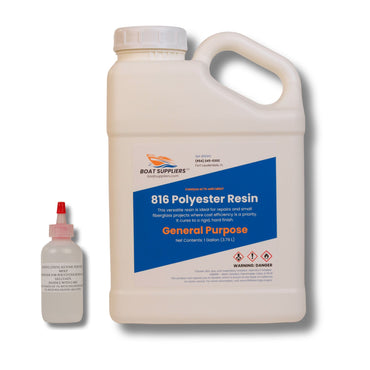
Orthophthalic resins like our 816 General Purpose Polyester Resin work fine for above-waterline repairs, interior patches, and non-structural work. They cure fast, wet out easily, and cost less, but they absorb more water over time and have higher shrinkage rates.
Isophthalic resins like the 404 Tooling Polyester Resin are engineered for structural work. Lower shrinkage means better dimensional stability. Better chemical resistance means they hold up in bilge areas and below the waterline. You pay more upfront, but the repair lasts.
Water Absorption Comparison
| Resin Type | 24-hour Water Absorption (% by weight) | Typical Use |
|---|---|---|
| Orthophthalic | 0.15-0.60% | Above waterline, cosmetic |
| Isophthalic | 0.10-0.15% | Below waterline, structural |
Marine-Specific Polyester Formulations
Not all polyester resins are formulated for marine use. The 435 Standard Polyester Layup Resin is our most popular marine-grade polyester because it's formulated with better UV resistance and reduced styrene content than automotive or general composites resins.
Marine polyester resin typically includes:
- UV stabilizers to prevent chalking and degradation in sunlight
- Reduced styrene content for better handling in enclosed spaces
- Wax-free formulation for multi-coat compatibility
- Corrosion inhibitors for hardware compatibility
We've done transom rebuilds where the original failure wasn't the fiberglass. It was using automotive polyester that couldn't handle constant UV and salt exposure.
Laminating vs Finishing Resin: Why It Matters
Polyester resins are either laminating (air-inhibited) or finishing (non-air-inhibited with paraffin wax). Laminating resin stays tacky when cured, which means subsequent coats bond chemically. Finishing resin cures to a hard, non-tacky surface.
For multi-layer repairs (transom work, stringer reinforcement, hull patches), you want laminating resin for all layers except the final coat. The Hi-Bond Polyester Resin is a laminating resin that works well for structural layups where you need good inter-coat adhesion.
If you're doing a single-coat repair or want a finish that can be immediately sanded and painted, finishing resin is the call. Some shops keep both on hand; others just spray PVA film over the final laminating coat to eliminate air inhibition.
Clear vs Pigmented Resin Applications
Clear polyester resin like our Clear Polyester Surfboard Resin - Silmar 249 is essential when you need to see the reinforcement pattern or when working over gelcoat repairs where color matching matters.
Clear resins are also the standard for cosmetic work: console repairs, deck patches, anywhere the repair will be visible. The Silmar 249 includes UV inhibitors, which prevents the yellowing that kills most clear repairs after a season in the sun.
Pigmented resins work better for structural repairs where appearance doesn't matter. They hide the weave pattern of reinforcement cloth and often have slightly better UV resistance than clear formulations.
Cure Schedule Comparison (at 70°F with 2% MEKP)
| Resin | Working Time | Gel Time | Tack-Free | Full Cure |
|---|---|---|---|---|
| 816 General Purpose | 8-12 min | 12-18 min | 2-4 hours | 24 hours |
| 435 Marine Layup | 10-18 min | 15-25 min | 3-5 hours | 24-48 hours |
| 404 Isophthalic | 6-10 min | 10-15 min | 2-3 hours | 24 hours |
Polyester vs Vinyl Ester vs Epoxy for Marine Repairs
The resin choice debate usually comes down to cost versus performance. Polyester resin costs roughly half what epoxy costs, cures faster, and bonds well to existing polyester laminates (which is what most production boats are built with).
Vinyl ester resin splits the difference: better chemical resistance and strength than polyester, lower cost than epoxy. For structural repairs in harsh environments, VE offers the best balance.
Epoxy has better strength, lower shrinkage, and superior adhesion, but polyester resin has one major advantage in repair work: it bonds chemically to existing polyester gelcoat and laminate. Epoxy bonds mechanically, which means the prep work is more critical.
For structural repairs below the waterline, we usually recommend vinyl ester or epoxy. For cosmetic work, small patches, and non-critical repairs, polyester resin offers the best balance of performance and cost.
MEKP Catalyst: Getting the Mix Right
All these polyester resins cure with MEKP catalyst at 1-2% by volume. Too little catalyst and the resin stays soft; too much and it kicks off before you can work with it. Temperature affects cure time more than catalyst percentage. At 80°F, cut the catalyst back to 1.2%. At 60°F, you might need 2.0%, and never go above 2%.
Always measure catalyst by volume, not drops or "capfuls." A graduated cc dispenser or syringe is essential. Mix the catalyst thoroughly but don't whip air into the resin. Bubbles in the laminate create weak spots.
Use a fitted P100 respirator with organic vapor cartridges when working with polyester resin; nitrile gloves; eye protection. MEKP will burn skin on contact.
Reinforcement Pairing for Polyester Resin
Polyester resin works with standard fiberglass reinforcements:
- 1708 biaxial: Primary choice for transom and stringer work with any of these resins
- 10oz cloth: Good with 435 Marine Layup for hull repairs where drapability matters
- 1.5oz chopped strand mat (CSM): Pairs with orthophthalic for quick patches
- 6oz plain weave: Standard with clear resins for cosmetic repairs
Avoid using polyester resin with aramid (Kevlar) or carbon fiber. The chemical bond is poor. Stick to glass reinforcements.
Polyester Resin Selection by Application
For typical boat repairs, here's what we recommend:
Small patches and cosmetic work: 816 General Purpose with 6oz cloth or 1.5oz CSM. Economical and user-friendly.
Structural repairs above waterline: 435 Marine Layup with 1708 biaxial. Proven marine formulation with good UV resistance.
Below-waterline or high-stress areas: 404 Isophthalic with 1708 biaxial. Maximum strength and water resistance.
Clear cosmetic repairs: Silmar 249 clear with 6oz plain weave. UV-stable and crystal clear.
The key is matching the resin to the application. Don't over-spec for simple repairs, but don't compromise on critical structural work. A transom failure isn't worth the $20 you saved on resin.
For most structural marine repairs, we recommend the 435 Standard Polyester Layup Resin paired with 1708 biaxial cloth, a proven combination that handles 90% of shop repair work. Understanding how to use biaxial fiberglass properly ensures your repairs last.
Doing this work for paying customers? Our shop accounts get direct access to technical support plus 20% off all catalog pricing. Apply for wholesale pricing here.
Frequently asked questions
What is the difference between orthophthalic and isophthalic polyester resin?
Orthophthalic is the general-purpose grade: fast cure, easy wet-out, lower cost, fine for above-waterline and non-structural repairs. Isophthalic cross-links more densely, absorbs less water (0.10 to 0.15 percent versus up to 0.60 percent), and shrinks less, which makes it the choice for structural and below-waterline work.
How much MEKP catalyst do I add to polyester resin?
1 to 2 percent by volume, measured with a graduated cc dispenser or syringe, never by drops or capfuls. Adjust for temperature rather than chasing cure speed: around 1.2 percent at 80°F, up to 2.0 percent at 60°F, and never above 2 percent. Too little leaves the resin soft; too much kicks it off before you can work.
Should I use laminating or finishing polyester resin?
Laminating (air-inhibited) resin stays tacky on the surface so the next layer bonds chemically. Use it for every layer of a multi-layer repair except the last. Finishing resin cures hard and ready to sand. Many shops stock only laminating resin and spray PVA film over the final coat to get a tack-free cure.
Can I use polyester resin with carbon fiber or Kevlar?
No. The chemical bond between polyester resin and aramid or carbon reinforcements is poor. Keep polyester with glass reinforcements like 1708 biaxial, woven cloth, and chopped strand mat. For carbon fiber or Kevlar work, use epoxy.
Shop the materials in this guide
- 816 general purpose polyester resin, the economical ortho grade.
- 435 marine layup resin, the everyday marine laminating resin.
- 404 isophthalic resin, for structural and below-waterline work.
- Hi-Bond laminating resin, for multi-layer structural layups.
- Silmar 249 clear polyester resin, for cosmetic and clear repairs.
- compare all of our resins.
- Partall Coverall Film PVA mold release.
Prev post

How to Winterize Fiberglass Boat: Complete Hull Protection Guide
Updated on 12 June 2026
Next post

How to Fix Fiberglass Crack: Complete Guide to Boat Hull Crack Repair
Updated on 09 June 2026