
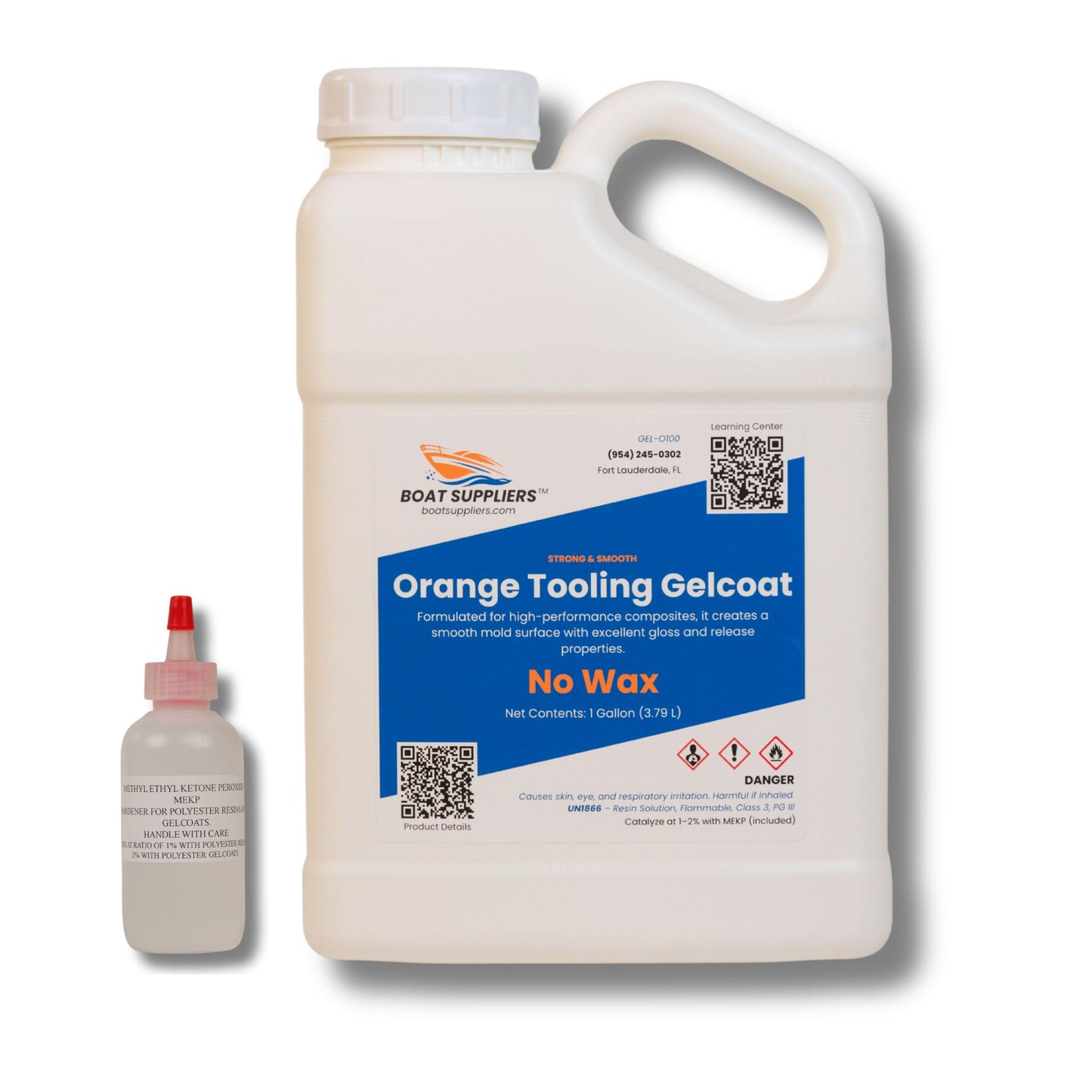
Orange Tooling Gelcoat with Hardener - No Wax
Orange, unwaxed15 to 20 min pot lifeNo wax by design


Orange, unwaxed15 to 20 min pot lifeNo wax by design
SKU:GEL-OR025
Regular price
$42.95 USD
Sale price
$42.95 USD
Regular price
USD
Unit price
$1.34
per
floz
Shipping calculated at checkout.
In stock
Couldn't load pickup availability
Shipping At CheckoutSee your shipping cost before you pay.
Nonreturnable ItemCheck suitability with us before ordering.
In stock
Key Specs
- Mix Ratio
- MEKP 2% by volume: 19 cc (2/3 oz) per quart, 76 cc (2.5 oz) per gallon; 1.5% hot to 2.5% cold
- Pot Life
- ~15-20 min @ 80°F; up to 2.5% MEKP in a cold shop
- Resin Type
- Polyester tooling gelcoat - orange, unwaxed
- Cured Color
- Orange - high visibility against laminate
- Wax Content
- No wax by design - the mold's backup laminate bonds chemically
- Catalyst$
- No wax by design - the mold's backup laminate bonds chemically
The surface coat for building a mold. Orange is not decoration: against white laminate it shows you exactly where the gelcoat is thin while you are still spraying, and later it shows wear and pinholes on a working mold before a part picks them up. Unwaxed by design so the backup laminate bonds chemically to it.
- Catalyze at about 2% MEKP, roughly 19 cc (2/3 oz) per quart or 76 cc (2.5 oz) per gallon, included
- Pot life about 15 to 20 minutes at 80 F; up to about 2.5% MEKP in a cold shop
- Unwaxed so the tooling laminate bonds to it without sanding
- Apply into waxed or PVA-prepped molds, then back it with isophthalic tooling resin and mat or cloth
- Store at 60 to 75 F; shelf life 3 to 6 months unopened
- Sizes: quart, gallon and 5 gallon (the 5 gallon ships as five 1-gallon jugs)
Build it to a real film thickness. A mold surface coat that is too thin telegraphs the backup laminate print into every part you pull off it.
Specifications
Includes
Features


Technical Specifications
Mix MEKP 2% by volume: 19 cc (2/3 oz) per quart, 76 cc (2.5 oz) per gallon; 1.5% hot to 2.5% cold
Resin TypePolyester tooling gelcoat - orange, unwaxed
Mix RatioMEKP 2% by volume: 19 cc (2/3 oz) per quart, 76 cc (2.5 oz) per gallon; 1.5% hot to 2.5% cold
Pot Life~15-20 min @ 80°F; up to 2.5% MEKP in a cold shop
Cured ColorOrange - high visibility against laminate
Wax ContentNo wax by design - the mold's backup laminate bonds chemically
CatalystMEKP included
Apply OverInto waxed/PVA-prepped molds; back with isophthalic tooling resin + mat/cloth
Best ForMold surface coat - orange shows thin spots while laminating
Compare Resins
| Product |  Orange Tooling Gelcoat with Hardener - No WaxYou're viewingfrom $42.95 |  Black Tooling Gelcoat with Hardener - No Waxfrom $42.95 | 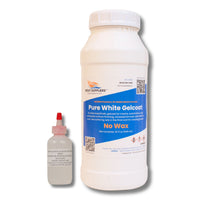 Pure White Gelcoat with Hardener - No Waxfrom $39.95 |
|---|---|---|---|
| Type | Polyester tooling gelcoat - orange, unwaxed | Polyester tooling gelcoat - black, unwaxed | Polyester gelcoat - pigmented white, unwaxed |
| Mix Ratio | MEKP 2% by volume: 19 cc (2/3 oz) per quart, 76 cc (2.5 oz) per gallon; 1.5% hot to 2.5% cold | MEKP 2% by volume: 19 cc (2/3 oz) per quart, 76 cc (2.5 oz) per gallon; 1.5% hot to 2.5% cold | MEKP 2% by volume: 19 cc (2/3 oz) per quart, 76 cc (2.5 oz) per gallon; 1.5% hot to 2.5% cold |
| Pot Life | ~15-20 min @ 80°F; up to 2.5% MEKP in a cold shop | ~15-20 min @ 80°F; up to 2.5% MEKP in a cold shop | ~15-20 min @ 80°F |
| Cured Color | Orange - high visibility against laminate | Black - shows mold-surface defects while polishing | White |
| Wax | No wax by design - the mold's backup laminate bonds chemically | No wax by design - the mold's backup laminate bonds chemically | Unwaxed - stir surfacing wax into the FINAL coat only, 1/2 to 1 oz per quart (2 to 4 oz per gallon) |
| Best For | Mold surface coat - orange shows thin spots while laminating | Mold surface coat - black reveals scratches & defects | Hull & deck refinishing, repairs |
| View | View |
How do I apply polyester gelcoat?
Do I need to add wax to gelcoat?
How much MEKP do I add to gelcoat?
What's the difference between waxed and unwaxed gelcoat?
Can I use polyester gelcoat over epoxy resin?
Can I roll or brush gelcoat instead of spraying it?
Why is my gelcoat still tacky and not curing?
How much gelcoat do I need?
What's the difference between tooling gelcoat and regular gelcoat?
How do I thin gelcoat for spraying?
Guides for this product

23 February 2026
How to Make a Fiberglass Mold: Complete Step-...
23 February 2026
How to Make a Fiberglass Mold: Complete Step-...

26 September 2026
Polyester Gelcoat: Waxed vs Unwaxed, Tooling ...
26 September 2026
Polyester Gelcoat: Waxed vs Unwaxed, Tooling ...

08 October 2026
PVA vs Wax vs Semi-Permanent Mold Release: Wh...
08 October 2026
PVA vs Wax vs Semi-Permanent Mold Release: Wh...
Calculators and charts:Gelcoat CalculatorMEKP Catalyst Calculator