Epoxy Calculator: How Much Resin Your Layup Actually Needs

28 September 2026
You have the cloth cut and the job measured, and the question is how many gallons of epoxy to order so you do not run out mid-layup or leave a half gallon curing in the can next spring. The epoxy calculator math is simple once you work in weight: in hand layup, woven cloth takes about its own weight in mixed resin, 1708 biaxial takes about 1.3 times its weight, and chopped strand mat takes double. Multiply by square yards, add a waste factor, convert to gallons at about 150 oz of mixed epoxy per gallon, and you have a purchase quantity. Here is how to run it by hand; the resin calculator does the arithmetic once you know the inputs.
Step 1: area in square yards
Measure the surface you are glassing and convert to square yards (divide square feet by 9). A 16 ft transom skin at 16 in tall is about 21 sq ft, or 2.4 sq yd per ply. Count plies. Three plies of 1708 on that transom is 7.2 sq yd of reinforcement. If the part has compound curves or you are cutting darts, add 10% to the cloth count, because you will trim more than you lay.
Step 2: resin per square yard, by reinforcement
Hand layup with a roller lands near a 50/50 glass to resin ratio by weight on woven cloth. Mat holds far more resin because there is open volume between the random strands. Stitched biaxial with a mat backer sits in between. These are the ratios we plan purchases around in the shop:
| Reinforcement | Fabric weight per sq yd | Resin to glass, hand layup | Mixed resin per sq yd |
|---|---|---|---|
| 4 oz plain weave | 4 oz | 1:1 | 4 oz |
| 6 oz plain weave | 6 oz | 1:1 | 6 oz |
| 10 oz plain weave | 10 oz | 1:1 | 10 oz |
| 1708 biaxial (17 oz plus 0.75 oz/ft² mat) | about 24 oz | 1.3:1 | about 30 oz |
| 1.5 oz chopped strand mat (CSM) | 13.5 oz | 2:1 to 2.5:1 | 27 to 34 oz |
Those resin figures are by weight. Vacuum bagging pulls the woven numbers down toward 0.7:1; a sloppy squeegee job pushes them up. If you are laying on bare plywood or a ground, porous laminate, the first ply also feeds the substrate, so add a seal coat (below) rather than trying to squeeze it into the ply number.
Step 3: coating and fill coats
Neat epoxy at 10 mils wet covers about 160 sq ft per gallon on paper. Plan on 100 to 120 sq ft per gallon for a first seal coat on bare plywood or end grain, since the wood drinks the first pass. Burying the weave of 6 oz cloth takes two fill coats after the wet-out coat, so budget three coats total on anything that will be painted or varnished. A fill coat on 1708 that will be faired can be skipped; the fairing compound does that job.
Step 4: waste and the gallon conversion
Add 15 to 20% for what stays in the cup, on the roller cover, and in the mixing pot when a batch kicks early. Then convert: mixed epoxy weighs roughly 9.3 lb per gallon, call it 150 oz by weight per gallon. Sixty ounces of resin by weight is 0.4 gallon. Kits are sold by volume and the 2:1 and 4:1 ratios on our kits are by volume, so a 96 oz kit is 96 fluid ounces of mixed resin, or 0.75 gallon.
Worked example: three plies of 1708 on a transom
7.2 sq yd of 1708 at 30 oz per sq yd is 216 oz. Add a seal coat on the new plywood core: 21 sq ft at 110 sq ft per gallon is about 30 oz. Total 246 oz, plus 20% waste, is 295 oz by weight, just under 2 gallons. Order the 1.5 gallon kit plus the 96 oz (0.75 gallon) kit, 2.25 gallons of laminating resin, and figure the fillets at the hull joint from a separate thick kit.
Which epoxy kit for the job
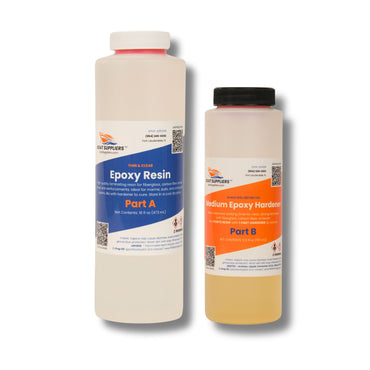
For laminating, use a thin, slow resin: it wets out 1708 faster, releases air under the roller, and gives you time to work a full transom before it gels. The Boat Suppliers Epoxy Resin Kit, Thin, Clear, with Hardener is a 2:1 by volume slow-cure system sold from a 12 oz kit up to 7.5 gallons, so the estimate above fits in one or two boxes. Cure schedule depends on shop temperature; check the TDS in the kit before you commit to a cold-night layup.
When the shop is below 60°F (16°C) or the batch is small enough to cool fast in the cup, switch the hardener. The Boat Suppliers Fast Epoxy Hardener 4:1 Ratio kicks in about 15 minutes at 80°F, sets in 1 to 2 hours, and stays workable down to about 45°F. That is a cup-sized batch, not a transom's worth, so mix it in 16 oz lots.
Bonding hardware, filling gaps, and coating vertical surfaces is a different resin. The Boat Suppliers Epoxy Resin Kit, Thick, 1:1 Bonding and Coating, with Hardener is a high-build, no-sag formula that stays put on a transom face instead of running to the bilge. Count it separately from the laminating resin: figure the fillet and bedding volume on its own and add a 16 or 32 oz kit.
Anything over a quart, mix with a drill. The 16" Steel Power Mixer has a 2-3/8 in head and a 16 in shaft that reaches the bottom of a gallon can, which is where unmixed hardener hides when you stir by hand. Wear a P100 respirator with organic vapor cartridges, nitrile gloves, and eye protection when mixing and rolling.
If the coating coat needs color, add pigment before the hardener. A 1 oz bottle of Black Epoxy Resin Pigment tints a quart of thick epoxy opaque for a bilge or a boot-stripe fill; stay at or under the loading printed on the bottle so you do not soften the cure.
Frequently asked questions
How much epoxy do I need per yard of 1708?
Plan on about 30 oz of mixed epoxy by weight per square yard of 1708 biaxial in hand layup: the 17 oz fabric at 1:1 plus the 0.75 oz/ft² mat backer at 2:1. A 50 in wide running yard is 1.39 sq yd, so about 42 oz per yard off the roll. Add 20% for waste and use a thin, slow laminating epoxy so the mat side wets through before the batch gels.
How many square feet does a gallon of epoxy cover?
About 160 sq ft at 10 mils wet film, which is a normal roller coat. Bare plywood soaks up the first coat, so budget 100 to 120 sq ft per gallon for a seal coat and 160 for each fill coat after it. Two fill coats bury the weave on 6 oz plain weave; 10 oz cloth usually needs three. Run the numbers in the resin calculator before ordering.
Is the mix ratio by weight or by volume?
Our kits are by volume: 2:1 for the thin laminating system and 4:1 for the fast hardener, and the kit sizes are built to those ratios, so a 48 oz kit is 32 oz resin plus 16 oz hardener. If you weigh instead, remember the hardener is lighter than the resin, so the weight ratio is not the same number. Use the ratio on the label, not a converted guess.
How big a batch can I mix at once?
Mass drives exotherm. A 4:1 fast batch gives about 15 minutes at 80°F in a cup; pour it into a roller tray to spread the heat and you gain working time. For laminating a transom, mix the slow 2:1 resin in 16 to 32 oz batches, roll each one out, then mix the next. Never leave a full quart of mixed epoxy sitting in a deep pot.
Can I add pigment to laminating epoxy?
You can, but keep it out of the structural plies unless you need it. Pigment adds nothing to strength and hides air you would otherwise see under the roller. Tint the final coating coat instead: 1 oz of opaque liquid pigment colors about a quart of epoxy when stirred streak-free into the resin before the hardener goes in. Check the maximum loading on the bottle and stay under it.
What You Need For This Job
- Boat Suppliers Epoxy Resin Kit, Thin, Clear, with Hardener: 2:1 slow laminating resin for wetting out cloth and 1708
- Boat Suppliers Fast Epoxy Hardener 4:1 Ratio: cold-shop and small-batch hardener, workable to about 45°F
- Boat Suppliers Epoxy Resin Kit, Thick, 1:1 Bonding and Coating, with Hardener: no-sag epoxy for fillets, bedding hardware, and vertical coats
- 16" Steel Power Mixer: drill mixer for gallon batches that reaches the bottom of the can
- Black Epoxy Resin Pigment, 1 oz: tints a coating coat opaque
Next post

Polyester Gelcoat: Waxed vs Unwaxed, Tooling vs Repair, Which to Buy
Updated on 26 September 2026