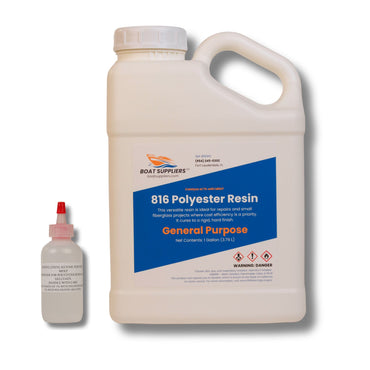
Yes. Silmar 249 is a laminating resin, specifically a water-clear, UV-stabilized, unwaxed polyester laminating resin made by Interplastic Corporation under the Silmar brand. It has been the surfboard industry's standard glassing resin for decades, and the reason it holds that spot is exactly the property people are asking about with this question: it's formulated for laminating, not for finishing.
What "laminating resin" actually means with polyester
Polyester resins cure air-inhibited: oxygen at the surface stops the cure right at the top layer, so an unwaxed polyester cures hard underneath but stays tacky on the surface. With a laminating resin, that's a feature. The tacky surface means your next ply, your fill coat, or your hotcoat bonds chemically to the previous one with no sanding between coats. You can glass the bottom of a board, flip it the next morning, and laminate the deck straight onto the lap without touching a sander.
Silmar 249 contains no wax (no surfacing agent), which is what makes it a laminating resin. That same fact means it is not a finishing resin out of the can. If your final coat is straight 249, it will stay tacky indefinitely and it will clog paper instead of sanding. Two ways to handle the last coat:
- Add surfacing wax to your final coat of 249. The wax rises to the surface, seals off the air, and the coat cures tack-free and sandable.
- Use the factory-waxed version, Silmar 250A, which is the same 249 base resin with wax already added, sold as a sanding or hotcoat resin.
Same resin family either way. The only difference between laminating and sanding grades here is the wax. The A and B suffixes are a separate split; see Silmar 249A vs 249B for that one.
Catalyzing it
Silmar 249 kicks with MEKP, the standard polyester catalyst. Working numbers:
| MEKP by volume | Roughly | Use when |
|---|---|---|
| 1% (10 cc per quart) | ~20 min working time at 75°F (24°C) | Full lamination, warm shop |
| 1.5% | ~12-15 min | Normal repairs |
| 2% (20 cc per quart) | Fast kick | Below 75°F, small batches, dings |
Stay inside the 1-2% window. Under-catalyzed 249 can stay soft for days; over 2% you risk excessive exotherm and yellowing in a thick fill. Temperature moves these numbers as much as catalyst does, so run a test batch if your garage is sitting at 60°F (16°C). Fitted respirator with organic vapor cartridges, nitrile gloves, and eye pro when working with styrene-based resins; done.
Why builders pick it over general layup resin
Silmar 249 cures water-white and carries UV inhibitors, so a clear glass job stays clear instead of ambering in the sun. It runs a slight blue tint in the can and dries clear. That clarity costs more per gallon than commodity layup resin, so use it where the laminate shows: clear boards over foam, tint and pigment work, wood veneer, anything bright-finished.
If the glass is getting painted, gelcoated, or buried inside a transom or stringer job, clarity is wasted money. For structural marine work, run marine-grade polyester layup resin and save the 249 for work that gets looked at.
Bottom line
Prev post

How to Thicken Epoxy: What to Add and How Much
Updated on 08 August 2026