Epoxy Resin Buying Guide: Viscosity, Ratio and Cure Speed

05 October 2026
Buying epoxy resin for a boat job comes down to three numbers on the can: viscosity, which decides whether it wets out cloth or stays put in a fillet; mix ratio, which is a measuring instruction and not a quality score; and cure speed, which you pick by hardener to match the shop temperature and the size of the batch. Get those three right and the brand matters a lot less than people think. Here is how to read each one and which resin and hardener to put on the bench for laminating, bonding and coating.
Viscosity: thin wets out glass, thick stays where you put it
Viscosity is measured in centipoise (cps). Water is about 1 cps, honey is a few thousand. A laminating epoxy resin in the 600 cps range, syrup thin, soaks through 1708 biaxial or 6 oz cloth under a squeegee and flows level as a coating instead of sitting up in ridges. A thick bonding epoxy is formulated the other way: high build, no sag, so it grabs a vertical transom or an overhead fillet and fills a gap without draining out of it. Neither one does the other's job. Thick resin over cloth leaves dry glass under a skin of resin; thin resin in a gap runs out the bottom before it gels. Every shop needs both, and the mistake is buying one and thickening or thinning it into the other.
| Product | Viscosity | Ratio by volume | Pot life at 80°F (27°C) | Set | Hard | Job |
|---|---|---|---|---|---|---|
| BS thin epoxy with 2:1 slow hardener | 600 cps resin | 2:1 | 35 to 40 min | 5 to 6 hr | 24 to 28 hr | Laminating, wet-out, clear coating, humid shops |
| BS thin epoxy with 4:1 fast hardener | 600 cps resin | 4:1 | 15 min | 1 to 2 hr | 3 to 4 hr | Small batches, cold weather to about 45°F (7°C) |
| BS thick epoxy, 1:1 | High build, no sag | 1:1 | 30 to 35 min | 3 to 4 hr | 12 to 14 hr | Bonding, fillets, gap filling, vertical coats |
Pot life is the working time of a mixed batch in the cup. Set is when it will hold a shape and take another wet coat without sanding; hard is when you can sand it and load it. All three move with temperature: every 18°F (10°C) warmer roughly halves the pot life, and a big cup kicks faster than a thin film because the exotherm feeds itself. Pour a mixed batch out into a roller tray or spread it on the work as soon as it is mixed if you want the full working time.
Mix ratio: an instruction, not a grade
A 1:1 epoxy is not a beginner's resin and a 5:1 is not a professional's. The ratio is set by the chemistry of the hardener and it is the one number you cannot adjust. Off-ratio epoxy does not cure slower; it never fully cures, stays soft or tacky, and you find out weeks later when the paint wrinkles. Measure by volume in graduated cups or with pumps sized to the system, pour the smaller component into the larger, stir for two full minutes scraping the sides and bottom, and if the batch matters, pour it into a second cup and stir again. A scale beats cups if the system publishes a weight ratio; use that number, not the volume ratio, because the two differ.
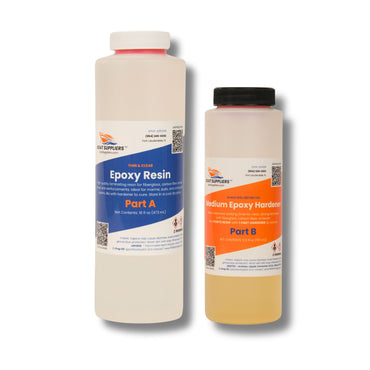
Ratios also tell you which hardeners belong to which resin. The Boat Suppliers thin laminating resin runs with three hardeners at three ratios: 2:1 slow, 3:1 medium, and 4:1 fast. Same resin, different hardener, different cure. The thick bonding epoxy is a 1:1 system with its own hardener, and you do not cross them.
Cure speed: pick the hardener for the temperature and the batch
The hardener sets the speed, and the right one depends on how warm the shop is and how much resin you are mixing at once. Slow for a full transom skin at 85°F when you need 35 minutes to wet out four plies. Fast for a 4 oz batch to bed a cleat when the garage is 50°F and you want to sand tomorrow morning. The hardener also decides whether you get amine blush, the waxy film some epoxies sweat as they cure in humid air; it has to be washed off with water before sanding or recoating. The BS 2:1 slow hardener is non-blushing; the 3:1 blushes and wants a wipe-down between coats.
| Hardener | Ratio | Pot life at 80°F | Set | Working floor | Blush | Reach for it when |
|---|---|---|---|---|---|---|
| BS slow 2:1 | 2:1 | 35 to 40 min | 5 to 6 hr | Keep above 70°F (21°C) | No | Big layups, warm or humid shops, clear work |
| BS medium 3:1 | 3:1 | 20 to 25 min | 3 to 4 hr | About 55°F (13°C) | Yes | General repair at normal temperatures |
| BS fast 4:1 | 4:1 | 15 min | 1 to 2 hr | About 45°F (7°C) | Yes | Small batches, cold weather, next-morning sanding |
What to buy for each job
Laminating fiberglass, carbon or Kevlar, sealing plywood, or a clear coat over a wood deck: the Boat Suppliers Epoxy Resin Kit, Thin, Clear, with Hardener at 2:1 slow. The 600 cps resin wets out 1708 and 6 oz cloth without a fight, the 2:1 hardener gives you 35 to 40 minutes at 80°F and dries clear in thin coats without blush. Kits run from 12 oz to 7.5 gal; a transom skin on a 20 ft outboard wants the 1.5 gal kit and change, and the resin calculator will settle the number from your fabric and ply count.
Bonding a core, bedding hardware, fillets under stringer tabs, filling screw holes, coating a vertical surface: the Boat Suppliers Epoxy Resin Kit, Thick, 1:1 Bonding and Coating, with Hardener. Equal parts by volume, 30 to 35 minutes of pot life at 80°F, sets in 3 to 4 hours and does not run down the transom while it does. It is not a laminating resin: it will not wet out cloth. Stir in fumed silica for a stiffer fillet or milled fiber for a structural gap fill.
Restocking hardener to match the shop calendar: the Boat Suppliers Slow Epoxy Hardener 2:1 Ratio for summer and for anything you want to look clear, and the Boat Suppliers Fast Epoxy Hardener 4:1 Ratio for the cold months and the small jobs. Both are sold from 8 oz to a gallon so you can stock a gallon of resin and split the hardener by season. Keep the ratio straight on the cup: a 2:1 batch is 8 oz resin to 4 oz hardener, a 4:1 batch is 8 oz to 2 oz.
Color, UV and topcoats
Epoxy has no UV resistance. Left in the sun it chalks and yellows, so any epoxy that stays outside gets a topcoat: paint, varnish with UV inhibitors, or gelcoat over a polyester-compatible tie coat. If you want color in the resin itself for a fillet, a cast part or a non-cosmetic surface, an opaque liquid pigment goes in before the hardener at 1 fl oz per quart of resin for full opaque coverage, about 3 percent by weight; a few drops make a tint. Keep total pigment under about 5 percent by weight or the cure suffers. Black Epoxy Resin Pigment, 1 oz covers a quart solid; it hides fillets and shadow lines on a dark hull interior. Pigmented epoxy is still not a UV-stable finish, so tint gelcoat instead for anything that faces the weather. Epoxy resin and hardener are skin sensitizers and sanding it makes fine dust, so nitrile gloves, eye protection and a fitted P100 respirator with organic vapor cartridges are the standard kit.
The bench, in one line: a thin 2:1 laminating epoxy for glass and coating, a thick 1:1 for bonding and fillets, a fast 4:1 hardener on the shelf for winter and small batches, and a topcoat plan for anything that sees the sun.
Frequently asked questions
Is a 1:1 epoxy resin weaker than a 2:1 or 5:1?
No. The ratio is set by the hardener chemistry and says nothing about cured strength. The BS thick 1:1 system is a bonding epoxy with 30 to 35 minutes of pot life at 80°F and it holds hardware as well as any 5:1. What does weaken epoxy is mixing off ratio; measure by volume in graduated cups and stir two full minutes. Pick by viscosity and cure speed, not by ratio.
What viscosity epoxy resin do I need to wet out fiberglass?
Around 600 cps or lower at room temperature, which is the BS thin laminating resin. That syrup consistency soaks through 1708 biaxial and 6 oz cloth under a squeegee without leaving dry glass. Anything described as thick, high build or no-sag is a bonding resin and will sit on top of the cloth. For laminating, use the thin resin with the 2:1 slow hardener and warm the resin to 75°F if the shop is cold.
Which epoxy hardener for cold weather?
The BS fast 4:1 hardener works down to about 45°F (7°C), kicks in 15 minutes at 80°F and sets in 1 to 2 hours, so at 50°F you still get a sandable surface the next morning. The 2:1 slow wants the shop above 70°F and will stay soft for days in a cold garage. Warm the resin can in a bucket of hot water before mixing; it cuts viscosity and speeds the cure.
Can I add pigment to epoxy resin?
Yes, with an opaque liquid pigment made for resin, stirred into the resin side before the hardener. One fluid ounce per quart of resin gives full opaque color at about 3 percent by weight; a few drops give a tint. Stay under 5 percent total by weight or the cure suffers. Pigmented epoxy still needs a UV topcoat outdoors; for a finish surface, tint gelcoat instead.
How long does epoxy resin take to fully cure?
Depends on the hardener and temperature. With the BS 2:1 slow hardener at 80°F, set in 5 to 6 hours and hard in 24 to 28; with the 4:1 fast, set in 1 to 2 hours and hard in 3 to 4. Full chemical cure and full strength take several days at room temperature with any hardener. Do not load a bonded part or launch a repaired hull the day after; give it a week if the shop is under 70°F.
What You Need For This Job
- Boat Suppliers Epoxy Resin Kit, Thin, Clear, with Hardener: 600 cps laminating resin with 2:1 slow hardener for wet-out and coating
- Boat Suppliers Epoxy Resin Kit, Thick, 1:1 Bonding and Coating, with Hardener: no-sag epoxy for bonding, fillets and vertical surfaces
- Boat Suppliers Slow Epoxy Hardener 2:1 Ratio: 35 to 40 minute pot life, non-blushing, for big layups and warm shops
- Boat Suppliers Fast Epoxy Hardener 4:1 Ratio: 15 minute pot life, workable to about 45°F, for small batches and winter
- Black Epoxy Resin Pigment, 1 oz: opaque colorant, 1 fl oz per quart of resin
Next post

Fairing Compound: Mixing a Batch That Sands Flat
Updated on 03 October 2026