Epoxy Fillets for Stitch-and-Glue: Radius, Blend and Tabbing Tape

02 November 2026
On a stitch-and-glue hull the epoxy fillets are the joint: the fillet turns a wired-together chine or keel seam into a structural corner and the tape reinforces it. The spec: a 3/8 to 1/2 in (10 to 12 mm) radius for 1/4 to 3/8 in plywood, mixed from epoxy, fumed silica for body and cotton flock or milled fiber for strength, to a peanut butter consistency that holds a peak, then taped with 6 oz cloth tape or 1708 tape while the fillet is still green. Microballoons are for fairing, not for a structural fillet.
Radius: size the fillet to the plywood
The radius sets how far the tape has to bend and how much glue bridges the gap between panels. Too small and the tape kinks and lifts; too big and you are carrying epoxy that does nothing. Your plans have the number; these are the common ranges.
| Plywood | Typical boat | Fillet radius | Tape over it |
|---|---|---|---|
| 4 mm (5/32 in) | Kayak, canoe, pram | 3/8 in (10 mm) | 6 oz tape, 2 in, one layer |
| 6 mm (1/4 in) | Dinghy, tender, small skiff | 3/8 to 1/2 in (10 to 12 mm) | 6 oz tape, 3 in, one or two layers |
| 9 mm (3/8 in) | Skiff, garvey, 14 to 18 ft | 1/2 in (12 mm) | 1708 tape, 4 in, one layer inside; 6 oz outside |
| 12 mm (1/2 in) | Outboard skiff 18 ft and up, keel seam | 3/4 in (19 mm) | 1708 tape, 4 or 6 in, two layers staggered |
The tool sets the radius: a tongue depressor rounded on the end gives about 3/8 in, a plastic spreader cut with a 1/2 in radius on one corner gives 1/2 in, and a length of 1 in PVC pipe ripped lengthwise gives about 3/4 in. A consistent tool is most of what makes a fillet look factory.
The blend: silica for body, fiber for strength
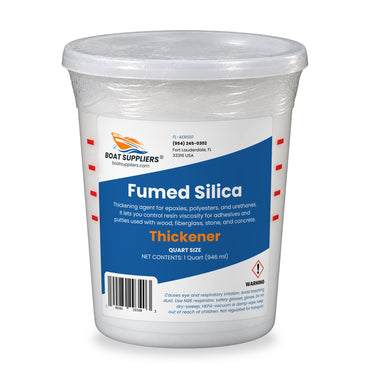
Fumed silica gives the mix body: loose Aerosil fumed silica stirred into mixed epoxy reaches mayonnaise at about 3/4 cup per cup of epoxy and peanut butter at about 1 cup per cup, and peanut butter, holding a peak, is the fillet consistency.
| Blend, per cup of mixed epoxy | Character | Use it for |
|---|---|---|
| 1 cup fumed silica | Hard, white, never sags, sands badly | Tack welds; bonding fillets that get fully taped |
| 1/2 cup silica, then cotton flock to peanut butter | Tough, fibrous, off-white, resists cracking under flex | Chine and keel fillets on skiffs that pound; bulkhead joints |
| 3/4 cup silica plus 1/4 cup milled fiber | Strongest gap-filling bond, smooth under the tool | Wide gaps between panels; transom and stem joints |
| West System 405 Filleting Blend to peanut butter | Brown, wood tone under varnish | Bright-finished kayak and canoe interiors |
| Microballoons | Light, soft, sands easy | Cosmetic fairing over a cured fillet, never the fillet itself |
Cotton Flock is the classic wooden boat glue filler: fine cotton fiber that grips into the plywood grain and gives the fillet some give, what a chine that slams needs. 1/32 in Milled Fiber is short E-glass; it blends smoother than flock and makes the highest-strength gap filler. West System 405 Filleting Blend Filler is for a varnished interior: mixed into 105 epoxy it finishes brown and disappears under the coating.
The Boat Suppliers Epoxy Resin Kit, Thick 1:1 is already high-build and non-sag at its 1:1 by volume mix, so it needs roughly half the silica to reach peanut butter. It will wet out 6 oz tape with a spreader rather than a pour and roll, so on a full hull we fillet with the thick kit and wet the tape with a thinner laminating epoxy. Pot life is on the kit's TDS; thickened epoxy in a cup kicks faster than the same batch spread thin, so mix 8 oz (240 ml) at a time and get it into the bag.
Laying epoxy fillets
- Tack weld first. With the panels wired, put a 1 in (25 mm) dab of thickened epoxy between every pair of stitches and let it cure hard, 6 to 8 hours at 70°F (21°C) with a medium hardener. Snip and pull the wires.
- Fill the gap. Where panels sit apart, push the milled fiber mix into the seam with a putty knife so the fillet is not bridging a void. Fill the wire holes with a Resin Dispensing Syringe of the same mix; the syringes also measure hardener by the mark.
- Pipe the bead. Load a zip bag, cut the corner to about 3/8 in, and run a bead down the seam a little bigger than the finished fillet, 4 to 6 ft (1.2 to 1.8 m) at a time.
- Tool it in one pass. Drag the radius tool along the seam at a steady angle. Scrape the ridges off both sides; anything left outside the tape line cracks later and has to be sanded off.
- Tape while green. Green is when the fillet is firm enough that the squeegee does not smear it but a gloved fingertip still sticks, usually 1 to 3 hours at 70°F depending on hardener. Lay dry tape into the fillet and wet it out from the center with a brush and squeegee, mat side down if it is 1708 tape. Miss the window and you let it cure, wash off the amine blush with water, sand 80 grit, and tape the next day.
Wear nitrile gloves, eye protection, and a fitted P100 with organic vapor cartridges when you sand cured epoxy inside a closed hull.
How much epoxy fillet mix
Figure about 1 fl oz (30 ml) of thickened mix per foot of 1/2 in fillet, and remember the silica adds volume: 1 cup of epoxy and 1 cup of silica gives about 1.3 cups of fillet. A 16 ft skiff with a keel seam, two chines and three bulkheads has roughly 60 ft (18 m) of inside fillet, call it 60 oz of mix from about 45 oz (1.3 L) of liquid epoxy, so the 2 Quart kit covers the fillets. Size the tape wet-out in the resin calculator.
We built a 15 ft garvey two winters ago on 9 mm okoume with 1/2 in fillets of silica and cotton flock and a single layer of 4 in 1708 tape inside. Two seasons of oyster bars and the chines have not opened. The one place we used pure silica, a bulkhead we taped late, has a hairline crack in the fillet. Fiber in the mix, tape it green.
Frequently asked questions
What is the best filler for epoxy fillets?
Fumed silica for body plus a structural fiber: 1/2 cup of silica per cup of mixed epoxy, then cotton flock to peanut butter, or 3/4 cup of silica with 1/4 cup of milled fiber for a wider gap. West System 405 Filleting Blend for a varnished interior. Never microballoons in a structural fillet.
How big should a stitch-and-glue fillet be?
Match the plywood: 3/8 in (10 mm) radius on 4 mm ply, 3/8 to 1/2 in on 6 mm, 1/2 in (12 mm) on 9 mm, and 3/4 in (19 mm) on 12 mm keel seams; your plans override these ranges. A bigger fillet is not stronger past that point, just heavier.
Do you tape over epoxy fillets while they are wet?
While green, not wet: 1 to 3 hours at 70°F (21°C), when the fillet holds its shape under the squeegee but is still tacky, which gives a chemical bond with no sanding. If it cures hard, wash off the amine blush with water, sand with 80 grit, and tape the next day.
Can I use polyester resin for stitch-and-glue fillets?
No. Polyester bonds poorly to plywood, shrinks as it cures, and cracks at the fillet under flex. Use epoxy for the fillets, the tape and the coating; a 16 ft skiff runs about 45 oz (1.3 L) of liquid epoxy in fillets alone.
What You Need For This Job
- Boat Suppliers Epoxy Resin Kit, Thick 1:1: no-sag 1:1 epoxy for the fillet mix
- Aerosil - Cabosil (Fumed Silica): the thixotrope that gives the fillet body
- Cotton Flock: the tough fiber for chine and keel fillets
- 1/32" Milled Fiber: the high-strength fiber for gap filling
- West System 405 Filleting Blend Filler: brown blend for bright-finished interiors
- Resin Dispensing Syringes: measure small hardener batches and fill wire holes