Soft Spot Boat Deck Repair: Replace Rotten Core Before Spring

29 October 2026
A soft spot boat deck repair is a core job, not a skin job. The deck flexes because the balsa or plywood under the top skin has gone to mush, and glassing over it hides the rot for one season. The fix is to cut the top skin, dig out every scrap of wet core, bed new core in silica-thickened resin, and lay a new skin of 1.5 oz chopped strand mat plus two plies of 1708 biaxial scarfed 12:1 onto the old laminate. On a 2 ft x 3 ft (60 x 90 cm) spot that is three weekends, and polyester needs 60°F (16°C) to cure, which is why it gets done in the fall.
Soft spot boat deck repair: confirm it is core rot before you cut
Tap around every place that gives underfoot with a plastic mallet: sound laminate knocks sharp, wet core thuds. Tape the edge of the dull zone; it is always bigger than the soft spot. For proof, drill a 3/16 in (5 mm) hole at the low point: dry tan shavings mean the deck is just thin, dark wet stringy wood means you are cutting. Find the leak too, almost always an unsealed hardware hole; fix the core without sealing it and you are back here in two years.
Top-cut or bottom-cut
| Approach | When | Cost |
|---|---|---|
| Cut the top skin | Almost always: no access below, or the top has non-skid you will redo anyway | You rebuild the finish: fair, gelcoat, non-skid |
| Cut the bottom skin | Open underside and a molded non-skid pattern you cannot match | Overhead layup; the core wants to fall out of every ply |
Set a circular saw to the top skin thickness, usually 1/8 to 3/16 in (3 to 5 mm), cut 2 in (50 mm) outside the tape line, and pry the skin up. Chisel and wire-wheel the cavity to clean inner skin with no dark wood left, then dry it: a fan and a week in a Florida garage, longer up north.
Which core goes back in
| Core | Water tolerance | Use it when |
|---|---|---|
| End-grain balsa | Rots again if the seal fails | Matching an original build and sealing every hole |
| PVC foam (Divinycell) | Will not rot | Most deck repairs; the default |
| Coosa Bluewater 26 board | Will not rot | Pads under cleats, stanchions and other torqued hardware |
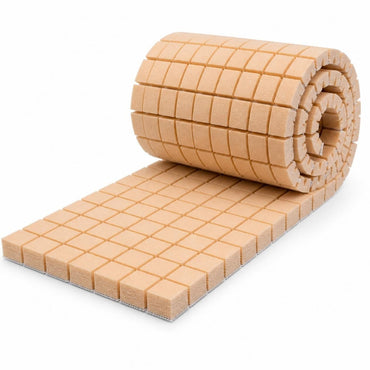
Match the original thickness, usually 1/2 or 3/4 in (12 or 19 mm). A crowned deck takes the Divinycell H Contoured PVC Foam Core, scored into small blocks on a glass scrim so it lies down on the crown; a flat sole takes the Divinycell H Plain PVC Foam Core panels. Where a cleat or stanchion bolts through, cut the foam back and set in a pad of Coosa Bluewater 26 Composite Board so the bolts bear on something that will not crush. Our Divinycell foam core guide covers contoured vs plain and which thickness. Cut the core to fit with a 1/8 in (3 mm) gap all round, bed it in laminating resin thickened with fumed silica to a mayonnaise consistency, fill the gap with the same putty, and weight it until it kicks. Drill every hardware hole through new core oversize, fill with thickened resin, and re-drill after cure; that seal is what keeps you from doing this twice.
The new skin: mat, then 1708, scarfed 12:1
Grind a 12:1 scarf around the cut: a 3/16 in skin needs a 2 1/4 in (57 mm) taper, and that taper is the joint. Fitted P100 with organic vapor cartridges, nitrile gloves and eye protection for the grinding and the styrene, then get to work.
Cut every piece dry. One ply of 1.5 oz chopped strand mat over the core and the scarf, then two plies of 1708 biaxial, each cut 1 in (25 mm) larger than the last so the stack steps out across the taper. Catalyze polyester laminating resin with MEKP at 1.5 percent by weight at 65 to 85°F (18 to 29°C), 2 percent at 60 to 65°F, 1 percent above 85°F; mix no more than you can lay in 15 minutes, and let the MEKP catalyst calculator give you the milliliters for the cup. Wet the mat until it goes translucent, add the 1708, wet through, and roll every ply until the white flecks are gone. Work wet on wet, stop at three or four plies a session, and let it cure overnight. The cured skin is about 1/8 in (3 mm) and stiffer than the deck around it.
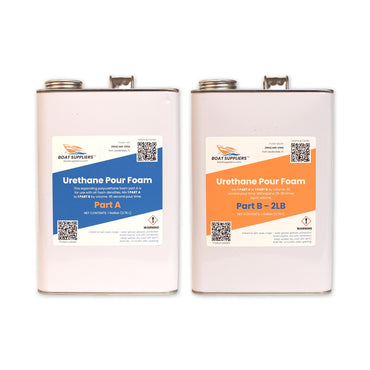
Figure a gallon of laminating resin for about 10 to 12 sq ft (1 m²) of mat plus two plies of 1708, core bed included. A 2 x 3 ft spot with its tapers is nearer 16 sq ft, so have a second gallon on hand; the resin calculator sizes it for your cut. For a spot that size the Boat Fiberglass Repair Kit is the whole list: a gallon of 435 marine-grade polyester layup resin with MEKP, 3 yards of 50 in 1708 biaxial, 3 yards of 1.5 oz chopped strand mat, a quart of fumed silica and the laminating roller. For a hardware-hole repair the size of a dinner plate, the Fiberglass Repair Kit with a quart of the same resin, mat and 6 oz cloth covers it.
Fair, then put the non-skid back
Knock the high spots down with 36 grit, fill with silica-thickened resin slightly proud, and sand fair with 80 then 120. A smooth deck gets two coats of gelcoat tinted to the old color, matched against the boat in daylight. A non-skid deck gets gelcoat with grit stirred in: Non-Skid Additive For Gelcoats & Paints in the final coat of the Pure White Gelcoat Finish Kit, which comes with surfacing wax so the last coat cures tack-free. Catalyze it like the resin and brush two coats 30 to 45 minutes apart. For a cream or off-white deck, the Gelcoat Repair Kit pairs pure white gelcoat and surfacing wax with yellow and black tinting pigments: yellow warms the white toward cream, black cools it toward grey. Tint a test batch and let it cure before you judge the color.
The calendar
Polyester will not cure reliably below 60°F (16°C) and the cavity has to be dry first. Count back from spring: a week to dry, a day to bed core, a day for the skin, a day to fair, a day for gelcoat, a week before you walk on fresh grit. Cut in October and it is done by Thanksgiving.
Frequently asked questions
Can I fix a soft boat deck without replacing the core?
Not for long. Injecting epoxy into wet balsa bonds to nothing and the deck goes soft again within a season. The one exception is a small dry-rot pocket under a hardware hole, where drilling a grid of 1/4 in (6 mm) holes and filling with thin epoxy can work. Anything you can feel flex underfoot gets the top skin cut and the core replaced.
What is the best core for a boat deck repair?
PVC foam for most decks. It will not rot if the seal fails again, it beds flat in silica-thickened resin, and it matches the stiffness of 1/2 in (12 mm) balsa closely enough. Set pads of Coosa Bluewater 26 under cleats, stanchions and other hardware that gets torqued down. Go back to end-grain balsa only if you are matching an original build and will seal every hole.
How much MEKP for polyester deck resin?
1.5 percent by weight at 65 to 85°F (18 to 29°C), which is 14 mL in a quart. Drop to 1 percent above 85°F and go to 2 percent between 60 and 65°F. Below 60°F, wait for warmer weather or heat the space; under-catalyzed polyester stays gummy for good. Mix 8 to 16 oz at a time and lay it in 15 minutes.
How do I get non-skid back on a repaired deck?
Stir non-skid grit into the final coat of waxed gelcoat and brush or roll it on. Medium grit matches most production decks, fine suits a cockpit sole you walk barefoot, and coarse belongs on a work deck or swim platform. Catalyze it like the resin, lay two coats 30 to 45 minutes apart so the wax only sits in the last one, and give it a week before hard use.
What You Need For This Job
- Boat Fiberglass Repair Kit: gallon of laminating resin, MEKP, 1708, mat, fumed silica and roller for a 2 x 3 ft deck spot
- Divinycell H Contoured PVC Foam Core: the new core, scored to lie down on a crowned deck
- Coosa Bluewater 26 Composite Board: pads under cleats and stanchions
- Non-Skid Additive For Gelcoats & Paints: grit for the walking surface
- Gelcoat Repair Kit: white gelcoat, wax and tints to match an off-white deck