


SKU:FOAM-0204
13 in stock
Couldn't load pickup availability
Order several sizes at once density by kit size, one add to cart
| Density | 2 Quart Kit | 2 Gallon Kit |
|---|---|---|
| 2 LB | ||
| 4 LB | ||
| 8 LB | ||
| 16 LB |
Urethane Pour Foam is a two-part rigid foam that expands and resists water. It can be layered and bonded well, and works best between 75°F and 80°F. Once cured, it can be coated with various resins without damage. It’s ideal for filling gaps, insulation, flotation, and support. For best results, measure and mix carefully, and use within three months.
Specs
| Type | two-part closed-cell rigid polyurethane foam |
|---|---|
| Mix ratio | 1:1 by volume |
| Densities | 2, 4, 8 and 16 lb/cu ft |
| Kits | 2 quart, 2 gallon |
| Working time | approx 45 seconds after mixing |
| Rise and set | full expansion in 5 min; initial set 15 min; full cure 1 hr |
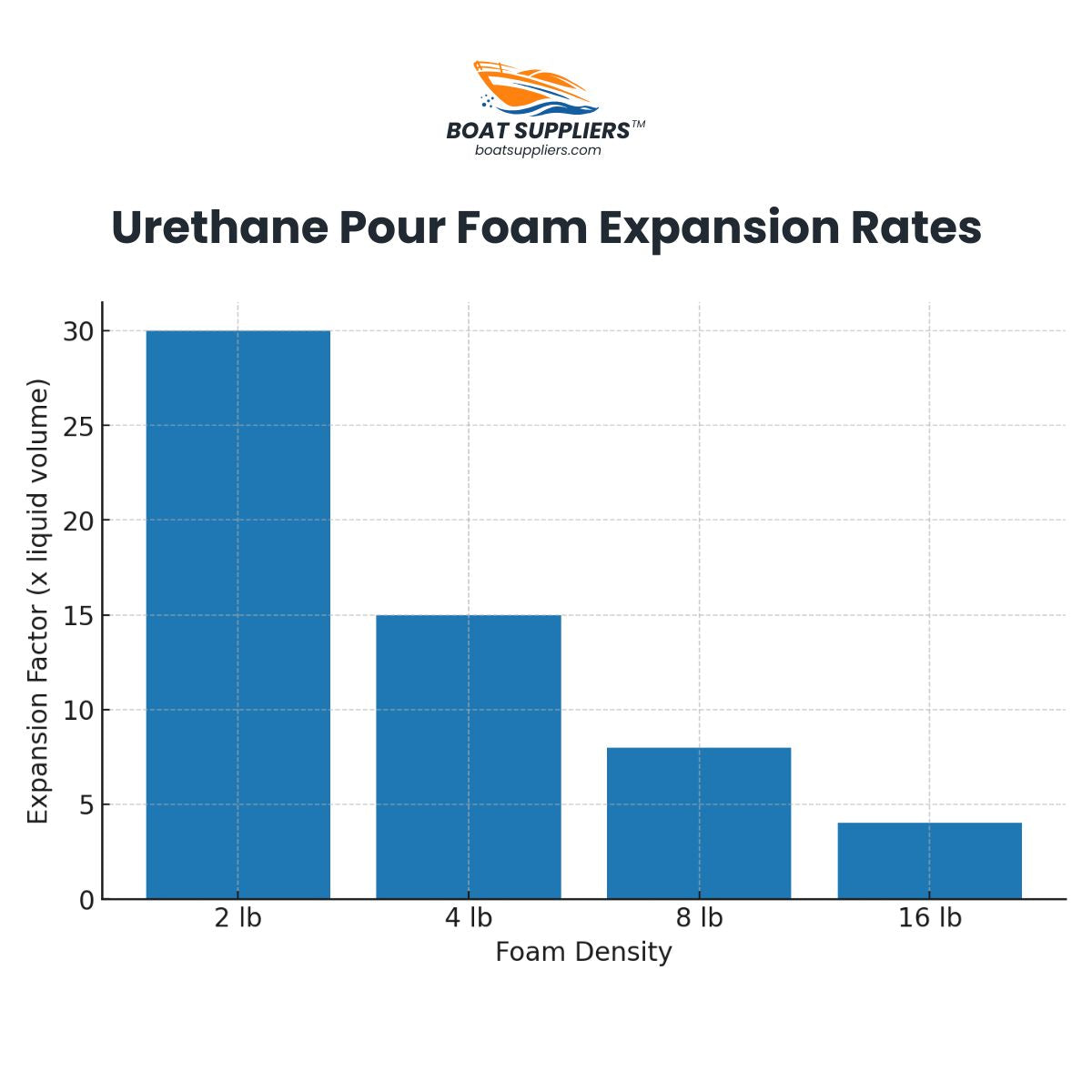
| Expansion | 2 lb foam 20 to 25x liquid volume, approx 60 lb buoyancy per cu ft |
| Application temp | 75 to 85°F |
Pick the density by the job. 2 lb is flotation: pontoons, under-deck and bilge voids where the foam only has to displace water. 4 lb carries load, under decks and around tanks. 8 and 16 lb expand less and cure dense enough to carve and shape for backing blocks and high-strength fills. Pour big cavities in lifts; the 2 quart kit is the small-void size, the 2 gallon kit does a hull. Replacing soaked flotation at haul-out? Start with the pour foam guide; all densities and kits are in pour foam.
Specifications
Includes
Features



What is expanding urethane pour foam?
Can urethane pour foam be sprayed?
Can I use expanding foam in cold weather?
Which foam density should I use for flotation in a boat?
How much time do I have to pour the foam after mixing?
Can I pour the foam in layers for large cavities?
How do I calculate how much foam I need?
Is the foam solvent-resistant?
Can I use a mold, and how do I release the foam?
Can I use urethane pour foam to fill a pontoon or pipe?
How do I use 2-part pour foam for flotation?
What density of pour foam do I need: 2 lb, 4 lb, 8 lb, or 16 lb?
How much does 2-part pour foam expand?
Blog posts

Best Fiberglass Cutting Tools for Clean Edges...
Best Fiberglass Cutting Tools for Clean Edges...

Kevlar Fabric for Boats: A Fabricator's Guide...
Kevlar Fabric for Boats: A Fabricator's Guide...
