


Boat Fiberglass Repair Kit - Professional Grade with Gallon Resin & Roller
Boat Fiberglass Repair Kit - Professional Grade with Gallon Resin & Roller
Share
SKU:SK-BOA001
20 in stock
Couldn't load pickup availability
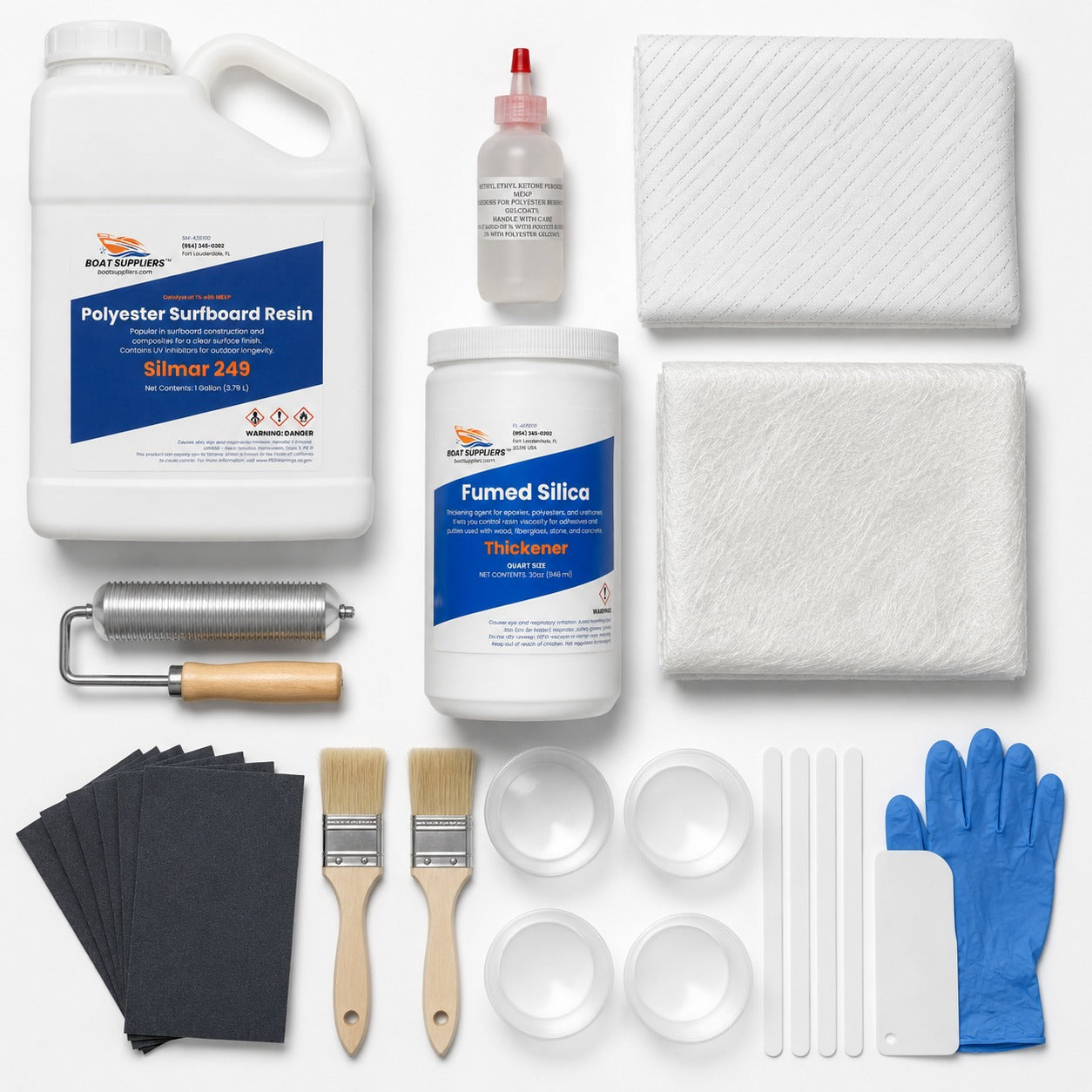
The full boatyard materials list for real hull and deck repairs, in one box. A full gallon of laminating resin, the same 1708 biaxial fabric shops lay up transoms and stringers with, mat for quick buildup, and the roller that separates a solid laminate from a bubbled one. This is the kit for holes, soft decks, cracked stringers, and repairs bigger than a patch.
What is in the kit:
- 1 Gallon Silmar 249 clear polyester laminating resin
- MEKP hardener (catalyzes the full gallon)
- 3 yards x 50" of 1708 biaxial fiberglass
- 3 yards x 38" of 1.5oz chopped strand mat
- 1 Quart fumed silica thickener for putty and fillets
- Fiberglass laminating roller for driving out air between layers
- Prep & Fair wet/dry sandpaper 6-pack (120 through 400)
- 2 chip brushes, 4 mixing cups, 4 mixing sticks, plastic spreader, nitrile gloves
How the repair works: grind the damage back to solid glass with a 12:1 bevel, laminate alternating layers of mat and 1708, rolling air out of every layer, then fair with silica-thickened resin and sand through the included grits. Finish with gelcoat or paint to match your hull (see our Pure White Gelcoat and pigments).
Enough material for several square feet of multi-layer structural laminate. Not for polyethylene (rotomolded) hulls.
Specifications

How to use this kit
Hull and deck repair with 1708 biaxial, gallon resin and a laminating roller. Every kit ships with this same sheet printed and in the box.
What is in the kit
- 1 gal Silmar 249 polyester laminating resinenough for several square feet of multi-layer laminate
- 1 MEKP hardenercatalyzes the full gallon
- 3 yd 1708 biaxial fiberglass, 50 in widethe structural fabric for real strength
- 3 yd 1.5 oz chopped strand mat, 38 in widefirst layer and buildup between 1708
- 1 qt Fumed silica thickenerputty, fillets and fairing
- 1 Fiberglass laminating rollerdrives air out between layers
- 6 Prep & Fair wet/dry sandpaper120 / 150 / 180 / 240 / 320 / 400 grit
- 2 / 4 / 4 Chip brushes, mixing cups, mixing sticks
- 1 / 1 pr Plastic spreader, nitrile gloves
You supply: acetone, an angle grinder with 24 to 36 grit, a respirator, masking tape and plastic sheet.
Mixing MEKP (1.5 percent)
| 8 oz mix | 3.6 mL MEKP (about 3/4 tsp) |
| 16 oz mix | 7 mL MEKP (about 1.5 tsp) |
| 32 oz mix | 14 mL MEKP (about 3 tsp) |
That is 1.5 percent for 65 to 85 F. Above 85 F drop to 1 percent; at 60 to 65 F go to 2 percent. Quick field rule: 10 drops per ounce.
Never mix more than you can lay up in 15 minutes. A full gallon at once will boil in the bucket.
The job, start to finish
Grind the bevel
Cut out anything soft or delaminated until you reach solid glass. Grind a 12 to 1 bevel around the hole: a half inch thick skin needs a 6 inch taper. That taper is what carries the load, so do not shortcut it. Wipe with acetone and mask off.
Cut your stack
Cut every piece dry before you mix. Smallest goes in first at the bottom of the bevel, each following piece about an inch larger, so the stack steps out to the full taper. Alternate mat and 1708, with mat against the old laminate.
Laminate
Wet the bevel with catalyzed resin, lay in mat, and stipple until it goes translucent. Add 1708 and wet it out. Work wet on wet, do not wait for a layer to cure between plies, and stop at about 4 layers per session so the heat does not run away.
Roll out the air
This is the step that separates a solid laminate from a bubbled one. Run the laminating roller firmly in both directions over every layer until you stop seeing white flecks. White means dry glass or trapped air, and both are weak spots you cannot fix later.
Fair and finish
Once hard, knock down the high spots, then fill with silica-thickened resin slightly proud. Sand fair with 120 through 400. Finish with gelcoat or paint matched to the hull. Below the waterline, follow with barrier coat and bottom paint.
If something goes wrong
White flecks in the layup
Dry glass or trapped air. Roll it out while the resin is still wet; once cured it has to be ground out.
Laminate feels tacky
Normal. Clear laminating resin stays tacky on top so the next layer bonds to it.
The bucket got hot fast
Too big a batch or too much MEKP. Pour it out thin outdoors and mix smaller.
Repair cracked again
The bevel was too steep or too few layers. A structural repair needs to match the original skin thickness.
Resin ran off vertical
Thicken it with a little fumed silica, or laminate in smaller sections.
No topcoat is included. Pure White Gelcoat, tints, barrier coat and bottom paint are all at boatsuppliers.com.
Blog posts

Best Fiberglass Cutting Tools for Clean Edges...
Best Fiberglass Cutting Tools for Clean Edges...

Kevlar Fabric for Boats: A Fabricator's Guide...
Kevlar Fabric for Boats: A Fabricator's Guide...
