Divinycell Foam Core: Contoured vs Plain Sheets and Which Thickness

22 October 2026
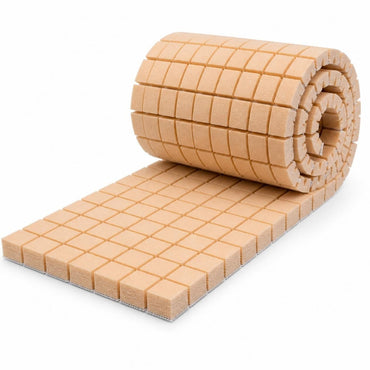
Divinycell is closed cell PVC foam core, and PVC foam and end-grain balsa are the two cores you find inside most cored decks, cockpit soles and hull panels. Ordering it comes down to two choices. Contoured or plain: contoured sheets are scored into small blocks on a fiberglass scrim so they lie down on a crowned deck or a curved hull side, and plain sheets are rigid boards for flat panels. Thickness: match the core you cut out, which on most small boat decks is 1/2 in and on larger decks and soles 3/4 in. Get those two right and the rest is bedding and skinning.
What the H number means
Divinycell H is the general purpose marine series, and the number after the H is the density in kilograms per cubic meter. Higher density means more compressive and shear strength, more weight and more cost.
| Grade | Density | Where it goes |
|---|---|---|
| H60 | 60 kg/m³ (about 3.75 lb/ft³) | Light panels, hatch lids, interior joinery |
| H80 | 80 kg/m³ (about 5 lb/ft³) | The standard deck, sole and hull core |
| H100 | 100 kg/m³ (about 6.2 lb/ft³) | Decks and soles that take heavier traffic |
| H130 | 130 kg/m³ (about 8.1 lb/ft³) | High load areas, bottom panels on fast boats |
| H200 | 200 kg/m³ (about 12.5 lb/ft³) | Inserts under hardware and other point loads |
For a deck or sole repair, H80 is the grade that matches what most builders laid down, and a 3/4 in 4 x 8 ft sheet of it weighs about 10 lb. That weight is the reason to use foam: the same sheet of marine plywood is about 70 lb.
Contoured vs plain Divinycell
| Contoured (scored on scrim) | Plain sheet | |
|---|---|---|
| Shape | Bends to a crown or a curve with no heat | Rigid and flat; heat forms to gentle curves |
| Resin | More: every kerf fills with bedding putty | Less: only the faces wet out |
| Best for | Crowned decks, hull sides, curved hatches and cabin tops | Flat soles, bulkheads, hatch lids, stiffeners |
| What we carry | 32 x 48 in sheet: 3, 4 and 5 mm; 1/2, 3/4 and 1 in | 2 x 4 ft panels, or a full sheet as four panels: 1/8, 1/4, 1/2, 3/4 and 1 in |
A contoured sheet is cut almost through into a grid of small squares, roughly an inch on a side, with a light glass scrim holding the blocks together. It drapes over a crown the way the original core did, and the kerfs fill with putty as you bed it, which locks the blocks together and ties the core to the skin. The price of that is resin: plan on more bedding putty than a plain sheet takes, and fill any kerfs that open on the top face before you skin it.
A plain sheet is the better core for anything flat, because it takes less resin and gives a fair surface to skin. It also heat forms: H80 softens at about 212°F (100°C), and a form made 5 to 10 percent tighter than the finished curve allows for springback. For anything with real curvature, contoured is the easier route.
Both come from us in parcel sizes. The Divinycell H Contoured PVC Foam Core is the standard 32 x 48 in scored sheet, and the Divinycell H Plain PVC Foam Core comes as 2 x 4 ft panels, or a full 4 x 8 ft sheet cut into four panels, so it ships in a normal box instead of on a truck.
Which thickness
| Thickness | Typical job |
|---|---|
| 3 to 5 mm contoured, 1/8 in plain | Thin skins, kayak and small craft panels, stiffening a flat laminate |
| 1/4 in | Hatch lids, locker doors, light interior panels |
| 1/2 in | Most decks and cockpit soles on boats under about 25 ft |
| 3/4 in | Larger decks, soles with wide spans, bulkheads |
| 1 in | Heavy soles, bulkheads and panels that span a long way unsupported |
On a repair, the old core decides it. Cut the top skin, pull a clean piece of the original core from the edge of the cutout, and measure it with calipers. Do not go thinner to save resin; the stiffness of a cored panel climbs with the square of the core thickness, so 1/2 in in place of 3/4 in gives you a much softer deck.
Divinycell vs Coosa
Both get called core, and they do different jobs.
| Divinycell H80 | Coosa Bluewater 26 | |
|---|---|---|
| What it is | PVC foam core for a sandwich panel | Glass reinforced polyurethane foam board |
| Density | About 5 lb/ft³ | 26 lb/ft³ |
| 3/4 in 4 x 8 ft sheet | About 10 lb | About 52 lb |
| Stiff on its own | No: it needs a glass skin on both sides | Yes: it is a board |
| Bolt and screw loads | Crushes; needs a dense insert at every fastener | Takes screws and through-bolts with an epoxy sleeve |
| Follows a curve | Contoured sheet does | No |
| Best for | Decks, soles, hull panels, hatch lids | Transoms, stringers, floors, backing pads |
The two work together. Re-core a deck with contoured Divinycell and set pads of Coosa Bluewater 26 Composite Board into the core wherever a cleat, stanchion base or rod holder will bolt through. The foam keeps the deck light, the pads take the bolt loads, and neither one rots. Our Coosa board guide covers the grades and sheet weights. A transom is Coosa or plywood work; standard 5 lb foam lacks the crush strength for engine bolts.
Bedding and skinning foam core
- Prep: grind the inner skin to clean, sound laminate with 36 grit and vacuum it. Scuff the foam faces lightly with 80 grit and blow them off. Wear a fitted P100 respirator with organic vapor cartridges, nitrile gloves and eye protection for the grinding and the resin work.
- Fit: cut plain sheet with a fine tooth saw, or a sharp utility knife on the thin sheets; split contoured sheet along a kerf with a knife through the scrim. Leave a 1/8 in (3 mm) gap at the edges for the putty.
- Bed: mix laminating resin with Aerosil - Cabosil (Fumed Silica) and Phenolic Microballoons to a mayonnaise that will not run. Trowel it onto the skin, press the core in, and weight it evenly with sandbags or a vacuum bag until putty shows in the kerfs and at every edge. Fill the edge gaps and any open kerfs with the same putty.
- Skin: once the bed has kicked, lay the new skin: on a deck, a ply of 1.5 oz chopped strand mat and two plies of 1708 Biaxial Fiberglass, mat side down, lapping onto the old laminate with a 12:1 scarf. Figure about 4 oz of resin per square foot per ply of 1708 by hand; the resin calculator sizes the job.
- Hardware: at every fastener, cut the foam back and set a dense insert or a Coosa pad in thickened resin before you skin, then drill the finished deck oversize, fill with thickened resin and redrill.
Divinycell H is styrene resistant, so it runs with polyester and vinyl ester as well as epoxy. On a deck re-core where the skins are polyester, Marine-Grade Polyester Layup Resin at about 1.25 percent MEKP does the bedding and the skins in one system. Where the new skin bonds onto old, cured laminate around the cutout, epoxy gives the stronger secondary bond; pick one resin for the whole job and do not lay polyester over cured epoxy.
Our foam core vs wood core comparison covers when balsa or plywood still makes sense.
Frequently asked questions
What is Divinycell foam?
Divinycell is a closed cell PVC foam core made by Diab and used as the middle of a fiberglass sandwich panel in decks, soles, hulls and hatches. The H series number is its density in kg per cubic meter: H80 is 80 kg/m³, about 5 lb per cubic foot, the standard grade for deck and hull work. It does not rot and takes on very little water.
Should I use contoured or plain Divinycell for a boat deck?
Contoured for almost every deck, because decks have a crown and the scored sheet lies down on it without heat or kerfing. Use plain sheet on flat work: cockpit soles, bulkheads, hatch lids and stiffeners. Contoured takes more bedding putty because the kerfs fill, so mix extra and fill any kerfs that open on the top face before you skin it.
What thickness of foam core for a boat deck?
Match the original core, measured with calipers at the edge of your cutout. On most decks under about 25 ft that is 1/2 in, and on larger decks and wide soles 3/4 in. Do not go thinner to save money: stiffness rises with the square of the core thickness, so a 1/2 in core in place of 3/4 in leaves a noticeably softer deck.
Can you use polyester resin with Divinycell?
Yes. Divinycell H is styrene resistant, so it bonds with polyester, vinyl ester and epoxy. Bed it in resin thickened with fumed silica and microballoons, and lay the skins in the same resin. Use epoxy where the new skin has to bond to old, cured laminate around a repair, since epoxy makes the stronger secondary bond, and never lay polyester over cured epoxy.
Is Divinycell better than Coosa board?
They do different jobs. Divinycell H80 weighs about 10 lb per 3/4 in 4 x 8 ft sheet and needs a glass skin on both sides; it is the core for decks, soles and hull panels. Coosa Bluewater 26 weighs about 52 lb, is stiff on its own and takes bolts, so it belongs in transoms, stringers and backing pads. Many re-cores use both: foam in the field, Coosa under hardware.
What You Need For This Job
- Divinycell H Contoured PVC Foam Core: scored sheet for crowned decks and curved panels
- Divinycell H Plain PVC Foam Core: rigid panels for soles, bulkheads and hatch lids
- Coosa Bluewater 26 Composite Board: hardware pads set into the foam
- 1708 Biaxial Fiberglass: the new skin over the core
- Aerosil - Cabosil (Fumed Silica): thickens the bedding putty
- Phenolic Microballoons: lightens the bedding putty and fills kerfs
Prev post

What Is Coosa Board? Bluewater 26 vs Nautical 15, Weights and Sizes
Updated on 22 October 2026
Next post

Winter Boat Storage: Indoor, Outdoor, or Shrink Wrap for Gelcoat
Updated on 22 October 2026