Gelcoat Color Matching: Tinting a Neutral Base to an Aged Hull

16 November 2026
Gelcoat color matching starts with one decision: do not start from white. A hull that has spent ten summers outside is not white anymore. It is cream, oyster, almond or sand, and a patch shot from a pure white can reads as a bright square from thirty feet away. The fix is a neutral tintable base, a gram scale, and pigment added a drop at a time until a cured test chip disappears against a compounded spot on the hull. Here is the procedure, the starting recipes, and the test that tells you when to stop.
Why a fresh white patch never matches an aged hull
Three things drift on an old hull. Sun pushes white gelcoat toward yellow, so the panel is warmer than it was on the showroom floor. Oxidation chalks the surface, which reads lighter and flatter than the color underneath. And the original color was rarely a pure white to begin with; most builders shoot an off-white with a touch of yellow or brown already in it. Any white you buy in a can is bluer, brighter and cleaner than all three. You can compound the chalk off the hull, but you cannot compound the yellow out, so the patch has to meet the hull where it is.
That is why the base for a match is neutral, not white. Neutral gelcoat cures translucent with no color bias, so every part of the final color comes from what you add. White goes in first because it carries the hiding power; the other colors ride on top of it in trace amounts.
Set up the match: scale, batch size, light
Mix by weight on a gram scale that reads to 0.1 g. Drops are fine while you are hunting, but a match you cannot repeat is worthless when you shoot the second coat tomorrow. Work in 100 g test batches of uncatalyzed base, write down every addition, and scale the final recipe up to the job. Pigment loading stays low: most aged-white matches land between 1 and 3 percent pigment by weight, and you do not want to pass about 5 percent total or the gelcoat cures soft and chalks early. Check the pigment TDS for the hard cap on the dispersion you are using.
Judge color in daylight, out of direct sun, with the test chip held flat against a spot on the hull you have wet sanded with 600 grit and compounded. Shop fluorescents shift whites toward green and LEDs push them blue, so a match made under the lights is usually a miss outside. Judge it cured, not wet; gelcoat shifts as it goes off and again after sanding and buffing.
Gelcoat color matching order: white, yellow, brown, then a trace of black
| Color | What it does to a white | Amount per 100 g of base |
|---|---|---|
| White | Hiding power and the bulk of the color | Add until a wet smear on black tape is opaque |
| Maize yellow | Sun-aged cream, ivory, lemon whites | 1 to 3 drops |
| Colonial brown | Oyster, almond, sand; warms and dulls in one move | 1 to 3 drops |
| Autumn (rust red) | Pinks an almond, warms a salmon white | A toothpick tip, not a drop |
| Black | Kills brightness, grays a chalky white | A toothpick tip, not a drop |
White first, to opacity. Then yellow, then brown, mixing fully after each addition, because a streaky cup reads as the wrong color. Black and red never come out of the bottle as a drop: one drop of black in 100 g moves a white a full shade, and the only way back is to double the batch. Dip a toothpick, wipe most of it on the rim, stir in what is left, look again.
| Hull color | Start with (per 100 g opaque white base) | If it is off |
|---|---|---|
| Sun-yellowed white | 1 drop yellow | Toothpick of brown if it reads lemon |
| Cream or ivory | 2 drops yellow, toothpick of brown | More white if too saturated |
| Oyster | 1 drop yellow, 1 drop brown | Toothpick of black if too warm |
| Almond | 2 drops yellow, 1 drop brown, toothpick of autumn | Yellow if it goes pink |
| Sand or beige | 2 drops brown, 1 drop yellow | Black toothpick to dull it |
| Chalky gray white | Toothpick of black, half drop yellow | White if it goes muddy |
These are starting points. Plan on two rounds, and stop when you cannot find the chip against the compounded panel at arm's length.
The test chip that settles it
Pull 10 g from the test batch and catalyze it at 2 percent MEKP at 77°F (25°C), which is 0.2 g on the scale. Spread it on a scrap of waxed glass or the back of packing tape at about 20 mil and let it cure hard, an hour or two at shop temperature. Wet sand it with 600, compound it, and hold it against the hull in daylight. Too bright: a toothpick of brown or black. Too yellow: a touch of white. Too pink: yellow. Write down what fixed it, because that correction scales with the batch.
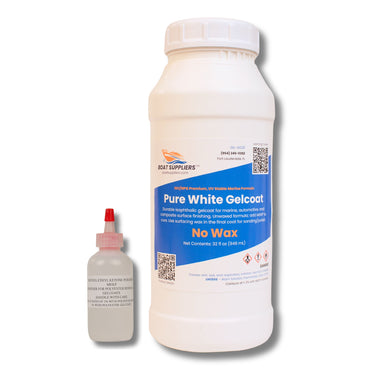
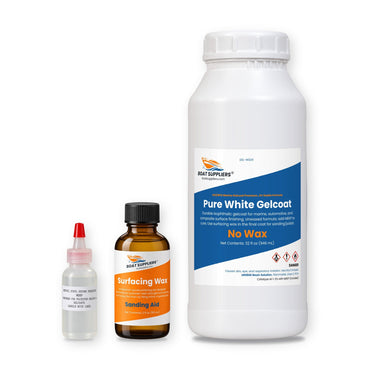
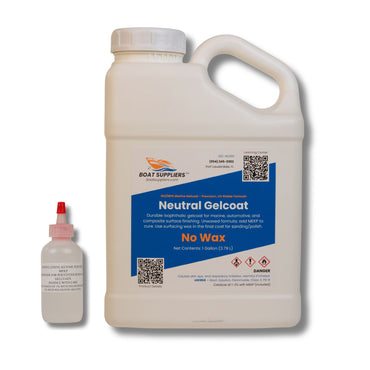
For a first job, start from Neutral Gelcoat with Hardener - No Wax, the tintable base: it cures neutral and translucent and ships with MEKP in quart, gallon and 5 gallon. The Boat Suppliers Opaque Liquid Pigment Sampler Pack - 14 Colors puts all 14 of our opaque colors in 1 oz bottles, white, the yellows, Colonial Brown, Autumn and Carbon Black included, which is more pigment than a season of hull repairs uses. The two colors you will actually burn through on aged whites are yellow and brown, so keep a 1 oz bottle each of Maize Yellow and Colonial Brown from the Liquid Colored Pigments line on the shelf. A 1 oz bottle of black lasts for years at toothpick doses.
Shooting the matched color
Scale the recipe by weight, mix the full batch uncatalyzed until streak-free, and pull one more chip before you catalyze anything, because a scaled batch can drift. Catalyze at 2 percent at 77°F, plus or minus 0.03 percent per degree, held between 1.5 and 2.5 percent. Brush or spray 15 to 20 mil in two coats; a Preval or touch-up gun wants the gelcoat thinned about 5 percent with styrene, never acetone. Neutral base is unwaxed, so either mist PVA over the final coat once it gels or stir surfacing wax into the last cup only. Wet sand 320, 600, 1000, then compound, feathering 1 to 2 in past the repair so the transition is a gradient and not a line. Use the gelcoat calculator to size the batch for the area.
Wear a fitted P100 respirator with organic vapor cartridges, nitrile gloves and eye protection while mixing and shooting; styrene and MEKP both earn it.
Frequently asked questions
Can you color match gelcoat starting from a white can?
You can pull a factory white toward cream or oyster with yellow and brown, but you cannot take the blue brightness out of it, and you get there at a pigment load past 5 percent that softens the cure. Start from a neutral base instead, add white to opacity, then tint. The match lands at 1 to 3 percent pigment and cures like the gelcoat should.
How much pigment can you add to gelcoat?
Most aged-white matches use 1 to 3 percent pigment by weight, counting the white. Stay under about 5 percent total; past that the film cures soft, chalks early and loses gloss. Concentrated dispersions get there fast, which is why yellow and brown go in by the drop and black and red go in on a toothpick. Check the pigment TDS for the exact ceiling.
Why does my gelcoat patch look different after it cures?
Gelcoat shifts slightly as it cures and again once it is sanded and compounded, and the hull next to it is chalked and reads lighter than its real color. Compound a test spot on the hull with 600 grit and polish, catalyze a 10 g chip at 2 percent MEKP, cure it hard, sand and buff it, and compare those two in daylight. Never judge wet gelcoat against a chalky panel.
Does the gelcoat match have to be exact?
Close beats exact if the edge is right. A match one shade off with a 1 to 2 in feathered, compounded edge vanishes from ten feet; a perfect match with a hard edge shows from anywhere. Get within one round of the test chip, then spend the extra time on wet sanding through 1000 grit and compounding the transition.
What You Need For This Job
- Neutral Gelcoat with Hardener - No Wax: the tintable base for a match, with MEKP in the box
- Boat Suppliers Opaque Liquid Pigment Sampler Pack - 14 Colors: every opaque color in 1 oz bottles for a first match
- Liquid Colored Pigments: Maize Yellow, Colonial Brown, Carbon Black and Autumn by the bottle once the recipe is set
Prev post

Carbon Fiber Sheets: Buy a Cured Panel or Lay Up Your Own?
Updated on 17 November 2026
Next post

Breather Cloth: 4oz vs 7oz and How Much to Buy
Updated on 14 November 2026