
Thin Epoxy Resin
600 cps


600 cps
SKU:EPOX-635T008
In stock
Couldn't load pickup availability
Shipping cost shows at checkout.
Key Specs
- Mix Ratio
- 2:1 / 3:1 / 4:1 by volume with the matching BS hardener
- Viscosity
- 600 cps - thin, syrup-like for fast wet-out
- Max Service Temp
- 150-195°F
- Works With (Fabrics)
- Fiberglass, carbon fiber, Kevlar, 1708/1208 biaxial (CSM: stitched only)
- Resin Type
- Epoxy - thin laminating resin (resin side only)
- Cured Color
- Semi-clear
Thin epoxy resin at 600 cps is for wetting out glass, carbon fiber and Kevlar® laminates and for sealing wood, sold as the resin side only. It flows like syrup, so it soaks through heavy stitched cloth such as 1708 and into the end grain of a soft transom or stringer instead of sitting on top.
Pick the hardener for the cure speed
Three ratios, all by volume: 2:1 is slow, 3:1 is medium and 4:1 is fast. Use the matching epoxy hardener for the ratio you choose. MEKP will not cure epoxy, so never reach for it here. Build in applications of about 1/4 in or less.
Bonding, fillers and sun
Once the surface is scuff sanded and clean, it will bond to wood, metal and cured polyester, gelcoat or epoxy. Epoxy goes over polyester; polyester laid over cured epoxy will not bond. Stir in cotton flock, milled fiber, chopped strand, fumed silica, Q-cells, microballoons or glass bubbles to make fillet and fairing mixes. There is no UV inhibitor, so topcoat any part that sits in the sun.
- thin laminating epoxy, resin only
- Viscosity: 600 cps
- Cures semi-clear
- Maximum service temperature: 150 to 195°F
- Reinforcements: fiberglass, carbon fiber, Kevlar®, 1708 and 1208 biaxial; mat must be stitched
- Sizes: 8 oz, 16 oz, 32 oz quart, 64 oz half gallon, 128 oz gallon
Work out how much resin a layup needs with the resin calculator.


Technical Specifications
Compare Resins
| Product | 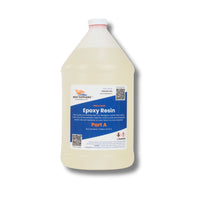 Thin Epoxy ResinYou're viewingfrom $9.98 | 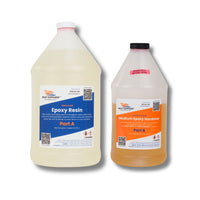 Boat Suppliers Epoxy Resin Kit – Thin, Clear, with Hardenerfrom $31.95 | 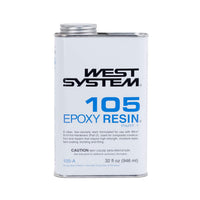 West System 105 Epoxy Resinfrom $59.51 | 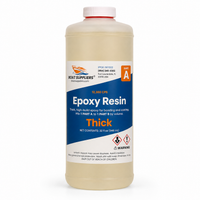 Thick Epoxy Resinfrom $9.98 |
|---|---|---|---|---|
| Type | Epoxy - thin laminating resin (resin side only) | Epoxy - low-viscosity laminating system | Epoxy - base resin for WEST SYSTEM 200-series hardeners | Epoxy - thick bonding & coating resin (no-sag), resin only |
| Mix Ratio | 2:1 / 3:1 / 4:1 by volume with the matching BS hardener | 2:1, 3:1, or 4:1 by volume (match your hardener) | 5:1 by volume with 205/206; 3:1 with 207/209 (300 Mini Pumps meter it) | 1:1 with Thick Hardener; also runs 2:1 Slow or 4:1 Fast for cure-speed control |
| Viscosity | 600 cps - thin, syrup-like for fast wet-out | 600 cps resin - thin, syrup-like for fast wet-out | Mixed @ 72°F: 975 cps (205) / 725 cps (206) / 760 cps (207) | Very thick - high build, no sag on vertical surfaces |
| Pot Life | — | 35-40 min (2:1) / 20-25 min (3:1) / 15 min (4:1) @ 80°F | 9-12 min (205) / 20-25 min (206) / 20-26 min (207), 100 g @ 72°F | 30-35 min @ 80°F with the 1:1 hardener |
| Full Cure | — | Sandable in 24-28 hr (2:1) / 8-10 hr (3:1) / 3-4 hr (4:1); full cure 1-5 days after | Solid in 6-8 hr (205) to 10-15 hr (206/207); working strength 1-4 days | — |
| Cured Color | Semi-clear | Semi-clear - hardener has an amber tint, dries clear in thin coats | Clear/amber; exceptionally clear with 207 | — |
| Max Temp | 150-195°F | 150-195°F | HDT 117-123°F by hardener | — |
| UV | No UV inhibitor - topcoat for sun exposure | No UV inhibitor - topcoat for sun exposure | Pair with 207 + UV varnish for bright finishes | Not UV-stable - topcoat for sun exposure |
| Fabrics | Fiberglass, carbon fiber, Kevlar, 1708/1208 biaxial (CSM: stitched only) | Fiberglass, carbon fiber, Kevlar, 1708/1208 biaxial (CSM: stitched only) | Fiberglass, carbon fiber, Kevlar, 1708/1208 biaxial (CSM: stitched only) | None - NOT for wetting out fiberglass, carbon, or Kevlar; use Thin Epoxy Resin for laminating |
| Best For | Lamination & wet-out, wood sealing | Lamination & wet-out, wood sealing, all-around marine repair | Premium marine coating, bonding & repair | Bonding, fillets & high-build coats - buy ala carte to match your hardener stock |
| View | View | View |
What’s the difference between epoxy and polyester resin?
How do I mix epoxy resin and hardener properly?
Why are there different epoxy mix ratios like 5:1, 4:1, 3:1, and 2:1?
What is amine blush and how do I remove it?
What's the difference between fast and slow epoxy hardener?
Can I apply epoxy resin in cold weather?
How do I thin epoxy resin?
Can I tint or color epoxy resin?
Is epoxy still good after being frozen?
Does epoxy or polyester resin expire?
Guides for this product

Epoxy Resin Buying Guide: Viscosity, Ratio an...
Epoxy Resin Buying Guide: Viscosity, Ratio an...

Two-Part Epoxy: Mix Ratios, Pot Life and Whic...
Two-Part Epoxy: Mix Ratios, Pot Life and Whic...

How to Thicken Epoxy: What to Add and How Much
How to Thicken Epoxy: What to Add and How Much
Calculators and charts:Epoxy & Resin CalculatorResin Compatibility Chart