

Kayak & Canoe Repair Kit - Epoxy & Fiberglass for Composite Hulls
Kayak & Canoe Repair Kit - Epoxy & Fiberglass for Composite Hulls
Share
SKU:SK-KYK001
20 in stock
Couldn't load pickup availability
A hull repair kit built for composite kayaks, canoes, and paddle craft: fiberglass, kevlar, and carbon hulls that need a real structural patch, not tape. Epoxy based, because a hull repair is a secondary bond to cured laminate, and epoxy grips old laminate far better than polyester. Ships UPS or FedEx Ground to the lower 48. The fabric and the epoxy resin are not regulated for transport; the small hardener bottle is a limited quantity corrosive, so the kit travels by ground and cannot go by air.
What is in the kit:
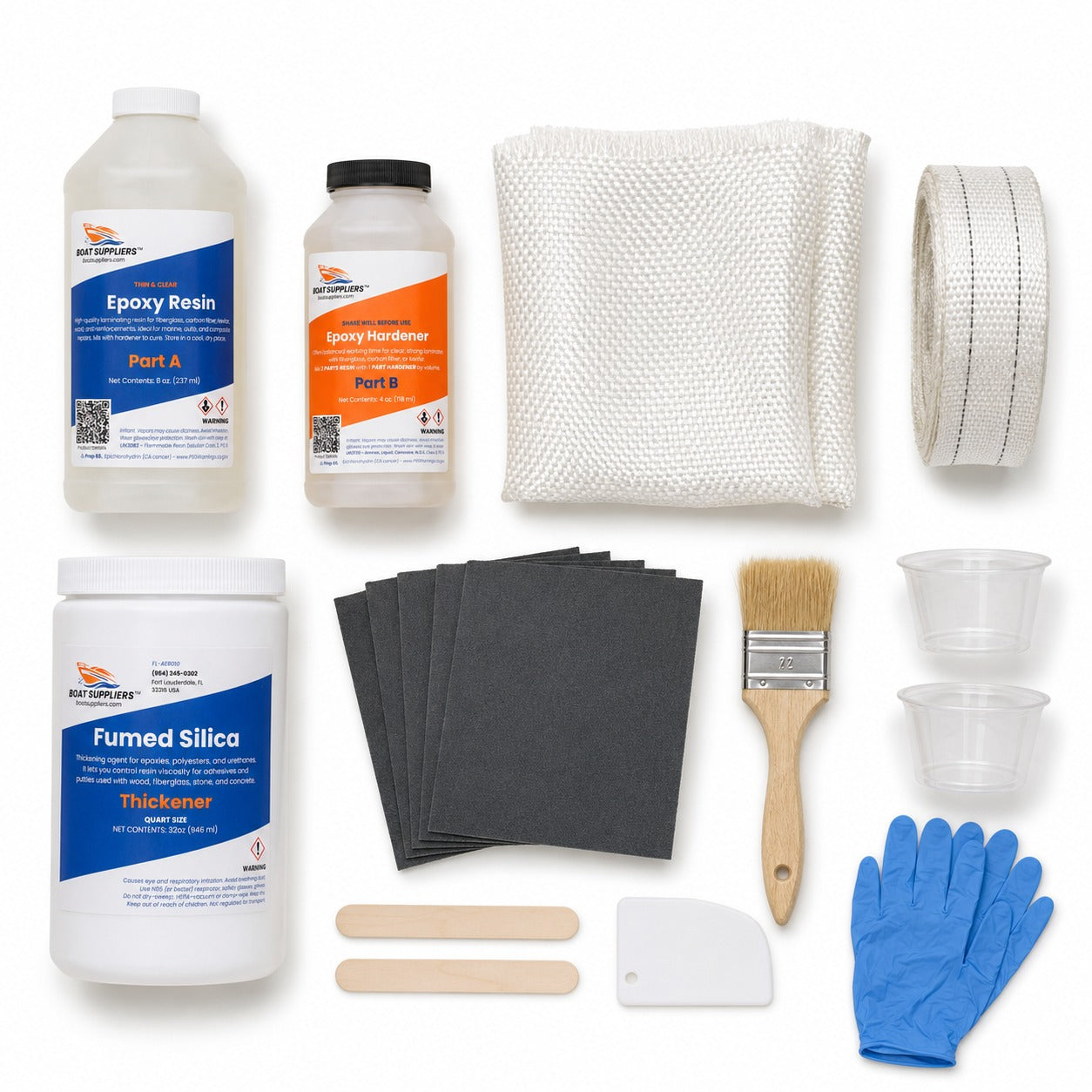
- 12oz two-part epoxy kit (8oz resin + 4oz hardener), long enough working time to wet out a patch clean
- 1 yard x 38" of 6oz woven fiberglass cloth for the structural patch layers
- 2 yards of 6" stitched 1708 fiberglass tape for cracks, seams, and stem repairs
- 1 Quart fumed silica thickener for gap filling and fairing the patch edges
- Prep & Fair wet/dry sandpaper 6-pack (120 through 400)
- Chip brush, 2 mixing cups, 2 mixing sticks, plastic spreader, nitrile gloves
How the repair works: sand the damaged area back to solid laminate, laminate cloth patches in increasing sizes over the break, tape seams and stems with the 1708 tape, then fair with silica-thickened epoxy and sand smooth.
For fiberglass, kevlar, and carbon composite hulls only. Rotomolded polyethylene kayaks (most sit-on-tops) cannot be repaired with resin; nothing bonds reliably to polyethylene.
Specifications
How to use this kit
Epoxy and fiberglass hull repair for composite paddle craft. Every kit ships with this same sheet printed and in the box.
What is in the kit
- 12 oz Two-part epoxy kit8 oz resin plus 4 oz hardener, 2:1 by volume
- 1 yd 6 oz woven fiberglass cloth, 38 in widethe structural patch layers
- 2 yd 6 in stitched 1708 fiberglass tapecracks, seams and stem repairs
- 1 qt Fumed silica thickenergap filling and fairing the patch edges
- 6 Prep & Fair wet/dry sandpaper120 / 150 / 180 / 240 / 320 / 400 grit
- 1 / 2 / 2 Chip brush, mixing cups, mixing sticks
- 1 / 1 pr Plastic spreader, nitrile gloves
You supply: denatured alcohol or acetone, 80 grit paper, masking tape, plastic sheet to back a through-hole, and a dust mask.
Mixing epoxy (2:1 by volume)
| Ratio | 2 parts resin to 1 part hardener |
| Small batch | 2 oz resin + 1 oz hardener |
| Full kit | 8 oz resin + 4 oz hardener |
Measure by volume in the graduated cups. Off-ratio epoxy does not cure slow, it never fully cures. Confirm the ratio printed on your hardener bottle.
Stir 2 minutes scraping sides and bottom, then pour into a second cup and stir again before you use it.
The job, start to finish
Sand back to solid laminate
Clean the area, then sand the damage back to sound laminate with 80 grit and feather the edges out several inches. Epoxy is a secondary bond to cured glass, so its whole grip comes from clean, freshly abraded surface. Wipe with alcohol and let it flash off.
Cut patches in sizes
Cut cloth patches in increasing sizes: the smallest just covers the damage, each next one about an inch larger all round. For a crack or a stem, cut 1708 tape to length instead. Tape plastic sheet behind any through-hole so the first layer has something to sit on.
Laminate the patch
Brush mixed epoxy onto the sanded area, lay the smallest patch on, and wet it out from the centre outward until the weave goes clear. Add each larger patch the same way. Squeegee gently: you want the cloth wet, not swimming. Cure overnight.
Tape seams and stems
For split seams, cracked stems or a keel line, use the 1708 tape rather than cloth. It carries far more load along its length. Wet the hull, lay the tape in, and work it down with the spreader so it follows the curve without bridging.
Fair and finish
Thicken leftover epoxy with fumed silica to a peanut butter consistency and fill the weave and patch edges slightly proud. Once cured, sand fair through 120 to 400. Epoxy has no UV resistance on its own, so paint or varnish the repair before it lives outside.
If something goes wrong
Soft or greasy spots
Off-ratio or under-stirred epoxy. Scrape it out, wash with soap and water, and redo with double-potted mix.
Cloudy waxy film
Amine blush from humid curing. Wash with warm soapy water and scuff before the next coat, or nothing sticks.
Patch edge lifted
Not sanded far enough out, or the surface was contaminated. Feather wider and wipe with alcohol.
Cure crawled overnight
Under 60 F. Epoxy stalls in the cold. Warm the space, do not add more hardener.
Cloth will not lie flat
It is bridging a curve. Cut a dart, or switch to the 1708 tape, which follows a stem without darts.
Epoxy needs a topcoat for UV. Paint or varnish over the cured repair. Bigger job? Add cloth and 1708 tape by the yard at boatsuppliers.com.
Blog posts

Best Fiberglass Cutting Tools for Clean Edges...
Best Fiberglass Cutting Tools for Clean Edges...

Kevlar Fabric for Boats: A Fabricator's Guide...
Kevlar Fabric for Boats: A Fabricator's Guide...
