Wood Rot Repair in a Boat: Stringers, Transoms and When to Cut It Out

19 November 2026
Wood rot repair in a boat comes down to one decision: is the wood still structurally there, or is it gone? The test that settles it costs nothing. Push an awl into the suspect area and drill a 1/8 in hole. If the awl sinks more than 1/4 in (6 mm) under hand pressure, or the bit pulls wet brown crumbs instead of dry shavings, the core is gone and you cut it out. If the wood is discolored but hard, the shavings are dry, and a pin moisture meter reads under 15 percent, you can consolidate it with penetrating epoxy and seal it. Anything in between on a stringer or a transom gets cut out too; those parts carry the engine and the hull loads, and a half-rotten core will not.
Finding how far it goes
Rot never stops where the soft spot does. Tap the whole stringer, transom or deck with a plastic mallet: laminate over sound wood rings, laminate over wet or rotten wood thuds. Mark the thuds. Drill 1/8 in test holes every 6 in (150 mm) from the soft spot outward until the shavings come up dry and pale, then add 12 in (300 mm); that is the cut line. On a transom, drill from inside the bilge at the drain, the lower engine bolts and the corners, where water gets in. A pin meter over 20 percent means active rot; under 15 percent is dry enough to bond epoxy to.
| Where | Condition | Fix |
|---|---|---|
| Deck or sole, under 1 sq ft | Discolored but hard, dry shavings, under 15 percent | Consolidate with penetrating epoxy, seal with two coats of West System 105/206 |
| Deck or sole | Soft, wet, over 20 percent | Cut out to dry wood plus 6 in, new marine plywood coated all six sides, glass over |
| Stringer | Any soft length | Cut out soft length plus 12 in each end, new core bedded in thickened epoxy, tab with 1708 |
| Transom | Wet at drain or bolts, any softness | Remove inner skin, replace core, bed to outer skin, reglass and tab to hull |
| Bolt hole or fitting | Wet but hard around the hole | Drill oversize, dry, fill with thickened epoxy, redrill and rebed |
The resin for the job
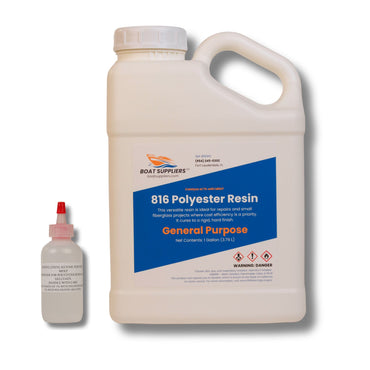
Every structural wood rot repair is a secondary bond to wood and to cured laminate, and that is epoxy work. West System 105 with 206 slow hardener mixes 5:1 by volume, gives 20 to 25 minutes pot life in a 100 g cup at 72°F (22°C), sets solid in 10 to 15 hours and reaches working strength in 1 to 4 days. Switch to 205 fast in cool weather: same 5:1, 9 to 12 minutes pot life, solid in 6 to 8 hours. Thicken with fumed silica for bedding and fillets; leave it neat for coating. Polyester will tab a new stringer into a polyester hull if you grind to fresh glass with 36 grit, and the Boat kit does exactly that with Silmar 249 at 1.5 percent MEKP, but polyester does not grip a wood core the way epoxy does and will not bond at all to any old epoxy repair it finds. Wear nitrile gloves, eye protection and a fitted P100 respirator with organic vapor cartridges; grinding old tabbing throws glass dust and epoxy is a skin sensitizer.
Stringers
Cut the top and sides of the tabbing with a grinder or a multitool, lift the old stringer, and dig out every bit of soft wood. Grind the hull where the new tabbing lands back to clean glass, 4 in (100 mm) each side. Cut the new core from Douglas fir or marine plywood to the old profile, dry-fit it, then coat it with neat 105/206 and let the first coat soak in. Bed it on a bead of 105/206 thickened with fumed silica, hold it with weights or hot glue blocks, and run a 3/8 in (10 mm) radius fillet along both sides so the glass does not bridge a square corner. Tab with two plies of 1708 biaxial, the first 4 in onto the hull each side, the second 6 in, mat side toward the hull, rolled out between plies. Where the stringer is scarfed rather than fully replaced, a 12:1 scarf on the wood and the same two plies of 1708 over the joint carry the load.
Transoms
A wet transom is almost always replaced from the inside so the outer skin and gelcoat stay. Cut the inner skin 2 in (50 mm) inside the transom edge, pry it off, and chisel and grind the old core out to the inside of the outer skin. Dry the skin, grind it to clean glass, check it for flatness. The new core is two layers of 3/4 in (19 mm) marine plywood laminated with 105/206 thickened to mayonnaise, clamped overnight, then cut to fit with 1/4 in clearance all round. Coat every face, bed it to the outer skin on a full spread of thickened epoxy, clamp through the engine bolt holes with plywood pads, and squeeze out the excess. Once solid, three plies of 1708 over the inside face, each 2 in wider than the last, tabbed 4 to 6 in onto the hull sides and bottom. Cure a full week at 70°F (21°C) before the engine goes back on.
Deck and sole
Cut the deck skin around the soft area, 6 in (150 mm) into dry wood, and pull the core. Cut new marine plywood to fit and coat all six sides with two coats of 105/206, or cut Coosa Bluewater 26 Composite Board, which needs no sealing and cannot rot. Bed it on thickened epoxy, then glass the top with the original schedule: usually one ply of 1.5 oz mat and one of 1708 from the Boat kit, or two plies of 10 oz cloth in epoxy. Fair it with fumed silica or a fairing filler sized with the fairing filler calculator. Then gelcoat. A ten-year-old Florida deck is not white, it is cream or oyster, and a white patch is more visible than the repair it covers. The Gelcoat Repair Kit - Pure White Gelcoat, Surfacing Wax, Hardener & Tinting Pigments gives you white gelcoat with yellow and black tints to walk it to a match, yellow toward cream and black toward grey: add drops, mix fully, dab it on the deck, look at it in daylight, go again. Size the gelcoat with the gelcoat calculator.
Wood rot repair without cutting: when consolidating is enough
Penetrating epoxy is for the last 10 percent of a rot problem, not the first 90. It works on wood that is dry, still hard, and only starting to go: a deck corner where a screw wept, the top edge of a bulkhead, a rub rail core. Drill 1/4 in holes on a 1 to 2 in (25 to 50 mm) staggered grid, feed it in until the holes stop taking it, let it solidify overnight, then seal with two coats of 105/206. It does not restore a soft stringer or a wet transom; consolidating a transom that reads 25 percent seals the water in.
What to order
For any transom, stringer or deck job, a gallon of West System 105 Epoxy Resin with a 206 hardener covers the core lamination, bedding and coating; a transom on a 20 ft outboard uses most of it. For the glass, the Boat Fiberglass Repair Kit - Professional Grade with Gallon Resin & Roller brings 3 yards of 50 in 1708, 3 yards of 1.5 oz mat, fumed silica and the roller, with a gallon of polyester for tabbing on a polyester hull; a single deck patch gets by with the Fiberglass Repair Kit - Complete DIY Kit with Resin, Cloth & Mat. Size the 1708 and resin with the resin calculator before you order.
Frequently asked questions
Can you fix wood rot in a boat without removing the wood?
Only if the wood is dry, still hard, and reads under 15 percent on a pin meter. Then penetrating epoxy through 1/4 in holes on a 1 to 2 in grid, sealed with two coats of West 105/206, holds a deck corner or a bulkhead edge. A soft stringer or a transom over 20 percent gets cut out. Consolidating wet wood seals the water in.
How do you know if boat stringers are rotten?
Tap the tabbing with a plastic mallet: a thud instead of a ring means wet or rotten wood under it. Confirm with 1/8 in drill holes every 6 in from the soft spot outward; wet brown crumbs are rot, dry pale shavings are sound. Cut 12 in past the last wet hole. A moisture meter over 20 percent at any hole is a replacement, not a patch.
What epoxy should I use for a rotted transom?
West System 105 with 206 slow hardener, 5:1 by volume, 20 to 25 minutes pot life at 72°F (22°C), for laminating the two plywood layers, bedding the core and coating it. Use 205 fast in a cold shop. Thicken with fumed silica for bedding and fillets. Plan on most of a gallon for a 20 ft outboard transom including the 1708 overlay.
How long does a transom repair need to cure before mounting the engine?
105/206 is solid in 10 to 15 hours and at working strength in 1 to 4 days at 72°F (22°C), but the bolted engine load goes on a fully cured laminate. Give the new transom 7 days at 70°F or warmer before hanging the outboard, longer if the shop is cold. Rebed the bolts in thickened epoxy or polyurethane sealant when it goes back on.
Marine plywood or composite core for a transom?
Two layers of 3/4 in marine plywood laminated with epoxy is the standard and matches the original stiffness. Coosa Bluewater 26 board cannot rot, weighs less, and takes the same three-ply 1708 schedule at a higher sheet price. On a boat you plan to keep, go composite. Where the rot came from a leaking drain you are also fixing, plywood coated on all six sides is fine.
What You Need For This Job
- West System 105 Epoxy Resin: laminating, bedding and coating the new core with a 200-series hardener
- Boat Fiberglass Repair Kit - Professional Grade with Gallon Resin & Roller: 1708, mat, fumed silica and roller for tabbing and overlay
- Fiberglass Repair Kit - Complete DIY Kit with Resin, Cloth & Mat: a single deck or sole patch
- Gelcoat Repair Kit - Pure White Gelcoat, Surfacing Wax, Hardener & Tinting Pigments: finishing the deck patch to match an aged hull
- Coosa Bluewater 26 Composite Board: rot proof core for a transom, stringer or sole
Next post

Carbon Fiber Sheets: Buy a Cured Panel or Lay Up Your Own?
Updated on 17 November 2026