

RV & Camper Fiberglass Repair Kit with White Gelcoat
RV & Camper Fiberglass Repair Kit with White Gelcoat
Share
SKU:SK-RVK001
19 in stock
Couldn't load pickup availability
A complete structural repair kit for fiberglass RV and camper bodies: cracked end caps, holed sidewalls, delaminating Filon panels, damaged wheel well trim, and wet-bath or shower pan cracks. The same materials a fiberglass shop would use, portioned for one DIY repair, plus a pint of white gelcoat to finish the patch in the gloss white most RV exteriors and baths already wear.
What is in the kit:
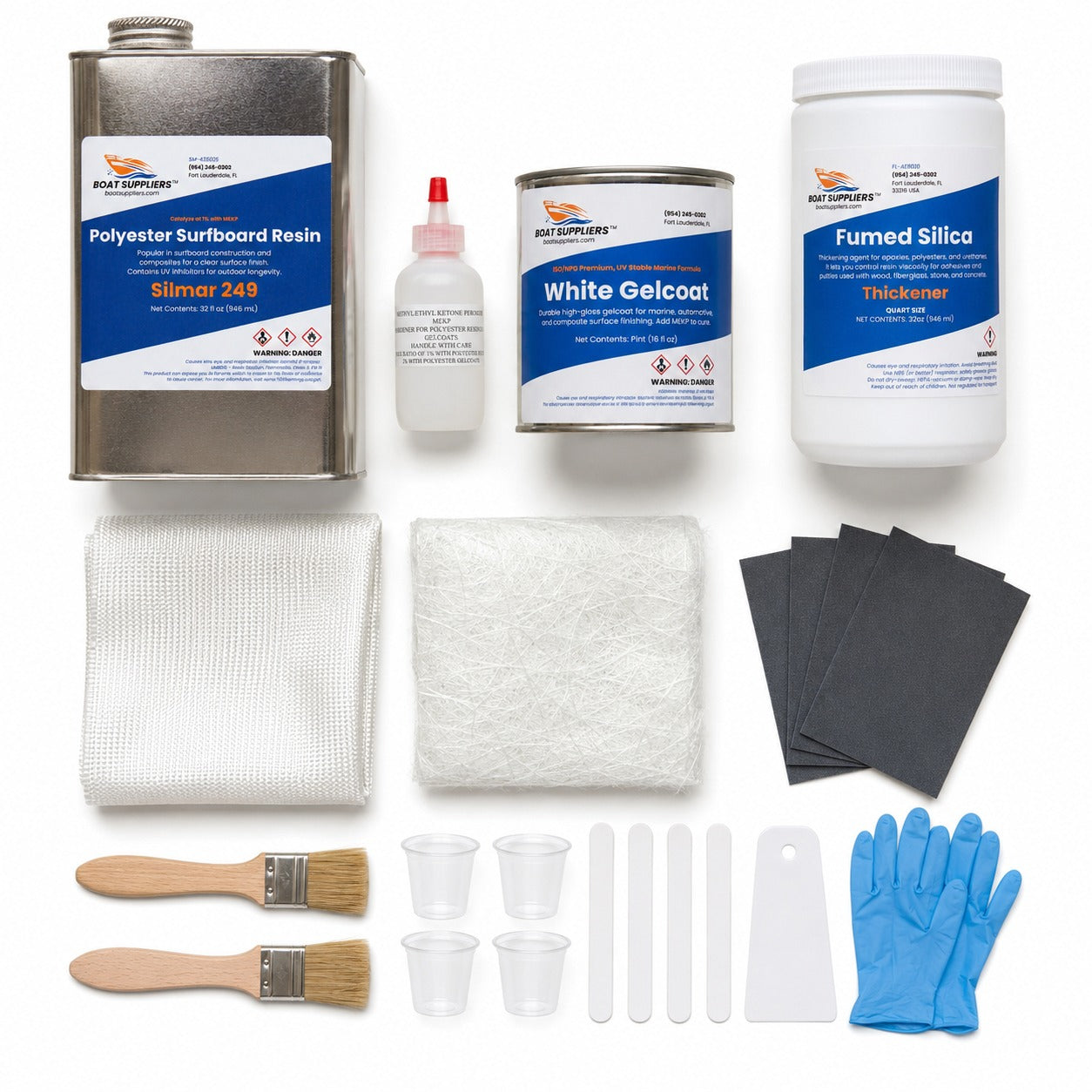
- 1 Quart Silmar 249 clear polyester laminating resin
- MEKP hardener (catalyzes both the resin and the gelcoat)
- 1 Pint pure white gelcoat with wax in a sealed metal can, cures tack-free to a gloss finish
- 1 yard x 38" of 6oz woven fiberglass cloth
- 1 yard x 38" of 1.5oz chopped strand mat
- 1 Quart fumed silica thickener, for filling gouges and building putty
- Prep & Fair wet/dry sandpaper 6-pack (120 / 150 / 180 / 240 / 320 / 400)
- 2 chip brushes, 4 mixing cups, 4 mixing sticks, plastic spreader, nitrile gloves
How the repair works: grind back the damaged area, laminate mat then cloth for strength, fair the patch smooth with silica-thickened resin, then topcoat with white gelcoat and sand to blend into the surrounding finish.
Works on fiberglass and Filon RV skins, end caps, and interior wet-bath fiberglass. Not for aluminum-skinned campers or polyethylene tanks.
Specifications
How to use this kit
Structural fiberglass repair with a gloss white gelcoat finish. Every kit ships with this same sheet printed and in the box.
What is in the kit
- 1 qt Silmar 249 polyester laminating resinthe structural resin for every glass layer
- 1 MEKP hardener, 2 ozcatalyzes both the resin and the gelcoat
- 1 pt Pure white gelcoat with wax, metal canthe gloss white finish coat, cures tack-free
- 1 yd 6 oz woven fiberglass cloth, 38 in widestrength and a smooth outer layer
- 1 yd 1.5 oz chopped strand mat, 38 in widebulk and the first layer against the repair
- 1 qt Fumed silica thickenerstir into resin to make fairing putty
- 6 Prep & Fair wet/dry sandpaper, 120 to 400 gritone sheet each grit
- 2 / 4 / 4 Chip brushes, mixing cups, mixing sticks
- 1 / 1 pr Plastic spreader, nitrile gloves
You supply: acetone, an angle grinder or 80 grit block, a dust mask or respirator, masking tape and plastic sheet.
Mixing MEKP (resin and gelcoat)
| 4 oz mix | 1.8 mL MEKP (about 1/3 tsp) |
| 8 oz mix | 3.6 mL MEKP (about 3/4 tsp) |
| Full quart | 14 mL MEKP (about 3 tsp) |
That is 1.5 percent for 65 to 85 F. Above 85 F drop to 1 percent; at 60 to 65 F go to 2 percent; below 60 F wait for a warmer day.
Working time is 15 to 20 minutes. Mix small batches you can use right away.
The job, start to finish
Prep and grind
Wash the area with soapy water, dry, then wipe with acetone. Grind or coarse-sand the damage back to solid glass and dish the edges out wide and shallow, about 12 times the panel thickness. Scuff 2 to 3 inches beyond that with 120 grit and mask off the surrounding finish.
Cut your glass
Before mixing anything, cut chopped strand mat to fill the dished area and cloth patches slightly larger to cap it. Mat goes down first, cloth on top. Lay the dry pieces in place to check fit.
Laminate
Mix a small batch of resin with MEKP (chart at left). Wet the repair, lay in the mat, and stipple resin through it with the chip brush until it turns translucent. Lay the cloth over it, wet it out, and chase air bubbles to the edges with the spreader. Let it cure hard, 2 to 4 hours.
Fill and fair
Stir fumed silica into a fresh catalyzed batch until it stands in peaks like peanut butter. Spread it over the patch slightly proud of the surface. Once cured, sand fair with 120 then 240 grit until the patch feels flush under your flat palm.
Gelcoat and finish
Stir the gelcoat well, catalyze it the same as the resin, and brush on 2 coats about the thickness of a business card, 30 to 45 minutes apart. The wax in it lets the last coat cure tack-free. Next day wet-sand with 320 then 400, and for full gloss keep going with finer grits and a polishing compound.
If something goes wrong
Laminate feels tacky
Normal. Clear laminating resin stays tacky on top so the next layer bonds to it. It sands fine once hard underneath.
Nothing hardened
Too little MEKP, or under 60 F. Scrape it off, warm the space, and remix.
It kicked in the cup
Too much MEKP, or it is too hot out. Cut back and mix 4 oz at a time.
Gelcoat stayed sticky
The coat went on too thin for the wax to rise. Add another full coat.
Patch shows through
Gelcoat is translucent when thin. Two coats minimum over a faired patch.
The kit's sandpaper runs to 400 grit. For a mirror blend, follow with a 600 to 3000 finishing pack and polish, both at boatsuppliers.com.
Blog posts

Best Fiberglass Cutting Tools for Clean Edges...
Best Fiberglass Cutting Tools for Clean Edges...

Kevlar Fabric for Boats: A Fabricator's Guide...
Kevlar Fabric for Boats: A Fabricator's Guide...
