

Fiberglass Mold Making Kit - Pro, Gallon Tooling Gelcoat + Gallon Isophthalic Resin
Fiberglass Mold Making Kit - Pro, Gallon Tooling Gelcoat + Gallon Isophthalic Resin
Share
SKU:SK-MMF003-BK
Hurry, only 3 left in stock
Couldn't load pickup availability
A full gallon of tooling gelcoat and the release, glass and tools to back it. This is the rung for a mold you intend to run production parts off, where the face has to stay flat and the laminate has to be thick enough not to move.
What is in the kit
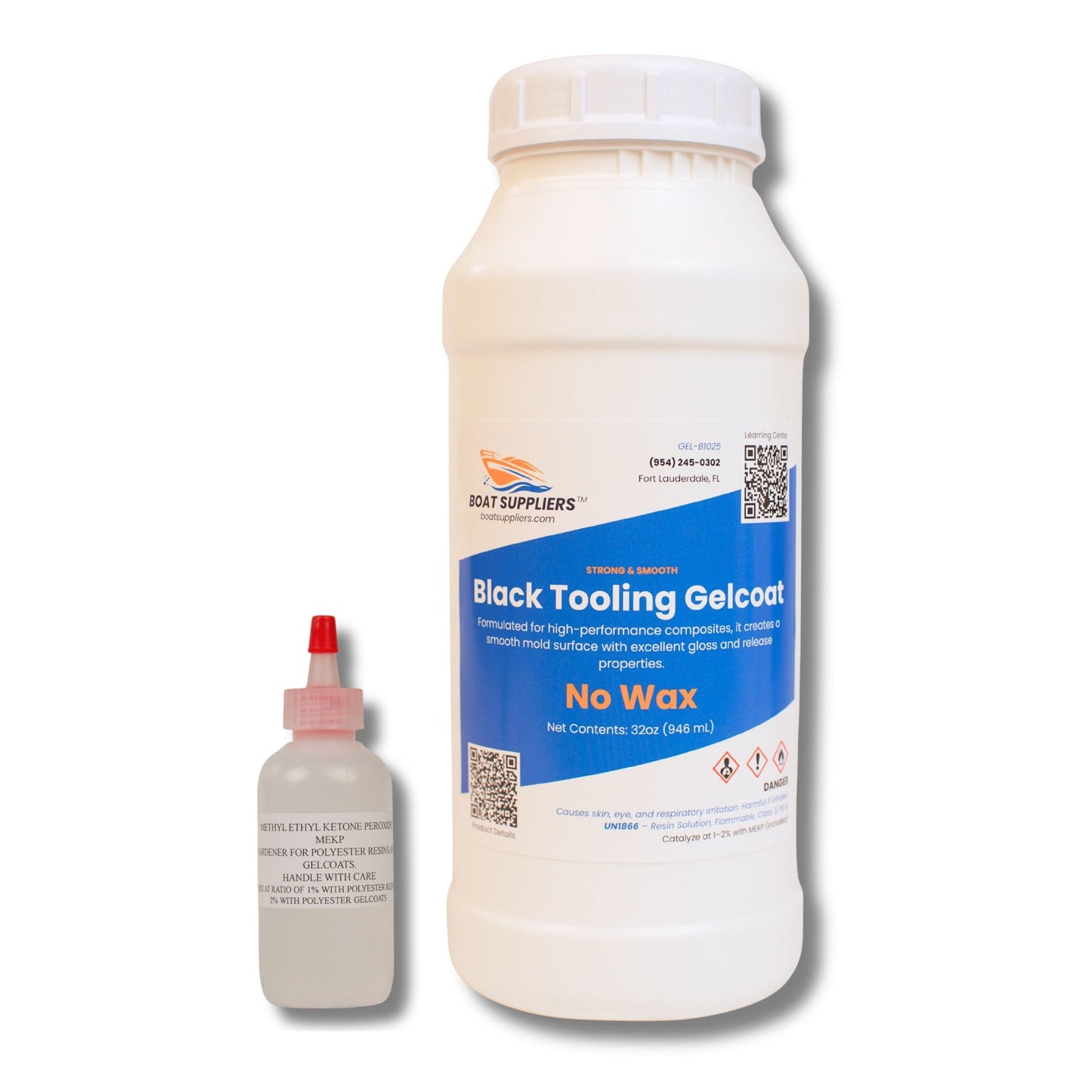
- 1 gallon tooling gelcoat with hardener, no wax, black or orange
- 1 gallon isophthalic polyester tooling resin with 8 oz MEKP
- Two 12 oz tubs of Partall #2 paste wax and two 32 oz Partall #10 PVA
- 1 yd 0.75 oz veil mat, 3 yd 1.5 oz chopped strand mat and 2 yd 24 oz woven roving, 50" wide
- 1 quart fumed silica and 1 lb of 1/4" chopped strand for filleting corners
- Two wet/dry sandpaper prep packs for finishing the plug
- 3/8" x 5" fiberglass roller and a 1/4" corner roller
- Eight 2" chip brushes, 8 graduated cups, stir sticks, gloves
- A full pint of surfacing wax, four release wedges, instruction card
Why double release: on a mold this size you are waxing a large plug several times over, and you want enough PVA left to redo a panel if a film goes patchy. Running out of wax halfway through waxing a plug is how first pulls get ruined.
Laminate in sessions. Do not try to put 8 yards of mat down in one go. Heavy polyester laminates exotherm, and a thick wet stack on a hot day will distort the face you just gelcoated. Two or three layers, let it firm up, carry on. Only the final session gets surfacing wax.
The three waxes, because everyone mixes them up
- Partall #2 paste wax is the release barrier. It goes on the plug, 3 to 5 coats, buffed between each.
- Partall #10 PVA is not a wax. It is a water-soluble green film brushed or sprayed over the wax as insurance on new plugs and first pulls. It washes off with warm water.
- Surfacing wax is an additive you stir into the last layer of resin only. Polyester cures tack-free only when air is sealed off it, and that is what the wax floating to the surface does. Put it in an intermediate layer and the next layer will not bond.
Why the gelcoat says No Wax: a mold face gets laminated over. Wax at that interface is exactly what you do not want. That is the difference between tooling gelcoat and the waxed gelcoat you would use as a finish coat.
Why chopped strand mat and not 1708
This is the most common question in mold building and the answer is not the one people expect.
- Chopped strand mat is random-oriented, so it has no grain and prints no pattern through to the mold face. A tool copies itself into every part you ever pull off it, so fibre read on a mold is permanent in a way it never is on a part.
- Mat conforms. It goes into compound curves and tight radii without bridging. 1708 is a stitched structural biaxial: stiff, prone to bridging in a corner, and its stitch bundles telegraph as the laminate shrinks.
- 1708 is a structural fabric, built for directional strength in a part. A mold does not want directional stiffness, it wants dimensional stability and thickness. 1708 also costs nearly twice as much per yard for a job mat does better.
Use 1708 to repair a transom or lay up a hull. Use mat to build the tool that makes them.
Where woven roving comes in: once a mold passes a few square feet, all-mat laminates get floppy, and a mold that flexes makes parts that do not fit. Roving builds thickness and stiffness fast. It never goes against the skin coat, always with mat between it and the face, because the coarse weave will print through otherwise. The schedule in this kit is veil, mat, mat, roving, mat.
Fillet your internal corners before you laminate. A sharp inside corner is exactly where glass bridges and traps air, and a void behind the gelcoat becomes a chip on the first pull. Thicken a little resin with the fumed silica into a peanut-butter putty, run a radius into every internal corner, and let the glass follow a curve instead of a crease.
Specifications
Specifications
Blog posts

PVA vs Wax vs Semi-Permanent Mold Release: Wh...
PVA vs Wax vs Semi-Permanent Mold Release: Wh...

Fiberglass Keel and Skeg Repair: Grind Back, ...
Fiberglass Keel and Skeg Repair: Grind Back, ...
