Fiberglass Repair: Picking Materials by Damage Type

02 October 2026
A fiberglass repair fails for one of two reasons: the wrong resin over the substrate, or too little glass over too small a bevel. The spec that settles both: polyester laminating resin over a polyester or vinyl ester boat, epoxy over cured epoxy or anything you cannot identify, a 12:1 bevel on every through-laminate repair, and enough plies to put the original thickness back. Here is how the material list changes with the kind of damage in front of you.
Resin first: match the substrate
Polyester will not bond to cured epoxy. Epoxy bonds to cured polyester, vinyl ester and epoxy. That one asymmetry decides most of the resin choices below, and it is why an epoxy repair on a polyester boat has to be finished with paint or a gelcoat you have tested over a cured epoxy sample, not assumed.
| What you are repairing | Resin | Why |
|---|---|---|
| Production polyester boat, gelcoat finish, repair will be gelcoated | Polyester laminating resin (Silmar 249) with MEKP | Same chemistry as the hull; gelcoat bonds to it; cheapest per gallon |
| Composite kayak, canoe, cold-molded hull, or a prior epoxy repair | Epoxy, 2:1 or 3:1 by volume | Polyester will not stick to cured epoxy; epoxy makes the stronger secondary bond |
| Transom, stringers, anything structural you cannot afford to redo | Epoxy, 3:1 marine laminating epoxy | Higher adhesive strength on a ground surface, and far more forgiving of a substrate that is not bone dry |
| Fiberglass tub or shower pan | Polyester laminating resin plus white gelcoat with wax | The pan is polyester; the gelcoat is the finish |
Polyester dosing is the same on every job: 1.5 percent MEKP at 65 to 85°F (18 to 29°C), which is 3.6 mL for an 8 oz mix or about 10 drops per ounce as a field rule. Drop to 1 percent above 85°F and go to 2 percent at 60 to 65°F. Working time is 15 to 20 minutes, so never mix more than you can lay up in that window. The MEKP catalyst calculator does the arithmetic for any batch size. Epoxy is measured by volume; off-ratio epoxy never cures, so confirm the ratio on the hardener bottle.
Gouges and scrapes that stop short of the laminate
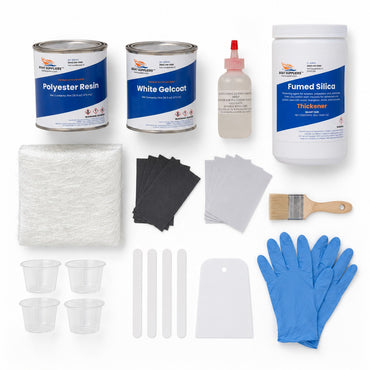
A trailer bunk scrape or a dock rash that only goes through gelcoat needs no glass. Grind the damage into a shallow V with 80 grit, fill with polyester resin thickened with fumed silica to peanut butter, sand at 120, and gelcoat. If the gouge reaches into the first ply of glass, add one piece of 1.5 oz mat cut to the V before the putty. The Silmar 249 quart in the Fiberglass Repair Kit - Complete DIY Kit with Resin, Cloth & Mat is the resin for this; the mat and fumed silica are in the box.
A hole or crack through the skin
Through damage gets the full treatment: cut back to solid glass, then grind a 12:1 bevel around the opening. A 1/2 in (12 mm) skin needs a 6 in (150 mm) taper on every side, and that taper, not the patch, is what carries the load into the old laminate. Tape a waxed backer over the outside, cut every ply dry before you mix, and lay them smallest first at the bottom of the bevel, each next piece about an inch larger, until the last ply covers the whole taper. Mat goes down first against the ground surface, then alternate mat and structural fabric.
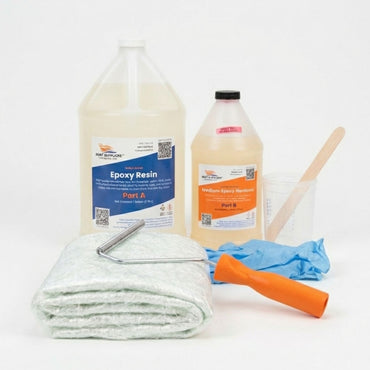
For a hole the size of your fist, the DIY kit above covers it: a quart of 249, a yard of 6 oz cloth and a yard of 1.5 oz mat at 38 in. For a hole you can put a hand through, or two or three of them, step up to the Boat Fiberglass Repair Kit - Professional Grade with Gallon Resin & Roller: a full gallon of Silmar 249, 3 yd of 50 in 1708 biaxial, 3 yd of 1.5 oz mat, fumed silica and the laminating roller that drives air out between plies.
Soft deck, wet stringer, punky transom
Once the damage is core rot rather than skin damage, you are rebuilding, not patching, and the resin is epoxy. Cut the skin, dig or grind the wet core out to dry material, replace it, and re-skin with 1708 biaxial. A transom skin runs 4 to 6 plies of 1708 at about 0.045 in (1.1 mm) per cured ply; stringer tabbing runs two plies of 1708 tape per side, each 2 in wider than the last. Figure about a quart of mixed epoxy per linear yard of 50 in 1708 in a single ply.
The 1708 Fiberglass Repair Kit with Marine Epoxy (5 Yards) is portioned for this scale: 5 yd of 50 in 1708 and 1.33 gal of 3:1 marine epoxy (128 oz resin, 42.7 oz hardener), which wets out about 5 yd in a single layer with margin for fill coats, plus the roller. Run the resin calculator for the exact ply stack you are building; a two-sided transom skin eats more than one kit.
Composite kayak or canoe hull
Every paddle craft repair is a secondary bond to a cured laminate, and half of them are epoxy or vinyl ester hulls to begin with, so the resin is epoxy without exception. Sand the damage back to sound laminate with 80 grit, feather several inches out, and lay 6 oz cloth patches in graduated sizes, with 6 in 1708 tape on stem cracks and seams. The Kayak & Canoe Repair Kit - Epoxy & Fiberglass for Composite Hulls carries 12 oz of 2:1 epoxy, a yard of 6 oz cloth, 2 yd of 6 in 1708 tape and the fumed silica for fairing the edges. Bow and stern wear is a different job: two 6 x 30 in pieces of 5 oz genuine KEVLAR(R) style 281 in epoxy, which is the KEVLAR(R) Canoe & Kayak Skid Plate Kit.
Fiberglass tub or shower pan
A cracked tub floor is a flex problem, so a filler-only fix cracks again. Grind the crack into a V, lay one ply of 1.5 oz mat in polyester, fair with fumed silica putty, and topcoat with white gelcoat that has wax in it so it cures hard and sands to gloss. The Bathtub & Shower Fiberglass Repair Kit with White Gelcoat is exactly that list: a pint of 249, a pint of waxed white gelcoat, a yard of mat, fumed silica and seven grits of wet-or-dry from 120 to 2000.
| Damage | Resin | Glass | Kit |
|---|---|---|---|
| Gelcoat gouge, no through damage | Polyester | Putty only, or 1 ply 1.5 oz mat | DIY kit |
| Fist-size hole through the skin | Polyester | Mat, 6 oz cloth, alternated to thickness | DIY kit |
| Hand-size hole, several holes, deck skin | Polyester, 1 gal | Mat and 1708, alternated | Boat kit |
| Transom, stringer, cored deck rebuild | Epoxy 3:1, 1.33 gal | 4 to 6 plies 1708 | 1708 kit |
| Kayak or canoe crack | Epoxy 2:1 | 6 oz cloth, 6 in 1708 tape | Kayak kit |
| Canoe stem and keel abrasion | Epoxy | 5 oz KEVLAR(R) tape | Skid plate kit |
| Tub or shower pan crack | Polyester plus gelcoat | 1 ply 1.5 oz mat | Bathtub kit |
Wear a P100 respirator with organic vapor cartridges whenever polyester or MEKP is open, nitrile gloves for every resin, and eye protection for grinding; that is the whole rule.
Frequently asked questions
Should I use epoxy or polyester resin for fiberglass repair?
Polyester over a polyester boat when the repair will be gelcoated and the damage is in the skin: it is the same chemistry and costs a fraction of what epoxy does. Epoxy for structural rebuilds (transoms, stringers, cored decks), for any composite kayak or canoe, and over any prior epoxy repair, because polyester will not bond to cured epoxy. When you cannot identify the substrate, epoxy is the safe answer.
How big does the bevel need to be on a fiberglass repair?
Twelve to one. Measure the skin thickness at the cut and grind a taper twelve times that wide on every side of the hole: a 1/4 in skin gets a 3 in bevel, a 1/2 in skin gets 6 in. The taper is the bond area that carries load into the old laminate. A patch laid over an unbeveled hole is held on by its edges and pops out the first time the panel flexes.
How many layers of fiberglass does a repair need?
Enough to put the original thickness back, and a ply more than you think. At about 0.045 in per cured ply of 1.5 oz mat or 1708, a 1/4 in skin is 5 to 6 plies. Cut them dry before mixing, smallest first at the bottom of the bevel, each about 1 in larger. On a polyester boat, mat goes down first and alternates with the structural fabric.
Can I repair fiberglass with resin alone, no cloth?
Only for a gelcoat-deep gouge. Resin with fumed silica is a putty; it has no fiber and no strength, so it cracks the first time the panel flexes. Any damage that reaches into the glass gets at least one ply of 1.5 oz mat cut to the V, and anything through the skin gets a full beveled ply stack. The glass carries the load; the resin only holds it in place.
How much MEKP do I add to polyester resin?
1.5 percent by volume at 65 to 85°F: 3.6 mL for 8 oz, 7 mL for a pint, 14 mL for a quart, or about 10 drops per ounce in the field. Above 85°F cut to 1 percent so it does not kick in the cup; at 60 to 65°F go to 2 percent. Below 60°F, wait for a warmer day or heat the shop. Working time at 1.5 percent is 15 to 20 minutes.
What You Need For This Job
- Fiberglass Repair Kit - Complete DIY Kit with Resin, Cloth & Mat: quart of Silmar 249, 6 oz cloth and 1.5 oz mat for gouges and fist-size holes
- Boat Fiberglass Repair Kit - Professional Grade with Gallon Resin & Roller: gallon of 249, 1708 and mat for hand-size holes and deck skins
- 1708 Fiberglass Repair Kit with Marine Epoxy (5 Yards): 5 yd of 1708 and 1.33 gal of 3:1 epoxy for transoms, stringers and cored decks
- Kayak & Canoe Repair Kit - Epoxy & Fiberglass for Composite Hulls: 2:1 epoxy, 6 oz cloth and 1708 tape for paddle craft
- KEVLAR(R) Canoe & Kayak Skid Plate Kit: genuine 5 oz aramid tape and epoxy for stem and keel abrasion
- Bathtub & Shower Fiberglass Repair Kit with White Gelcoat: pint of 249, mat and waxed white gelcoat for a cracked pan
Next post

Two-Part Epoxy: Mix Ratios, Pot Life and Which Kit to Buy
Updated on 01 October 2026