49 products

Resins

Every fiberglass resin we stock, and how to tell which one you need

Three chemistries do the work on a boat. Picking between them comes down to what you are bonding to and what the job is worth. All three are here, from quart repair sizes up to 5 gallon, and every one ships with its hardener or catalyst.

Polyester is the default for boat work

Polyester resin is what nearly every production hull was built from, it is the cheapest way to put glass down, and it is the correct partner for chopped strand mat, whose binder needs polyester's styrene to break down. It catalyzes with MEKP measured by percentage, it shrinks as it cures, and it will not bond reliably to cured epoxy.

Epoxy when the bond matters more than the price

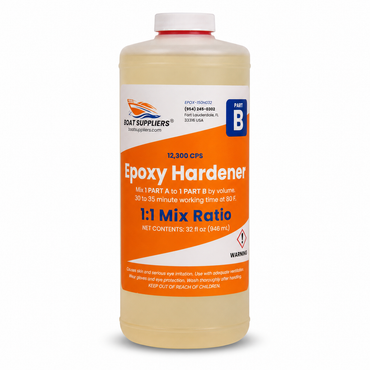
Epoxy runs roughly two to three times polyester per mixed gallon and earns it on adhesion. It sticks to wood, to cured polyester, to metal and to itself, it barely shrinks, and it is the only one of the three worth putting into a rotten stringer or a plywood transom. Our house epoxy ships in 2:1 slow, 3:1 medium and 4:1 fast so pot life matches the temperature you are actually working in, and the West System 105 system with 205, 206 or 207 hardener is here for anyone working to a published West schedule.

Vinyl ester sits between them

Vinyl ester catalyzes with MEKP and handles like polyester, but absorbs far less water. It is what to reach for on a barrier layer below the waterline or a blister repair, where polyester is too permeable and epoxy is more than the job needs.

The rule that saves the most rework

Epoxy goes over polyester. Polyester does not go over epoxy. If there is any chance the surface you are laminating onto was repaired with epoxy at some point, use epoxy, because polyester laid over cured epoxy can stay tacky or let go in sheets months later.

Working out how much

The resin calculator sizes the batch from your layup, and the MEKP calculator gives the catalyst dose for your batch and shop temperature. Both are free and neither asks for an email.

Epoxy resin provides better adhesion, moisture resistance, and flexibility compared to polyester resin. While polyester is more economical and widely used in mass production, epoxy is preferred for high-performance applications, repairs, and situations requiring a strong bond.

Choose vinyl ester when you need more strength, toughness and water and chemical resistance than polyester without moving to epoxy. It is the standard for blister-resistant hull skins, below-waterline repairs and tanks. It cures with MEKP like polyester, about 1.25% at 77°F, and goes over polyester or vinyl ester laminate, so it drops straight into a polyester layup schedule. It does not go over epoxy.

Laminating (layup) resin stays slightly tacky as it cures so the next layer of glass bonds chemically without sanding. Finishing resin has a wax or surfacing agent that rises to the top, sealing out air so the last coat cures hard and sands clean. Most marine polyester is laminating resin, so add surfacing wax to the final coat when you are ready to sand and finish.

It depends on the fabric, the area and the number of plies. For hand layup, plan about 0.73 oz of resin per square foot per ply of 6 oz cloth, 1.22 oz for 10 oz cloth, 3.4 oz for 1.5 oz chopped strand mat and 4 oz for 1708 biaxial, then add 15 to 20% for waste. Mat takes about 2.3 times its own weight in resin. The resin calculator works out a full layup.

The standard dose is 1.25% MEKP by volume at 77°F, about 12 cc per quart or 47 cc (1.6 fl oz) per gallon. Use more when it is cold and less in heat, but stay between 1% and 2%: below 1% the resin can stay soft, and above 2% it can crack, smoke or kick before you can work it. Measure in cc with a dispenser, not drops.

Hardener speed sets working time and cure time, not final strength. West System 205 Fast gives 9 to 12 minutes of pot life (100 g at 72°F), cures down to 40°F and suits cool shops and small batches. 206 Slow gives 20 to 25 minutes for warm shops and bigger layups, and 209 Extra Slow about 40 to 50 minutes. Always mix at the ratio the system specifies.

Yes. Unopened epoxy resin and hardener usually last one to several years stored cool and sealed, though hardener may darken without losing strength. Polyester resin and gelcoat are shorter lived, often three months to a year depending on the product, because the styrene and promoters break down. MEKP also weakens with age, and old catalyst can leave resin undercured, so check the label.

  • Cut To Order · Ships Within 1 Business Day

  • Safe & Secure Payments

  • 5 Star Rated

  • Professional Boating Support