What Is Coosa Board? Bluewater 26 vs Nautical 15, Weights and Sizes

22 October 2026
Coosa board is polyurethane foam reinforced with layers of fiberglass, made in plywood-size sheets, and it goes where marine plywood rots: transoms, stringers, floors, bulkheads, hatch lids and backing pads. The decision that matters is the grade. Bluewater 26 is the structural board, 26 lb per cubic foot, and it is the one that replaces plywood in a transom or a floor. Nautical 15 is the light, economical board for consoles, liners, seat boxes and fill. A 3/4 in 4 x 8 ft sheet of Bluewater 26 weighs about 52 lb against roughly 70 lb for marine plywood, and it never rots, because there is no wood in it.
What Coosa board is made of
Every grade is closed cell polyurethane foam with glass laid through it. The Bluewater grades carry chopped strand mat plus woven roving; the Nautical grades carry continuous strand mat only, which is why a Nautical board is less stiff than a Bluewater board of the same density. The number in the name is the density in pounds per cubic foot. Coosa paints the sheet corners by grade, blue for Bluewater 26 and white for Nautical 15, so offcuts in the shop stay sorted.
Three things follow from the build. It does not rot and takes on very little water, so a weeping bolt hole does not turn into a black transom. It cuts, drills and sands like a dense wood panel, with carbide tooling. And it is a board, not a flexible core: it stays flat, so it will not follow a crowned deck or a curved hull side the way a scored foam core does.
Coosa board grades: Bluewater 26 vs Nautical 15
| Bluewater 26 | Nautical 15 | |
|---|---|---|
| Density | 26 lb/ft³ (420 kg/m³) | 15 lb/ft³ (240 kg/m³) |
| Glass inside | Chopped strand mat plus woven roving | Continuous strand mat |
| 3/4 in 4 x 8 ft sheet | About 52 lb | About 30 lb |
| Job | Structural: transoms, stringers, floors, bulkheads, backing pads | Semi structural and fill: consoles, liners, seat boxes, shims |
| Spans | The grade Coosa points to for spans of 14 in and over | Short spans only, supported and glassed |
| Sheets we carry | 4 x 8 ft in 1/4, 1/2, 3/4, 1, 1-1/2 and 2 in; 4 x 4 ft in 1/2 and 3/4 in | 4 x 8 ft in 1/2, 3/4 and 1 in |
Coosa also makes a lighter Bluewater 20 for semi structural panels and a denser Bluewater 32 for heavy screw-holding work. For a repair shop, 26 covers the structural jobs and 15 covers the rest, so those are the two we carry: Coosa Bluewater 26 Composite Board and Coosa Nautical 15 Composite Board.
Coosa board vs marine plywood
| Coosa Bluewater 26 | Marine plywood | |
|---|---|---|
| 3/4 in 4 x 8 ft sheet | About 52 lb | About 70 lb |
| Rot | None; no wood in it | Rots once water gets past the epoxy seal |
| Stiffness per inch | Close to plywood | The benchmark |
| Screw holding | Good; through-bolt anything that carries load | Better per inch |
| Sealing before install | Scuff and bed it | Two coats of epoxy on every face, three on the edges |
| Price, 3/4 in 4 x 8 ft | Roughly $350 to $500 before freight | Roughly $100 to $250 |
Plywood is still stiffer per inch and a fraction of the price, and a plywood transom sealed properly in epoxy lasts a long time. The case for Coosa is the hole you did not seal: a drain, a transducer screw, a swim platform bracket. On plywood, that hole is where the next rebuild starts. On Coosa, it is a hole. Choose Coosa when the boat is worth keeping and you do not want to open that part of it again; choose plywood when the budget decides. Our guide to fiberglassing over plywood covers the sealing schedule if you go that way.
Which grade and thickness for the job
| Job | Board | Thickness |
|---|---|---|
| Outboard transom | Bluewater 26 | Match the old core; usually 1-1/2 in, or two layers of 3/4 in bonded together |
| Stringers and bulkheads | Bluewater 26 | Match the original; 3/4 to 1 in is common |
| Floor or cockpit sole over stringers | Bluewater 26 | 3/4 in for most 16 to 24 ft boats |
| Backing pads under cleats, rod holders, seat bases | Bluewater 26 | 3/4 to 1 in |
| Consoles, liners, seat boxes, filler panels | Nautical 15 | 1/2 to 3/4 in |
| Crowned deck or curved hull side | Not Coosa; use a contoured foam core | Match the original |
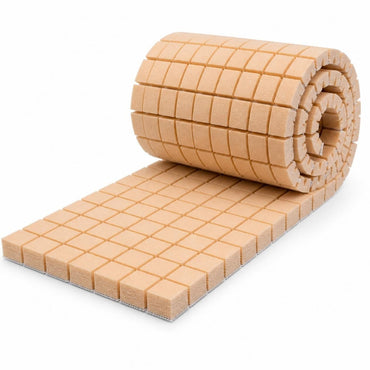
Measure the old core at a cut edge before you order, and measure the transom at the engine cutout before you demolish it: the motor's clamp bracket wants a finished thickness, skins included, and the engine's rigging guide gives the window. On a small skiff with a transom under 48 in wide and 24 in tall, one 4 x 4 ft half sheet of 3/4 in Bluewater 26 cuts into two 24 x 48 in pieces that bond into a 1-1/2 in core. For curved decks, the Divinycell H Contoured PVC Foam Core is scored into small blocks on a glass scrim so it lies down on the crown. Our Divinycell foam core guide covers contoured vs plain and which thickness.
Cutting, fastening and bonding Coosa
- Cutting: a circular saw or table saw with a carbide blade, and carbide drill bits. Coosa's own tooling advice steers you off jigsaws and reciprocating saws on Bluewater; the glass layers tear the edge and eat the blade. Fit the panel with a 1/8 to 1/4 in (3 to 6 mm) gap all round for the bedding fillet.
- Dust: it is glass and foam dust. A fitted P100 respirator with organic vapor cartridges, nitrile gloves and eye protection, and cut outside if you can.
- Prep: scuff both faces with 80 grit, blow the dust off, and wipe with acetone. Just before bedding, wet the bonding face with a thin coat of unthickened resin so the putty grabs.
- Bedding: epoxy thickened with Aerosil - Cabosil (Fumed Silica) to mayonnaise, about 1 cup of loose silica per cup of mixed epoxy, with a spoonful of 1/32" Milled Fiber for strength in the glue line. Trowel it on, press the board in, and weight or clamp it until squeeze-out shows on every edge. Coosa bonds with polyester and vinyl ester as well, but a repair is a secondary bond to cured laminate, and that is epoxy's job.
- Skins: on a transom or a floor, glass over it with 1708 Biaxial Fiberglass, mat side down, lapping 4 to 6 in onto the hull. Figure about 4 oz of resin per square foot per ply by hand, roughly a quart per square yard; the resin calculator sizes the batch.
- Hardware: drill every bolt hole oversize, fill it with thickened epoxy, let it cure, and redrill to size. That gives the bolt a hard sleeve to bear on, so the board does not crush when you torque it down, and it seals the hole.
For bedding and skinning, the Boat Suppliers Epoxy Resin Kit, Thin wets out 1708 and mixes into putty with silica, and its slow 2:1 hardener gives you the working time a full sheet of bedding takes.
How Coosa board ships
A full 4 x 8 ft sheet is too big for parcel carriers, so it travels by truck freight with a liftgate, and one freight charge covers several sheets. The 4 x 4 ft half sheet of Bluewater 26 goes by UPS in an oversize box, which is one more reason to plan a small transom or a run of backing pads around half sheets.
Frequently asked questions
Is Coosa board waterproof?
It does not rot and takes on very little water, because it is closed cell polyurethane foam and glass with no wood in it. Water can still track along an unsealed bolt hole and get behind the skins, so drill every fastener hole oversize, fill it with thickened epoxy, and redrill. Treat a Coosa transom like a plywood one at the holes and it stays dry for good.
Is Coosa board stronger than plywood?
Not per inch. Marine plywood is stiffer and holds screws better at the same thickness. Bluewater 26 comes close on stiffness at about 52 lb per 3/4 in sheet against roughly 70 lb, and it cannot rot. For a transom, stringer or floor on a 16 to 26 ft boat, Bluewater 26 at the original thickness does the job; through-bolt anything that carries load.
How much does a 4 x 8 sheet of Coosa board weigh?
A 3/4 in 4 x 8 ft sheet of Bluewater 26 weighs about 52 lb, and the same sheet of Nautical 15 about 30 lb. Scale by thickness: a 1/2 in Bluewater 26 sheet is about 35 lb and a 1-1/2 in sheet about 104 lb. Marine plywood at 3/4 in runs about 70 lb, so Coosa saves roughly a quarter of the weight.
What is the difference between Bluewater 26 and Nautical 15?
Density and the glass inside. Bluewater 26 is 26 lb per cubic foot with chopped strand mat and woven roving, the structural board for transoms, stringers and floors. Nautical 15 is 15 lb per cubic foot with continuous strand mat only, lighter and less stiff, for consoles, liners, seat boxes and filler panels. Anything that carries a load or spans 14 in or more gets Bluewater 26.
Can you bend Coosa board?
No. It is a stiff, flat board and will crack or spring back rather than follow a curve. For a crowned deck, a curved hull side or a rounded hatch lid, use a contoured PVC foam core, which is scored into small blocks on a glass scrim so it lies down on the shape, and keep Coosa for flat structural parts and backing pads.
What resin do you use with Coosa board?
Epoxy for repairs: bed the board in epoxy thickened with fumed silica to mayonnaise, about 1 cup of silica per cup of mixed epoxy, and lay the 1708 skins in the same epoxy. Coosa also bonds with polyester and vinyl ester, which suits new molded work, but a repair is a secondary bond to cured laminate and epoxy holds that bond best.
What You Need For This Job
- Coosa Bluewater 26 Composite Board: the structural board for transoms, stringers, floors and backing pads
- Coosa Nautical 15 Composite Board: the light board for consoles, liners and filler panels
- 1708 Biaxial Fiberglass: the skins over the board and the tabbing to the hull
- Boat Suppliers Epoxy Resin Kit, Thin: bedding putty and laminating resin
- Aerosil - Cabosil (Fumed Silica): thickens the bedding putty and fillets
- 1/32" Milled Fiber: adds strength to the glue line
Next post

Divinycell Foam Core: Contoured vs Plain Sheets and Which Thickness
Updated on 22 October 2026