West System

West System Six10 Thickened Epoxy Adhesive

West System Six10 Thickened Epoxy Adhesive

SKU:SWES-610

Regular price $36.78 USD
Sale price $36.78 USD Regular price
Sale Sold out
Shipping calculated at checkout.

In stock

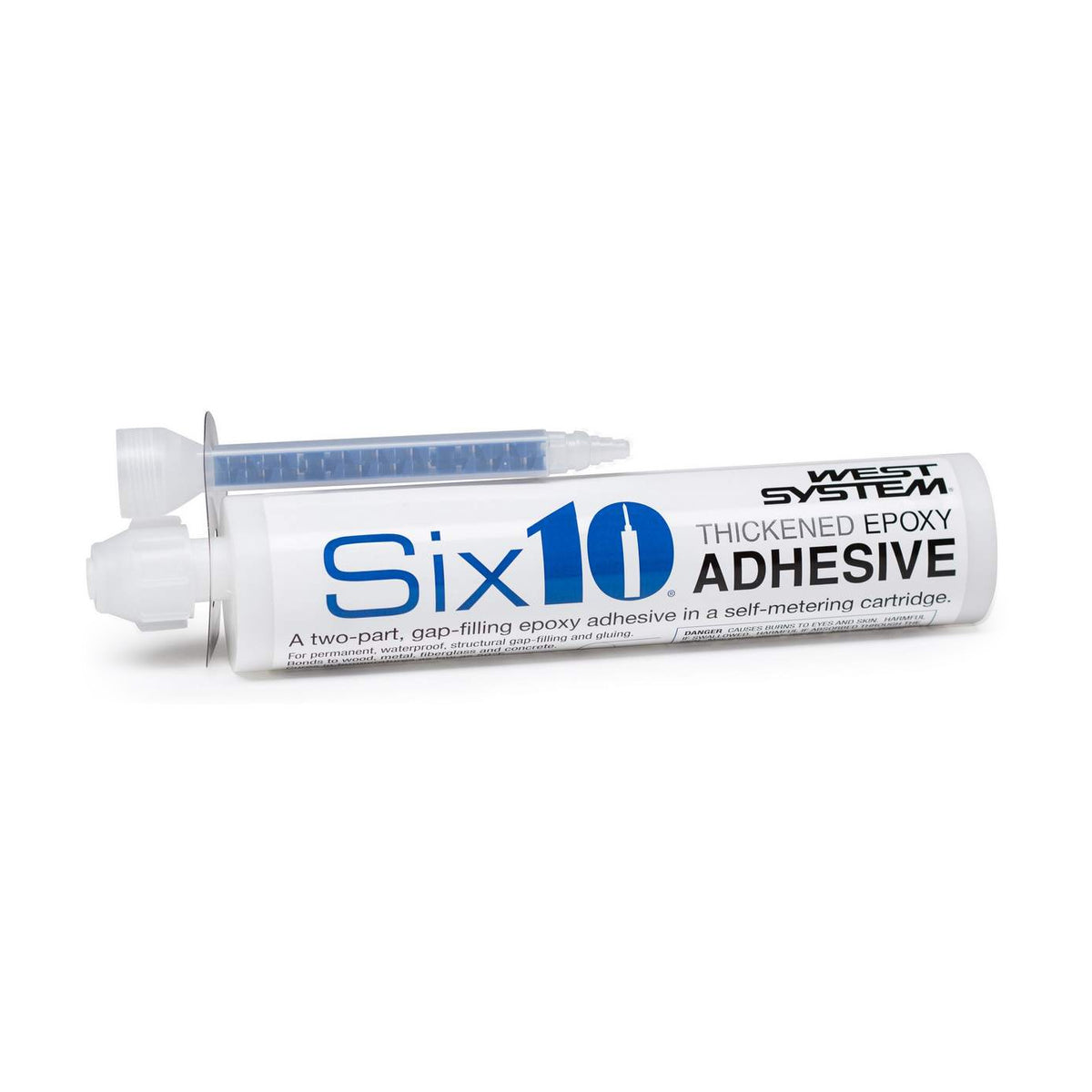
West System Six10 is a thickened epoxy adhesive in a self-metering coaxial cartridge, made for structural bonds, fillets and bedding hardware on jobs too small to justify pumps, cups and a can of filler. It fits any caulking gun, and the 600 static mixer on the tip meters and mixes resin and hardener as you squeeze.

How it handles

It comes out as a non-sag gel that stays put on a vertical face and fills gaps in a bond line. Because the gel is shear-thinning, working it under a tool lets it wet out fabric and a scuffed surface. Pot life is 42 minutes at 72°F (22°C), measured on a 100 g mass. It is solid in 5 to 6 hours and gains working strength over 1 to 4 days. Apply it at 50°F (10°C) or warmer.

Scuff sand and clean wood, metal, fiberglass, composites or masonry before you bond. Between jobs, cap the used tip, and fit a fresh 600 static mixer when you come back to it.

  • Tensile strength 6,440 psi (ASTM D-638) with 7.9% elongation, the toughest in the West range
  • Heat deflection temperature 127°F
  • Cured color: transparent straw yellow
  • Bonds wood, metals, fiberglass, composites and masonry
  • No cups, pumps or measuring
View full details

Technical Specifications


Made in USAMix Auto-metered through the 600 Static Mixer - fits any caulking gun
Resin TypeThickened epoxy adhesive - self-metering coaxial cartridge
Mix RatioAuto-metered through the 600 Static Mixer - fits any caulking gun
ViscosityNon-sag gel; shear-thinning, wets out fabric under tooling pressure
Pot Life42 min (100 g @ 72°F)
Full CureSolid in 5-6 hr; working strength 1-4 days
Cured ColorTransparent straw yellow
Max Service TempHDT 127°F
Tensile Strength6,440 psi (ASTM D-638); 7.9% elongation - toughest of the West range
Apply OverWood, metals, fiberglass, composites, masonry (scuff-sand + clean)
Best ForGap-filling structural bonds, fillets, hardware bedding; minimum 50°F
Country of OriginUSA

Compare Resins


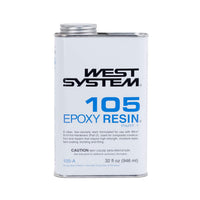
ProductWest System Six10 Thickened Epoxy AdhesiveWest System Six10 Thickened Epoxy AdhesiveYou're viewingfrom $36.78 West System 105 Epoxy ResinWest System 105 Epoxy Resinfrom $59.51
TypeThickened epoxy adhesive - self-metering coaxial cartridgeEpoxy - base resin for WEST SYSTEM 200-series hardeners
Mix RatioAuto-metered through the 600 Static Mixer - fits any caulking gun5:1 by volume with 205/206; 3:1 with 207/209 (300 Mini Pumps meter it)
ViscosityNon-sag gel; shear-thinning, wets out fabric under tooling pressureMixed @ 72°F: 975 cps (205) / 725 cps (206) / 760 cps (207)
Pot Life42 min (100 g @ 72°F)9-12 min (205) / 20-25 min (206) / 20-26 min (207), 100 g @ 72°F
Full CureSolid in 5-6 hr; working strength 1-4 daysSolid in 6-8 hr (205) to 10-15 hr (206/207); working strength 1-4 days
Cured ColorTransparent straw yellowClear/amber; exceptionally clear with 207
Max TempHDT 127°FHDT 117-123°F by hardener
UV—Pair with 207 + UV varnish for bright finishes
Fabrics—Fiberglass, carbon fiber, Kevlar, 1708/1208 biaxial (CSM: stitched only)
Best ForGap-filling structural bonds, fillets, hardware bedding; minimum 50°FPremium marine coating, bonding & repair
SelectedView

Epoxy resin provides better adhesion, moisture resistance, and flexibility compared to polyester resin. While polyester is more economical and widely used in mass production, epoxy is preferred for high-performance applications, repairs, and situations requiring a strong bond.

Follow the specific mix ratio provided by the manufacturer (commonly 2:1 or 1:1 by volume). Mix thoroughly in a clean container, scraping the sides and bottom, until the blend is uniform and streak-free.

The ratio is fixed by the resin and hardener chemistry, not by strength, so each system has its own ratio you must follow exactly. West System uses 5 parts resin to 1 part hardener, while our Boat Suppliers hardeners come in 2:1, 3:1, and 4:1 versions. A lower ratio like 2:1 means more hardener by volume and is easier to measure. Choose cure speed by hardener type, never by changing the ratio.

Amine blush is a waxy film that forms on curing epoxy as it reacts with moisture and carbon dioxide in the air, most often in cool, humid conditions. Left on, it blocks adhesion of the next coat, paint, or gelcoat. Wash the cured surface with plain water and a Scotch-Brite pad, dry it, then sand. West System 207 hardener is formulated to resist blushing.

Hardener speed sets working time and cure time, not final strength. West System 205 Fast gives 9 to 12 minutes of pot life (100 g at 72°F), cures down to 40°F and suits cool shops and small batches. 206 Slow gives 20 to 25 minutes for warm shops and bigger layups, and 209 Extra Slow about 40 to 50 minutes. Always mix at the ratio the system specifies.

Yes, but cold slows the cure and thickens the resin. Below about 60°F most epoxies cure slowly and can stay tacky, and below freezing they may not cure at all. Warm the resin and hardener to room temperature before mixing, heat the work area, and choose a fast hardener for low temperatures. Never add solvent to thin cold epoxy, since that weakens the cured bond.

The best way is to warm it, not add solvent. Stand the resin and hardener in warm water or a warm room and the viscosity drops so it wets out and brushes more easily. Acetone or lacquer thinner does lower viscosity but weakens the cured epoxy and can stop it from fully curing, so keep solvents out of structural mixes. Warm the surface too for a thinner film.

Yes, epoxy resin can be tinted using compatible pigments or dyes. This is often done for cosmetic finishes, artistic projects, or color-coding repairs.

Generally yes, as long as it wasn't frozen repeatedly or for an extended period, but it depends on the product and how it was handled.

What freezing does to epoxy:

  • Resin (Part A): Can cause crystallization or cloudiness. This looks alarming but is usually reversible, gentle warming (100 to 120°F water bath) and stirring typically restores it to normal.
  • Hardener (Part B): More sensitive. Some hardeners (especially amine-based) can be damaged by freezing, becoming cloudy or separating in ways that don't fully reverse.
  • Packaged kits: Pre-measured kits sitting frozen in a warehouse are typically fine, many manufacturers actually ship in cold weather without issue.

Yes. Unopened epoxy resin and hardener usually last one to several years stored cool and sealed, though hardener may darken without losing strength. Polyester resin and gelcoat are shorter lived, often three months to a year depending on the product, because the styrene and promoters break down. MEKP also weakens with age, and old catalyst can leave resin undercured, so check the label.