Table Top Epoxy vs Marine Epoxy: How to Choose the Right System for Your Project

04 April 2026
When you are standing at the workbench deciding between table top epoxy and marine epoxy, the stakes are real. Use the wrong system and you will be sanding it back off inside a season. Use the right one and you get a finish that holds for years. This guide cuts through the confusion so you can match the correct epoxy system to your specific job before you open a single can. The primary keyword throughout this post is table top epoxy vs marine epoxy, and every section is built around that comparison.
What Actually Separates Table Top Epoxy from Marine Epoxy?
Both are two-part epoxy systems. Both cure hard and bond well. The split happens at the formulation level, specifically in UV resistance, moisture barrier performance, and optical clarity priorities.
Table top epoxy is engineered for controlled indoor environments. The chemistry is tuned for maximum clarity and self-leveling flow. Those properties make it exceptional for bar tops, river tables, and art casting, but they come at the cost of UV stability. Put a table top resin in direct sun and it will yellow. The timeline depends on the formulation, but degradation is not a question of if, only when.
Marine epoxy trades some of that optical perfection for durability. UV inhibitors in the resin package resist yellowing and photodegradation under extended sun exposure. The chemistry also prioritizes moisture barrier performance and resistance to saltwater, fuel, and temperature cycling. These are not nice-to-have features on a hull; they are structural requirements.
UV Resistance: The Spec That Settles Most Decisions
If your project lives outdoors or on a boat's exterior, UV resistance is the deciding specification and marine epoxy wins it outright. UV inhibitors in marine-grade systems protect both the epoxy film and the substrate underneath from photodegradation, which on a fiberglass hull can mean the difference between a cosmetic issue and a structural one.
For interior projects where natural light is incidental rather than direct, the UV inhibitor package is less critical. A clear casting resin like Kleer Kote Table Top Epoxy Resin handles interior cabin furniture, bar tops, and woodworking pieces without any UV limitation, because those surfaces simply do not see the sustained UV load that degrades the resin film.
The practical rule: if the cured surface will see direct sun for more than a few hours per day, use marine epoxy. If it is a sheltered interior surface, table top epoxy gives you a better finish at a lower cost.
Table Top Epoxy: Where It Excels
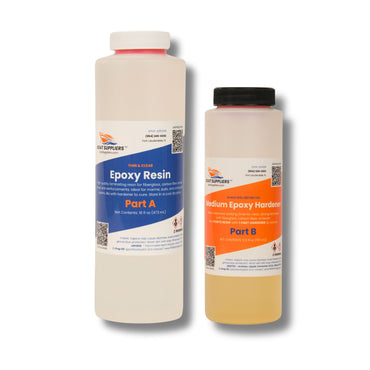
Kleer Kote Table Top Epoxy Resin is a 1:1 mix ratio system by volume that delivers a crystal-clear, glass-like finish. The equal-volume ratio means your measuring and mixing workflow is straightforward and repeatable, with no conversion factors between parts. It self-levels to eliminate brush marks, flows into surface texture, and cures with exceptional clarity.
Coverage varies with pour depth and substrate porosity, but a typical flood coat for a bar top runs approximately 1 gallon per 12 to 16 square feet at an 1/8-inch depth. Use the resin calculator to dial in your quantity before you order so you are not short mid-pour.
Best Applications for Table Top Epoxy
- River tables and live-edge wood slabs
- Bar tops and kitchen countertops
- Art casting, resin jewelry, and encapsulation
- Interior boat cabin surfaces: nav tables, galley counters, berth surrounds
- Electronics potting and encapsulation in sheltered locations
- Woodworking finishing coats for indoor furniture
Many fully cured table top formulations meet FDA compliance for incidental food contact, which is part of why they are the standard choice for commercial bar tops. Always verify the specific product data sheet for food-contact rating and allow full cure before use.
Where Table Top Epoxy Falls Short
- Any surface with direct or prolonged UV exposure
- Hull repairs, deck coatings, or exterior trim
- Submerged or splash-zone applications
- Structural lamination requiring high mechanical properties
Marine Epoxy: Built for Everything the Ocean Throws at It
Marine-grade epoxy systems are formulated around durability priorities that table top resins simply do not address. The key performance differences are measurable. For hull repairs, laminating, and exterior applications, Hawk Epoxy Marine Epoxy is the system we stock and recommend: it is a 2:1 ratio by volume (Part A resin to Part B hardener), available in slow and fast hardener options. With the standard hardener at 72 degrees F, pot life in a mixed cup runs approximately 20 to 25 minutes, giving you workable open time for laminating passes without rushing. Check the product data sheet for hardener selection guidance at temperatures outside that range.
- UV stability: Specialized inhibitor packages resist yellowing and surface degradation under sustained sun exposure
- Chemical resistance: Saltwater, diesel, bilge water, and marine cleaning chemicals do not attack the cured film
- Moisture barrier performance: Low water vapor transmission rate prevents osmotic blistering and substrate saturation
- Temperature cycling: Formulated to flex through the thermal expansion and contraction that cracks rigid systems
- Mechanical strength: Verify tensile and compressive psi values for your specific product on its technical data sheet before specifying for structural work; those numbers vary by hardener selection and cure schedule
Best Applications for Marine Epoxy
- Hull repairs and reinforcement with fiberglass cloth
- Deck coating, fairing, and non-skid applications
- Through-hull fitting installation and bedding
- Keel-to-hull joints and structural lamination
- Exterior trim, hardware backing plates, and chainplate reinforcement
- Underwater components and wet-area protection
When using marine epoxy for laminating work, layer count and fabric weight matter. A standard hull repair with 6 oz fiberglass cloth typically requires 3 to 5 layers depending on the damage depth, with each layer consuming roughly 0.035 to 0.045 gallons of mixed resin per square foot. Run your numbers through the resin calculator before cutting fabric.
Mixing Ratios and Application Conditions
Kleer Kote Table Top Epoxy Resin mixes at 1:1 by volume. Measure equal volumes, combine in a clean container, and mix for a full 3 minutes scraping the sides and bottom. Under-mixing at any ratio is the leading cause of sticky or soft spots in cured epoxy, and it cannot be fixed without grinding back to substrate.
Hawk Epoxy Marine Epoxy runs a 2:1 ratio by volume and is available in slow and fast hardener options to match ambient temperature. In cold weather below 60 degrees F, cure times extend significantly; above 85 degrees F, pot life shrinks fast. Both epoxy types need a clean, dry, contaminant-free surface and ambient temperatures within the manufacturer's recommended range for reliable adhesion.
Application Mistakes That Ruin the Job
- Using table top epoxy on any UV-exposed marine surface
- Mixing by weight when the ratio is specified by volume (or vice versa)
- Applying over damp, oily, or amine-blush-contaminated surfaces
- Working outside the specified temperature window
- Pouring table top epoxy too deep in a single pass (heat buildup causes cracking in thick pours; check the manufacturer's maximum single-pour depth)
- Skipping the seal coat on porous wood before a flood coat
Cost and Long-Term Value
Table top epoxy costs less per gallon than marine-grade systems. For a large indoor project measured in square feet, that difference adds up. The temptation to use table top resin on a marine application to cut costs is understandable, but the math inverts quickly when you factor in failure. A table top resin on an exterior deck surface may start yellowing and delaminating within a single season, requiring full removal and re-application. Marine epoxy applied correctly is a one-time job measured in years, not months.
Buy the right chemistry for the environment the first time. In most cases it is the cheaper path once rework is factored in.
Interior Boat Cabin Surfaces: Where Both Systems Overlap
Interior boat cabin surfaces sit in an interesting overlap zone. A nav table, galley counter, or cabin sole is inside the hull, sheltered from direct UV, but it still lives in a moisture-rich environment with temperature swings. For purely cosmetic surfaces like a varnished-over nav table top, Kleer Kote Table Top Epoxy Resin performs well and gives superior clarity. For structural cabin sole lamination or any repair that ties into the hull structure, use marine epoxy. When in doubt on a cabin surface, marine epoxy is the conservative and correct call.
Frequently Asked Questions
Can I use table top epoxy outdoors on my boat?
No. Table top epoxy is engineered for indoor use where UV exposure is minimal. It yellows under direct sun because it lacks the UV inhibitor package that marine-grade systems carry. For any exterior surface, use marine epoxy. Table top resin is a solid choice for interior cabin surfaces that stay out of the weather.
What is the real difference between table top epoxy and marine epoxy?
Formulation and environment. Table top epoxy prioritizes optical clarity and self-leveling flow for indoor furniture and bar tops. Marine epoxy trades some optical perfection for UV stability, saltwater and fuel resistance, low moisture vapor transmission, and higher mechanical strength for structural laminating and hull work.
Which epoxy do I need for hull repairs versus a bar top?
Hull repairs, deck coatings, through-hull fittings, exterior trim, and anything below the waterline all require marine epoxy. It is built for saltwater, UV, and temperature cycling. Bar tops, river tables, art casting, and interior cabin surfaces are the right territory for table top epoxy, where clarity and glass-like finish matter and the resin stays out of the weather.
Why is marine epoxy more expensive than table top epoxy?
Marine grades include UV inhibitors, chemical-resistance additives, and performance packages that require more expensive raw materials and more rigorous testing. Table top epoxy costs less per gallon, which is appropriate for large indoor projects, but using it in a marine environment leads to premature failure and costly rework. The marine system's longevity is where the value sits.
Is table top epoxy food-safe for a kitchen countertop?
Many table top formulations are FDA compliant for incidental food contact once fully cured, which is why they are standard for commercial bar tops and kitchen counters. Always confirm the specific product's food-contact rating on the data sheet and allow full cure before putting the surface into service.
How much epoxy do I need for my project?
Coverage depends on pour depth, substrate porosity, and number of coats. A flood coat of table top epoxy typically covers 12 to 16 square feet per gallon at 1/8-inch depth. Marine epoxy laminating coats over 6 oz fiberglass cloth run approximately 0.035 to 0.045 gallons of mixed resin per square foot per layer. Use the resin calculator to get an accurate quantity before ordering.
What You Need For This Job
- Kleer Kote Table Top Epoxy Resin: crystal-clear 1:1 system for bar tops, river tables, and interior cabin surfaces
- Hawk Epoxy Marine Epoxy: 2:1 system with slow and fast hardener options for hull repairs, laminating, deck coatings, and all exterior marine work
- 6 oz Fiberglass Cloth: standard weight for hull repairs and structural laminating passes with marine epoxy
- Epoxy Mixing Supplies: calibrated mixing cups, stir sticks, and reusable pumps for accurate ratio work on both systems
- Nitrile Gloves: barrier protection for every pour and laminating session
- Epoxy Fairing Compound: for hull repair finish work after structural laminate layers are complete
Shop the materials in this guide
Prev post

Vinyl Ester Resin Application: Professional Techniques for Superior Marine Composites
Updated on 05 April 2026
Next post

How to Mix Polyester Resin: Complete Beginner's Guide for Perfect Results
Updated on 04 April 2026