Boat Winterization Checklist: Fix the Fiberglass Before It Sits

20 October 2026
The boat is coming out and the question is what on the hull gets fixed now and what waits until spring. The rule that settles the boat winterization checklist for a fiberglass hull: anything that lets water into the laminate gets repaired before the boat sits, while the shop is still above 60°F (16°C), because polyester and epoxy both stall below that. Cosmetic gelcoat work waits.
The boat winterization checklist, hull side
- Wash the hull and inspect it wet under a raking light; dry chalk hides everything.
- Sound it with a plastic mallet: a sharp tap is solid laminate, a dull thud is delamination or wet core.
- Sort every mark into three piles: through the gelcoat into fiber, gelcoat only, or soft.
- Dry the repair areas, repair the first and third piles while it is warm enough to cure, then compound, wax, block, cover and vent.
What gets fixed before storage
Water inside the laminate in October is ice in January. A hairline crack you could fill in an afternoon is a hand-sized delamination by spring. The before-storage pile is every break that reaches fiber:
- Stress cracks that show white fiber at the bottom. If a fingernail catches, it is through.
- Gouges and punctures that show glass, from a bunk, a cleat or a rock.
- Keel and stem wear on composite paddle craft where the outer fiber is fuzzed through.
- Soft spots in a deck or transom: opened, dried and sealed at minimum; the rebuild can wait if the core is dry when you close it.
- Failed bedding around a cored-deck fitting: pull it, dig out wet core, fill and re-drill.
What waits for spring
Crazing and spider cracks that do not catch a fingernail are cosmetic and wait for warm weather. Chalky gelcoat is a compound-and-wax job, not a repair. Blisters are the exception, better opened in the fall: pop them, grind them out, let them dry under the cover all winter, then fill and barrier coat in spring when the laminate reads dry.
Temperature is the deadline
Neither resin family fixes itself in the cold. With Silmar 249 polyester the MEKP dose moves with temperature; with a 3:1 marine epoxy you never touch the ratio, you wait for a warmer day. Grinding cured glass and laying up polyester call for a fitted P100 with organic vapor cartridges, nitrile gloves and eye protection.
| System | Dose or ratio | Shop minimum | Below it |
|---|---|---|---|
| Silmar 249 polyester + MEKP | 1.5% MEKP (14 mL per quart) at 65 to 85°F (18 to 29°C); 2% at 60 to 65°F; 1% above 85°F | 60°F (16°C) | Never hardens. Scrape it off and remix on a warmer day. |
| Marine epoxy, medium 3:1 hardener | 3 parts resin to 1 part hardener by volume, always | 60°F (16°C) | Cure crawls for days. Do not add hardener; warm the space. |
Working time on the polyester is 15 to 20 minutes at room temperature and it sands in 2 to 4 hours. Epoxy cure depends on the hardener; check the TDS on the can. A heater and a tarp tent buys a week or two, but the laminate has to be warm, not just the air: heat the hull for an hour before you mix.
Pick the repair by the damage
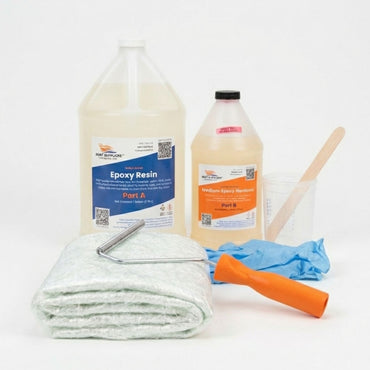
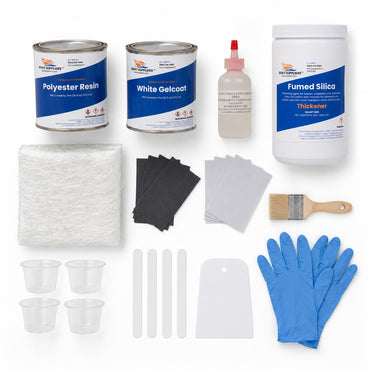
Match the box to the pile, not to the size of the boat. A crack or a fist-sized hole in a hull or deck is a quart job: the Fiberglass Repair Kit - Complete DIY Kit with Resin, Cloth & Mat carries a quart of Silmar 249 with MEKP, a yard each of 6 oz woven cloth and 1.5 oz chopped strand mat, and a quart of fumed silica for putty. A skin repair on a hull side, a soft deck section or a cracked stringer is a gallon job: the Boat Fiberglass Repair Kit - Professional Grade with Gallon Resin & Roller pairs a gallon of Silmar 249 with 3 yd of 50 in 1708 biaxial, 3 yd of 1.5 oz CSM and a laminating roller.
A transom or stringer rebuild is an epoxy job, because bonding to cured laminate and wood is a secondary bond and polyester does not hold one. The 1708 Fiberglass Repair Kit - 5 Yards with Marine Epoxy & Tools is sized so the resin covers the cloth: 5 yd of 50 in 1708 with 1.33 gal of mixed 3:1 marine epoxy. Composite kayaks and canoes (never rotomolded polyethylene) get the Kayak & Canoe Repair Kit - Epoxy & Fiberglass for Composite Hulls: 12 oz of 2:1 epoxy, a yard of 6 oz cloth and 2 yd of 6 in 1708 tape for stems and seams. Worn stems get the KEVLAR® Canoe & Kayak Skid Plate Kit - Genuine Aramid Tape + Epoxy. For anything bigger than a kit, run the area through the resin calculator first.
Storage: what the hull sits on and under
Pull the drain plug and leave it out; sponge the bilge dry. Trailer bunks should carry the hull under stringers or bulkheads, not on open panel, with the winch strap slack. On stands the keel takes the weight and the pads only steady the hull; a pad cranked into unsupported topside prints a dent by spring. Keep the cover off the gelcoat on spacers with air moving through; shrink wrap over a damp hull is a greenhouse, so vent it.
Frequently asked questions
What temperature is too cold to repair fiberglass before winter storage?
Below 60°F (16°C) for both polyester and epoxy. Silmar 249 with MEKP will not harden under that, and at 60 to 65°F you already need 2% catalyst instead of 1.5%. Epoxy at 3:1 gets a heater, not more hardener. Warm the hull itself for an hour before mixing and hold 60°F through the cure, or tape and tarp the damage until spring.
Should I fix gelcoat spider cracks before winterizing a boat?
Only if they catch a fingernail. Crazing that stays in the gelcoat does not admit water and is a spring cosmetic job. A crack that catches, or shows white at the bottom, reaches fiber: grind it to a shallow V, fill with silica-thickened resin from the fiberglass repair kit, and fair with 120 then 240 grit before the boat sits.
Can I winterize a boat with a soft transom and rebuild it in spring?
Yes, if you stop the water first. Pull the outboard bolts and through-transom fittings, let the core drain and dry under cover, and tape the holes. The rebuild wants a warm week: 3 to 4 plies of 50 in 1708 over a new core with 3:1 marine epoxy, which is what the 5 yd 1708 kit is sized for. Never close a wet core in the fall.
How do I know if a fiberglass hull is dry enough to repair?
Tape a 12 in square of clear plastic over the area, sealed on all four edges, and leave it overnight. Fog under it in the morning means the laminate is still giving up water and nothing will bond. A pin moisture meter across the repair should match a known-dry part of the hull. A cored deck can take weeks; a solid skin a few days of warm air.
Does a composite kayak or canoe need a skid plate before winter?
If the stems show fuzzed glass or aramid, yes, now: exposed fiber wicks water all winter. The Kevlar skid plate kit puts two 6 x 30 in pieces of 5 oz aramid tape on bow and stern with epoxy in an afternoon, over an 80 grit scuff. Cracks and seams elsewhere get the kayak and canoe kit's 6 oz cloth and 6 in 1708 tape. Rotomolded polyethylene takes neither.
What You Need For This Job
- Fiberglass Repair Kit - Complete DIY Kit with Resin, Cloth & Mat: cracks and small holes, quart scale
- Boat Fiberglass Repair Kit - Professional Grade with Gallon Resin & Roller: hull and deck skin repairs with 1708, gallon scale
- 1708 Fiberglass Repair Kit - 5 Yards with Marine Epoxy & Tools: transom and stringer rebuilds in 3:1 marine epoxy
- Kayak & Canoe Repair Kit - Epoxy & Fiberglass for Composite Hulls: hull cracks and seams on composite paddle craft
- KEVLAR® Canoe & Kayak Skid Plate Kit - Genuine Aramid Tape + Epoxy: bow and stern wear plates before the stems go through
Next post

Fiberglass Explained: Cloth, Mat, Roving and Biaxial by Job
Updated on 19 October 2026