Fiberglass Resin: Polyester vs Vinyl Ester vs Epoxy for Your Repair

29 September 2026
Which fiberglass resin you buy is decided by what is under the repair, not by what is cheapest on the shelf. Polyester and vinyl ester bond well to fresh, ground polyester laminate and to each other. Epoxy bonds to everything, including cured epoxy, wood, and old laminate you cannot fully trust, and it is the only one of the three that will stick to a previous epoxy repair. Start from the substrate, then pick the resin, then size the kit.
The one rule that settles most fiberglass resin decisions
Polyester and vinyl ester cure by a styrene crosslink kicked off with MEKP. Epoxy cures by a resin and hardener reaction at a fixed ratio. That chemistry difference is why polyester will not form a reliable secondary bond to cured epoxy. We learned this on a '94 Whaler transom where the previous owner had patched with epoxy and someone later laid polyester over it. The new glass peeled off in a sheet. We ground the whole thing back to sound laminate and rebuilt in epoxy.
So the rule: if there is any chance the surface was ever repaired with epoxy, or it is wood, or it is old laminate you cannot grind fully clean, use epoxy. If the boat is a production polyester hull and you can grind to bright, clean glass with a 36 grit disc, polyester or vinyl ester is fine and cheaper.
Polyester laminating resin
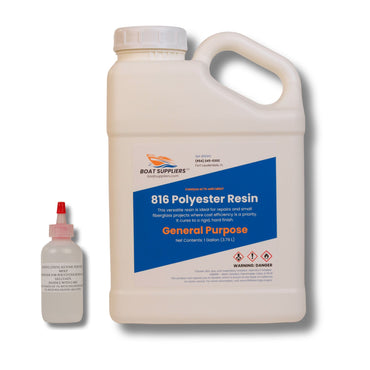
Ortho polyester is the resin the boat was built with. It wets out chopped strand mat and 1708 biaxial fast, it is the least expensive per gallon, and it gels on a schedule you control with MEKP dose. Catalyze at 1 to 2 percent by volume, 1.25 to 1.5 percent being the normal shop dose at 77°F (25°C). At 1.5 percent expect a gel time around 15 to 25 minutes in a quart cup; check the TDS on the can for your batch. Air-inhibited laminating resin stays tacky on the surface so the next ply bonds chemically. The last coat needs a surfacing agent or PVA, or gelcoat over it, to cure hard.
Its weaknesses: roughly 7 percent cure shrinkage, low elongation, and the weakest secondary bond of the three. Use it where the original hull is polyester, the repair is above the waterline, and you are laying 1708 or mat over freshly ground glass.
Vinyl ester resin
Vinyl ester (VE) catalyzes with MEKP like polyester, so the shop workflow is identical, but the backbone is epoxy-derived. That gets you higher elongation, better fatigue resistance, and far better water resistance. It is the resin for osmotic blister repair, below-waterline patches, fuel tank areas, and any transom or stringer job where you want polyester handling with a stronger laminate. VE bonds to ground polyester as well as polyester does and costs less than epoxy. The catch is shelf life: promoted VE is good for about three months, so buy it when you are ready to use it.
Epoxy resin
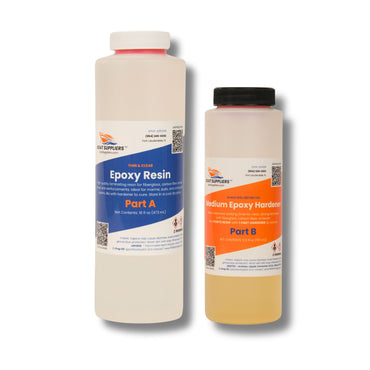
Epoxy is mixed at the system ratio, no more and no less. Our thin laminating epoxy runs 2:1 by volume with the slow hardener, which gives a long working window for wetting out 1708 and cloth. The fast 4:1 hardener kicks in about 15 minutes at 80°F (27°C), sets in 1 to 2 hours, and stays workable down to about 45°F (7°C). Epoxy has no styrene, shrinks very little, and has the best adhesion to wood, metal, cured laminate, and itself. It is the only resin for sheathing a wood boat or bonding a new plywood or composite transom core.
Two things to manage: amine blush on some formulations, which you wash off with water and a scuff before the next coat once fully cured, and UV. Epoxy chalks in sunlight, so it always gets paint or a UV-stable topcoat. Cold slows it badly. Below 60°F (16°C) plan on double the cure time or move to the fast hardener.
| Resin | Cure system | Typical gel or pot life at 77°F | Secondary bond | Best use |
|---|---|---|---|---|
| Polyester | MEKP, 1 to 2% by volume | 15 to 25 min at 1.5% | Fair, to ground polyester only | Above-waterline repairs on production hulls, molds, buildup |
| Vinyl ester | MEKP, 1 to 2% by volume | 15 to 30 min at 1.5% | Good, to ground polyester | Blister repair, below waterline, transoms, stringers |
| Epoxy (2:1 slow) | Hardener at fixed ratio | 30 to 45 min in a cup, check the TDS | Best, to anything sound | Wood, old laminate, prior epoxy repairs, cores |
| Epoxy (4:1 fast) | Hardener at fixed ratio | About 15 min at 80°F | Best, to anything sound | Cold shop, small batches, tabbing |
Match the resin to the repair
Transom rebuild on a production outboard boat. If you grind the inner skin to clean glass and use a new plywood or composite core, vinyl ester with 1708 is the standard boatyard answer. If the old skin was ever epoxied, or you want the strongest core bond you can buy, use epoxy. Either way, run 3 to 4 plies of 1708 over the core and tab into the hull sides.
Stringers and floor. Polyester or VE with 1708 over the stringer caps and 1.5oz chopped strand mat as the first ply against ground glass. Mat gives the resin-rich bed that 1708 wants underneath it.
Hull puncture below the waterline. Vinyl ester. Grind a 12:1 scarf, alternate mat and 1708, finish with gelcoat or barrier coat.
Wood boat, canoe, kayak, or bar top sheathing. Epoxy with 6oz plain weave cloth. Polyester will not hold on wood long term.
Which kit to buy
For a single transom or a couple of stringers, the 1708 Biaxial Fiberglass & Resin Kit gives you 5 yards of 50 inch 1708 with a gallon of polyester or vinyl ester and the MEKP and mixing supplies to run it. Five yards at 50 inches wide is about 6.9 square yards of fabric, and a gallon is right for hand layup of that much 1708 with a little left for tabbing.
For a full transom plus stringers and a floor, step up. The 1708 Fiberglass & Resin Kit, 10 Yards + 5 Gallons Polyester is the polyester version. The 1708 Fiberglass & Epoxy Kit, 10 Yards + 6 Gallons Epoxy ships the same fabric with four gallons of thin laminating epoxy and two gallons of slow hardener, already sized to the 2:1 mix. The Boat Building Fiberglass Kit splits the fabric into 5 yards of 1708 and 5 yards of 1.5oz mat with 5 gallons of resin, which is the right mix for jobs that need a mat bed under every ply of biax.
For sheathing and finish work, the Fiberglass Cloth & Resin Kit, 5 Yards 6oz Cloth comes in polyester, vinyl ester, or a half-gallon epoxy kit. For mold building and buildup layers, the Fiberglass Mat & Resin Kit, 5 Yards 1.5oz CSM is the bulk material. Mat drinks resin at roughly 2:1 resin to glass by weight, so if your job is mostly mat, budget more resin than you would for 1708. Run your actual square footage and ply count through the resin calculator before you order.
Wear a fitted P100 respirator with organic vapor cartridges for styrene work, nitrile gloves, and eye protection, and keep the MEKP away from the acetone.
Frequently asked questions
Can I use polyester fiberglass resin over an old epoxy repair?
No. Polyester and vinyl ester do not form a dependable secondary bond to cured epoxy, and the new laminate will peel under load. If you are not sure what the last repair was, grind a test spot: epoxy sands to a gummy, waxy dust and polyester sands to a dry, chalky powder. When in doubt, use epoxy, which bonds to both.
How much MEKP do I add to a gallon of polyester resin?
Dose at 1 to 2 percent by volume. At 1.5 percent that is about 1.9 oz (56 ml) per gallon, which gives a 15 to 25 minute gel at 77°F (25°C). Go to 1 percent when the shop is over 85°F or the batch is large, and up to 2 percent when it is under 65°F. Never exceed 2 percent; the laminate gets brittle. The MEKP catalyst calculator does the math per batch size.
Is vinyl ester worth the extra cost over polyester?
For anything below the waterline, yes. VE has about 4 to 5 percent elongation compared to under 2 percent for ortho polyester, and much lower water absorption, which is why it is the standard for blister repair and transom work. Above the waterline on a production hull, polyester is fine and the money is better spent on an extra ply of 1708.
How much resin does 5 yards of 1708 need?
Plan on about one gallon per 5 yards of 50 inch 1708 at hand-layup ratios, roughly 1:1 resin to glass by weight. Chopped strand mat takes closer to 2:1, so 5 yards of 1.5oz mat wants about 1.3 gallons. Add 10 percent for tabbing and cup waste, and run the numbers in the resin calculator for your ply schedule.
Which fiberglass resin should I use on a wood boat?
Epoxy, every time. Polyester and vinyl ester shrink as they cure and do not adhere well to wood, so the sheathing cracks and lifts within a season or two. Use a thin 2:1 laminating epoxy with 6oz plain weave cloth for sheathing, seal the end grain first with two neat coats, and paint or varnish over it for UV protection.
What You Need For This Job
- 1708 Biaxial Fiberglass & Resin Kit: 5 yards of 1708 with a gallon of polyester or vinyl ester for one transom or stringer job
- 1708 Fiberglass & Epoxy Kit, 10 Yards: the epoxy build, 6 gallons at 2:1 for wood cores and old laminate
- 1708 Fiberglass & Resin Kit, 10 Yards: the polyester build for full transom, stringer, and floor jobs
- Boat Building Fiberglass Kit: 1708 plus 1.5oz mat with 5 gallons for a mat-and-biax schedule
- Fiberglass Cloth & Resin Kit, 6oz: sheathing and finish laminate on wood, boards, and bar tops
- Fiberglass Mat & Resin Kit, 1.5oz CSM: buildup layers, molds, and the bed ply under 1708
Next post

Epoxy Calculator: How Much Resin Your Layup Actually Needs
Updated on 28 September 2026