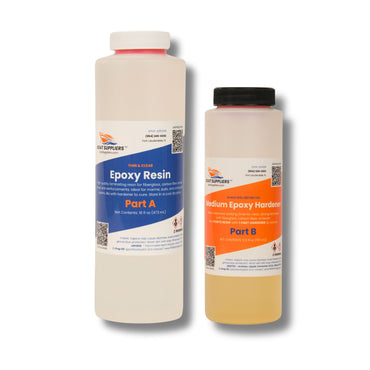
Epoxy & Resin Calculator
Estimate epoxy, polyester, or vinyl ester for a fiberglass layup, tabletop pour, fillet, or coating. Build your layup ply by ply to get resin, fabric, laminate thickness, and a shopping list.
- Free, no signup
- Multi-ply layup builder
- Hand, vacuum bag, infusion
- Live prices, one-click cart
Resin and thickness per ply, by fabric
Resin weight in ounces per square foot for one ply, and the cured thickness each ply adds in a hand layup. Multiply by your area and ply count, then add waste. Vacuum bagging and infusion also compress the laminate about 12 and 20 percent.
| Reinforcement | Weight | Hand layup oz/sq ft | Vacuum bag oz/sq ft | Infusion oz/sq ft | Gal per 100 sq ft hand, with waste | Thickness in per ply | Plies to 1/4 in |
|---|---|---|---|---|---|---|---|
| 4 oz E-glass cloth | 4 oz/yd² | 0.49 | 0.34 | 0.25 | 0.44 | 0.006 | 42 |
| 6 oz E-glass cloth | 6 oz/yd² | 0.73 | 0.51 | 0.37 | 0.66 | 0.009 | 27 |
| 8.5 oz 2x2 twill E-glass | 8.5 oz/yd² | 1.04 | 0.73 | 0.52 | 0.93 | 0.010 | 27 |
| 10 oz E-glass cloth | 10 oz/yd² | 1.22 | 0.85 | 0.61 | 1.1 | 0.015 | 17 |
| 18 oz E-glass cloth | 18 oz/yd² | 2.2 | 1.54 | 1.1 | 2.06 | 0.021 | 13 |
| 6 oz S-glass cloth (6533) | 6 oz/yd² | 0.73 | 0.51 | 0.37 | 0.66 | 0.009 | 28 |
| 1208 biaxial (12 oz + 3/4 oz mat) | 19 oz/yd² | 3.2 | 2.24 | 1.6 | 3 | 0.037 | 7 |
| 1708 biaxial (17 oz + 3/4 oz mat) | 24 oz/yd² | 4 | 2.8 | 2 | 3.75 | 0.044 | 6 |
| 1808 biaxial 0/90 (18 oz + 3/4 oz mat) | 25 oz/yd² | 4.1 | 2.87 | 2.05 | 3.84 | 0.048 | 6 |
| DB170 biaxial, no mat (17 oz) | 17 oz/yd² | 2 | 1.4 | 1 | 1.88 | 0.030 | 9 |
| 3/4 oz chopped strand mat | 0.75 oz/ft² | 1.7 | 1.2 | 0.85 | 1.53 | 0.020 | 13 |
| 1.5 oz chopped strand mat | 1.5 oz/ft² | 3.4 | 2.4 | 1.7 | 3.05 | 0.040 | 7 |
| 2 oz chopped strand mat | 2 oz/ft² | 4.54 | 3.18 | 2.27 | 4.08 | 0.055 | 5 |
| 18 oz woven roving | 18 oz/yd² | 2.2 | 1.54 | 1.1 | 2.06 | 0.030 | 9 |
| 24 oz woven roving | 24 oz/yd² | 2.93 | 2.05 | 1.47 | 2.75 | 0.040 | 7 |
| 5.7 oz 3K plain weave carbon | 5.7 oz/yd² | 0.63 | 0.44 | 0.32 | 0.59 | 0.010 | 25 |
| 11 oz 6K 2x2 twill carbon | 11 oz/yd² | 1.22 | 0.86 | 0.61 | 1.14 | 0.018 | 14 |
| 19.7 oz 12K 2x2 twill carbon | 19.7 oz/yd² | 2.29 | 1.6 | 1.15 | 2.15 | 0.030 | 9 |
| 5 oz Kevlar (style 285) | 5 oz/yd² | 0.67 | 0.47 | 0.34 | 0.63 | 0.010 | 25 |
| Coremat Xi 2 mm | 2 mm | 3.9 | n/a | n/a | 3.5 | 0.079 | - |
| Coremat Xi 4 mm | 4 mm | 7.9 | n/a | n/a | 7.1 | 0.157 | - |
Coremat soaks up a fixed amount of resin and is for hand layup only. Rates are resin weight; the calculator converts at 128 oz per gallon, which leaves a little extra volume on top of the waste factor.
Common layup schedules, per 10 square feet
Starting points for common jobs. Open any row in the calculator to change the size, resin, or plies.
| Job | Plies (mold side first) | Resin and method | Resin, gal | Thickness, in | Laminate, lb/sq ft |
|---|---|---|---|---|---|
| Hull or deck repair | 2 x 1708, 1 x 6 oz cloth, 2 x Fill coat | Epoxy, hand | 0.87 | 0.105 | 0.96 |
| Transom or stringer tabbing | 1 x 1.5 oz mat, 3 x 1708 | Polyester, hand | 1.44 | 0.172 | 1.56 |
| Kayak or canoe sheathing | 1 x Seal coat, 1 x 6 oz cloth, 2 x Fill coat | Epoxy, hand | 0.15 | 0.021 | 0.14 |
| Fiberglass mold (tooling) | 2 x Tooling gelcoat, 1 x 3/4 oz mat, 3 x 1.5 oz mat, 2 x 1708 | Polyester, hand | 1.82 + 0.3 gel | 0.268 | 2.21 |
| Production part from a mold | 1 x Gelcoat, 1 x 3/4 oz mat, 2 x 1.5 oz mat, 1 x 18 oz roving | Polyester, hand | 0.97 + 0.15 gel | 0.150 | 1.18 |
| Cored panel with Coremat | 1 x 1.5 oz mat, 1 x Coremat 2 mm, 1 x 1.5 oz mat | Polyester, hand | 0.97 | 0.159 | 0.87 |
| Carbon part, vacuum bagged | 4 x 5.7 oz twill carbon | Epoxy, vacuum bag | 0.15 | 0.035 | 0.27 |
| Infused structural panel | 2 x 1708, 1 x 18 oz roving, 2 x 1708 | Vinyl ester, infusion | 0.82 | 0.165 | 1.36 |
| Surfboard deck | 2 x 4 oz cloth, 1 x Fill coat | Epoxy, hand | 0.12 | 0.016 | 0.14 |
Resin includes waste. Gelcoat is listed separately where the schedule uses it. Always follow the design or repair spec for the boat you are working on.
How the calculator works
Each ply is estimated on its own and added up, so a schedule can mix cloth, mat, biaxial, carbon, Kevlar, core, gelcoat, and coats. Waste is added per ply: 15 percent for cloth and mat, 20 percent for heavy stitched fabrics, carbon, and Kevlar by hand, 10 percent under a vacuum bag, and 15 percent for infusion to cover the feed line.
- Example. 50 sq ft of 6 oz cloth, two plies, by hand: 50 x 2 x 0.73 / 128 x 1.15 = 0.66 gallons.
- Mix plan. Batches are capped at 32 oz for slow epoxy and polyester, 24 oz for medium, and 12 oz for fast hardener, so each batch goes on before it kicks.
- Buy list. Fabric is sized per material with 10 percent for cutting and overlaps, using the cheapest mix of cut lengths and roll widths in stock.
Tabletop, fillet, and coating coverage
| Thickness | Use | Sq ft/gal neat | With waste | Gal per 10 sq ft |
|---|---|---|---|---|
| 1/16 in | Thin coat or seal | 25.7 | 22.3 | 0.45 |
| 1/8 in | Standard flood coat | 12.8 | 11.2 | 0.90 |
| 1/4 in | Thick deep-pour look | 6.4 | 5.6 | 1.79 |
| Radius | Section, sq in | Mixed, gal | Resin, gal |
|---|---|---|---|
| 3/8 in | 0.030 | 0.02 | 0.01 |
| 1/2 in | 0.054 | 0.03 | 0.02 |
| 3/4 in | 0.121 | 0.07 | 0.05 |
| 1 in | 0.215 | 0.13 | 0.09 |
| Coat | Film | Sq ft/gal | Gal per coat | Notes |
|---|---|---|---|---|
| Seal coat on bare wood | 4 mil | 365 | 0.34 | First coat soaks in, so it uses more. |
| Build or fill coat | 4 mil | 365 | 0.27 | Roll and tip. About 4 mil per coat. |
| Barrier coat (per coat) | 5 mil | 292 | 0.34 | Blister protection below the waterline. Five coats is typical. |
| Heavy build coat | 8 mil | 182 | 0.55 | Squeegee coat for fairing or high build. |
Epoxy vs polyester vs vinyl ester
| Property | Epoxy | Polyester | Vinyl ester |
|---|---|---|---|
| Mix | 2:1, 3:1, or 4:1 resin to hardener by volume (Boat Suppliers epoxy) | 1 to 2% MEKP by volume | 1 to 2% MEKP by volume |
| Pot life at 80°F | 35 to 40 min (2:1), 20 to 25 min (3:1), about 15 min (4:1) | 15 to 20 min | 15 to 20 min |
| Bond to wood and cured laminate | Excellent | Fair | Good |
| Water and blister resistance | Excellent | Fair to good | Excellent |
| Shrinkage (by volume) | Under 1% | 6 to 8% | 3 to 5% |
| Works with chopped strand mat | No, use stitched fabric | Yes | Yes |
| Under gelcoat | No | Yes | Yes |
| Odor | Low | Strong (styrene) | Moderate (styrene) |
| Relative cost | Highest | Lowest | Middle |
Layup rules that prevent failures
- Gelcoat first, then a skin coat. Gelcoat goes into the mold first, backed by 3/4 oz mat or surfacing veil so the fabric pattern does not print through.
- Mat between woven roving. Roving laid on roving leaves resin-starved gaps. Alternate it with chopped strand mat.
- No chopped strand mat in epoxy. Its binder needs styrene to dissolve. Use 1708 or woven cloth with epoxy.
- Polyester does not bond to cured epoxy. Epoxy bonds well to cured polyester, so repairs over old polyester laminate are usually done in epoxy.
- Coremat is hand layup only. Vacuum pressure crushes it.
- Peel ply goes on last. It pulls off after cure and leaves a clean surface for the next bond.
Resin calculator FAQ
How much resin do I need per square foot of fiberglass cloth?
For 6 oz fiberglass cloth, plan on about 0.73 ounces of resin per square foot per layer to wet out the cloth, which is roughly a 1:1 ratio with the dry glass weight. To bury the weave for a smooth finish, add about 0.3 ounces per square foot for each fill coat. Heavier fabrics use more: 10 oz cloth runs about 1.22 ounces per square foot per layer, and 1708 biaxial about 4.0.
How do I calculate resin for a layup with different fabrics?
Work out each ply on its own and add them up: area times the resin rate for that fabric, times the number of plies, plus waste. A transom layup of one ply of 1.5 oz mat and three plies of 1708 over 25 square feet takes about 3.6 gallons of polyester by hand. The layup builder above does this for any stack of cloth, mat, biaxial, carbon, Kevlar, core, gelcoat, and coats.
How thick is a fiberglass layup?
Each ply adds a predictable amount when it is wet out by hand: about 0.009 inch for 6 oz cloth, 0.040 inch for 1.5 oz chopped strand mat, and 0.044 inch for 1708 biaxial. Six plies of 1.5 oz mat or six plies of 1708 build roughly a quarter inch. Vacuum bagging compresses the laminate about 12 percent, and infusion about 20 percent.
How much less resin does vacuum bagging use?
About 30 percent less than hand layup, because the bag squeezes the extra resin out into the breather. Infusion uses about half the resin of hand layup. The calculator also sizes the peel ply, release film, breather, bag film, and sealant tape for the part.
Can I use chopped strand mat with epoxy?
Standard chopped strand mat is held together with a binder that only dissolves in the styrene in polyester and vinyl ester resin, so epoxy will not wet it out properly. With epoxy, use woven cloth or a stitched fabric such as 1708, whose mat is stitched rather than glued.
How much epoxy do I need for a tabletop or bar top?
A standard 1/8 inch flood coat covers about 11 square feet per gallon after waste, so a 12 square foot top needs roughly 1.08 gallons. A thinner 1/16 inch coat covers about 22 square feet per gallon, and a thick 1/4 inch deep-pour look about 5.6 square feet per gallon.
How much resin does an epoxy fillet use?
A cove fillet only fills the concave corner the filleting tool leaves behind, so it uses less than a solid quarter-round would suggest. A standard 3/4 inch fillet uses about 0.07 gallons of thickened mix per 10 linear feet, about two thirds of which is resin, and a 1 inch fillet about 0.13 gallons.
What is the epoxy resin to hardener mix ratio?
Boat Suppliers epoxy is measured by volume and the ratio depends on the hardener speed: slow hardener is 2:1 resin to hardener, medium is 3:1, and fast is 4:1. Other brands use their own ratios, so follow the label. Polyester and vinyl ester instead use 1 to 2 percent MEKP catalyst by volume.
Should I use epoxy, polyester, or vinyl ester resin?
Epoxy has the best adhesion, strength, and near-zero shrinkage, which makes it the choice for repairs and bonding to wood, and it costs the most. Polyester is the most economical and cures fast, but shrinks more and has a stronger odor. Vinyl ester sits in the middle on price with excellent water and chemical resistance.
Related tools and guides
Fiberglass & Carbon Fiber
Shop Composites

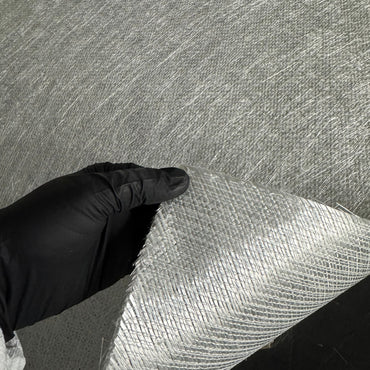
1708 Biaxial Fiberglass

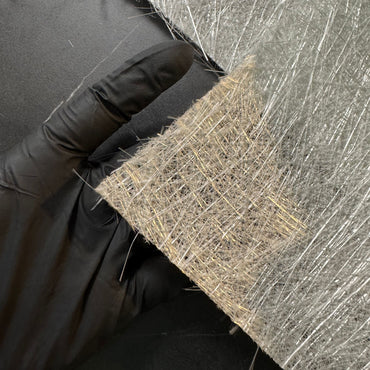
1.5oz Fiberglass Chopped Strand Mat

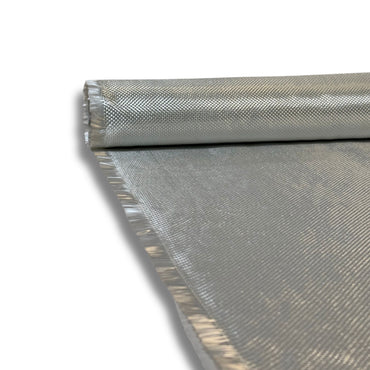
6oz Fiberglass E Cloth

4oz Fiberglass E Cloth