
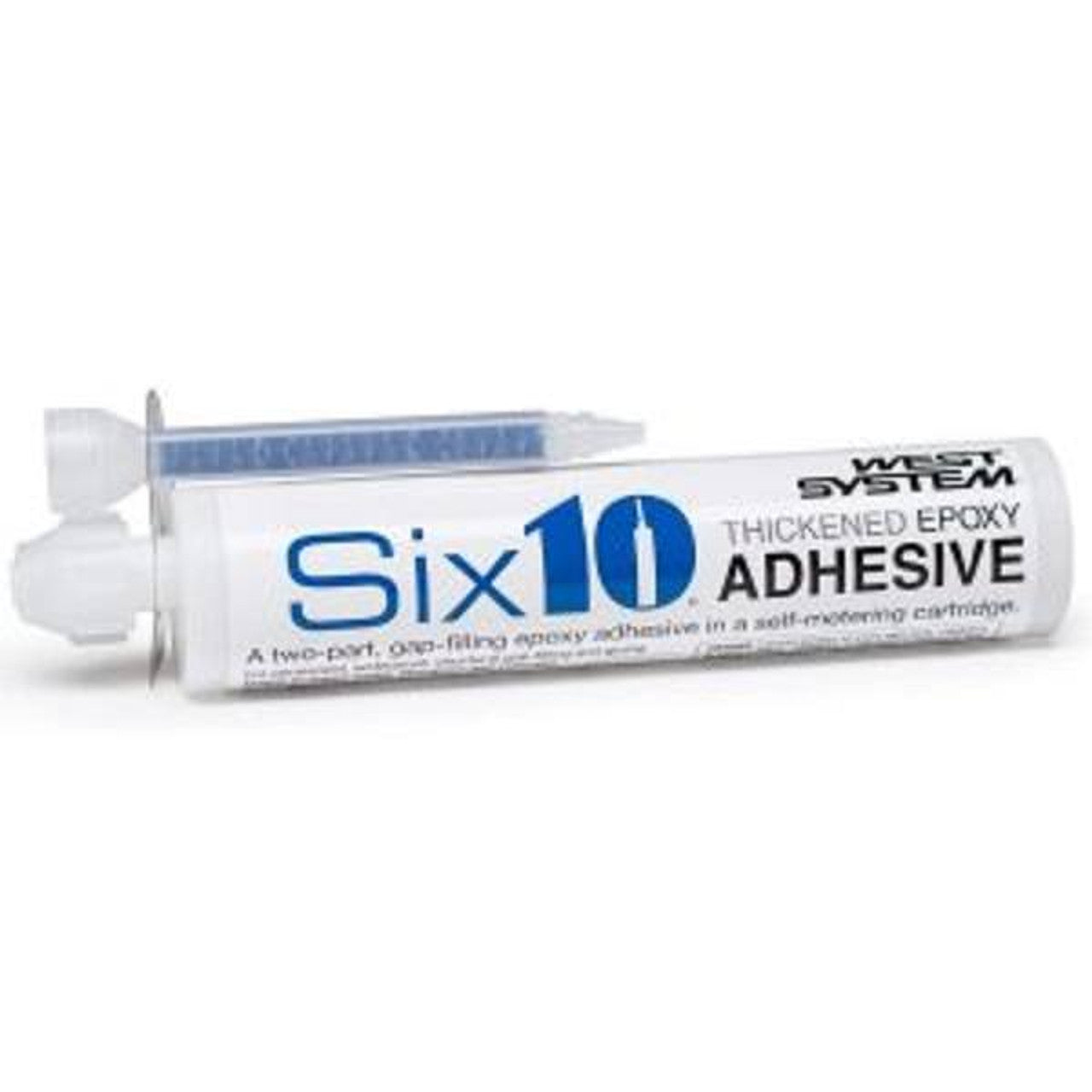
SKU:SWES-610
44 in stock
Couldn't load pickup availability
Six10 is structural epoxy in a caulking-gun cartridge: the coaxial tube meters 105-based resin and hardener through the static mixing tip, so you get a properly mixed, non-sag adhesive bead with zero measuring and zero cups.
Working time is about 42 minutes in a 100 g mass at 72°F (22°C); it goes solid in 5-6 hours and builds working strength over 1-4 days, down to a 50°F (10°C) shop. The gel is shear-thinning: it holds a bead on vertical surfaces but wets out fabric and scuffed substrates under tooling pressure. Bonds wood, fiberglass, metals, and masonry with the toughness of the 105 system, including the best elongation in the West range.
Use it for hardware bedding, fillets, and gap-filling structural bonds where breaking out pumps and cups is not worth it. Cap the used tip, save the spares, and swap a fresh mixer next session; the cartridge keeps.
Technical Specifications
Compare Resins
| Product |  West System Six10 Thickened Epoxy AdhesiveYou're viewingfrom $36.78 West System Six10 Thickened Epoxy AdhesiveYou're viewingfrom $36.78
|  West System 105 Epoxy Resinfrom $59.51 West System 105 Epoxy Resinfrom $59.51
|
|---|---|---|
| Type | Thickened epoxy adhesive - self-metering coaxial cartridge | Epoxy - base resin for WEST SYSTEM 200-series hardeners |
| Mix Ratio | Auto-metered through the 600 Static Mixer - fits any caulking gun | 5:1 by volume with 205/206; 3:1 with 207 (300 Mini Pumps meter it) |
| Viscosity | Non-sag gel; shear-thinning, wets out fabric under tooling pressure | Mixed @ 72°F: 975 cps (205) / 725 cps (206) / 760 cps (207) |
| Pot Life | 42 min (100 g @ 72°F) | 9-12 min (205) / 20-25 min (206) / 22-26 min (207), 100 g @ 72°F |
| Full Cure | Solid in 5-6 hr; working strength 1-4 days | Solid in 6-8 hr (205) to 10-15 hr (206/207); working strength 1-4 days |
| Cured Color | Transparent straw yellow | Clear/amber; exceptionally clear with 207 |
| Max Temp | HDT 127°F | HDT 117-123°F by hardener |
| UV | — | Pair with 207 + UV varnish for bright finishes |
| Fabrics | — | Fiberglass, carbon fiber, Kevlar, 1708/1208 biaxial (CSM: stitched only) |
| Best For | Gap-filling structural bonds, fillets, hardware bedding; minimum 50°F | Premium marine coating, bonding & repair |
| View |
What’s the difference between epoxy and polyester resin?
How do I mix epoxy resin and hardener properly?
Why are there different epoxy mix ratios like 5:1, 4:1, 3:1, and 2:1?
What is amine blush and how do I remove it?
What's the difference between fast and slow epoxy hardener?
Can I apply epoxy resin in cold weather?
How do I thin epoxy resin?
Can I tint or color epoxy resin?
Is epoxy still good after being frozen?
Does epoxy or polyester resin expire?
Blog posts

Best Fiberglass Cutting Tools for Clean Edges...
Best Fiberglass Cutting Tools for Clean Edges...

Kevlar Fabric for Boats: A Fabricator's Guide...
Kevlar Fabric for Boats: A Fabricator's Guide...
