


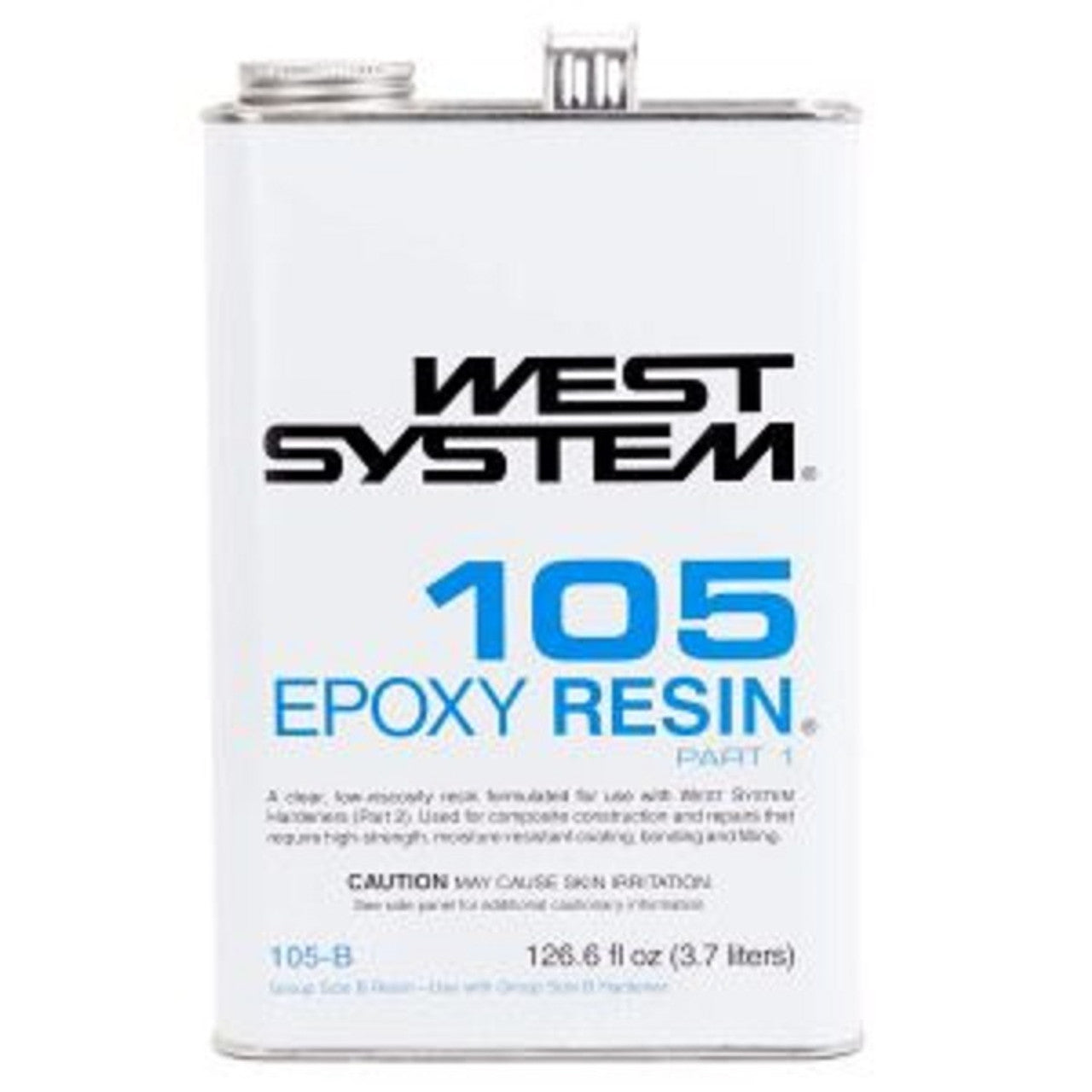
SKU:SWES-105-A
94 in stock
Couldn't load pickup availability
Ships Today if ordered before 4pm Learn More
Free Shipping on orders over $199 Learn More
West System 105 is the base resin of the 105/200-series system, the gold-standard marine epoxy from Gougeon Brothers. Pair it with a 200-series hardener for the cure speed and finish you need, and it covers coating, bonding, and laminating on fiberglass, wood, and metal.
Mix 5:1 by volume with 205 fast hardener or 206 slow hardener, 3:1 with 207 special clear. The 300 Mini Pumps meter both ratios one stroke to one stroke, which is how most shops run it. Mixed viscosity lands between 725 and 975 cps at 72°F (22°C) depending on hardener, thin enough to wet out heavy glass without starving the laminate.
Working numbers, 100 g cup at 72°F: 9-12 minutes pot life with 205, 20-25 with 206, 22-26 with 207. Solid overnight, working strength in 1-4 days. With 205/206, wash the amine blush off with water and a Scotch-Brite before recoating or paint; 207 skips the blush entirely. Sizes run quart, 0.98 gal, and the 4.35 gal pail, each matched to its own hardener group size.
If the job is general laminating or a bar top rather than premium marine work, our Boat Suppliers 2:1 epoxy kit runs thinner and costs less per gallon; the spec table below puts them side by side.
Specifications
Includes
Features


Resin Calculator
Overview
West System 105 Epoxy Resin is a high-performance, marine-grade epoxy formulated for structural bonding, laminating, sealing, and coating in boatbuilding and composite fabrication. Known for its excellent strength, moisture resistance, and versatility, it forms the backbone of the West System product line and is trusted by professionals and DIY builders alike.
Technical Specifications
Compare Resins
| Product |  West System 105 Epoxy ResinYou're viewingfrom $59.51 West System 105 Epoxy ResinYou're viewingfrom $59.51
| 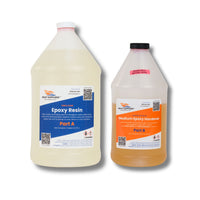 Boat Suppliers Epoxy Resin Kit – Thin, Clear, with Hardenerfrom $17.95 Boat Suppliers Epoxy Resin Kit – Thin, Clear, with Hardenerfrom $17.95
|  Thin Epoxy Resinfrom $9.98 Thin Epoxy Resinfrom $9.98
|
|---|---|---|---|
| Type | Epoxy - base resin for WEST SYSTEM 200-series hardeners | Epoxy - low-viscosity laminating system | Epoxy - 635 thin laminating resin (resin side only) |
| Mix Ratio | 5:1 by volume with 205/206; 3:1 with 207 (300 Mini Pumps meter it) | 2:1, 3:1, or 4:1 by volume (match your hardener) | 2:1 / 3:1 / 4:1 by volume with the matching BS hardener |
| Viscosity | Mixed @ 72°F: 975 cps (205) / 725 cps (206) / 760 cps (207) | 600 cps resin - thin, syrup-like for fast wet-out | 600 cps - thin, syrup-like for fast wet-out |
| Pot Life | 9-12 min (205) / 20-25 min (206) / 22-26 min (207), 100 g @ 72°F | 35-40 min (2:1) / 20-25 min (3:1) / 15 min (4:1) @ 80°F | — |
| Full Cure | Solid in 6-8 hr (205) to 10-15 hr (206/207); working strength 1-4 days | Dry: 24-28 hr (2:1) / 8-10 hr (3:1) / 3-4 hr (4:1) | — |
| Cured Color | Clear/amber; exceptionally clear with 207 | Semi-clear - hardener has an amber tint, dries clear in thin coats | Semi-clear |
| Max Temp | HDT 117-123°F by hardener | 150-195°F | 150-195°F |
| UV | Pair with 207 + UV varnish for bright finishes | No UV inhibitor - topcoat for sun exposure | No UV inhibitor - topcoat for sun exposure |
| Fabrics | Fiberglass, carbon fiber, Kevlar, 1708/1208 biaxial (CSM: stitched only) | Fiberglass, carbon fiber, Kevlar, 1708/1208 biaxial (CSM: stitched only) | Fiberglass, carbon fiber, Kevlar, 1708/1208 biaxial (CSM: stitched only) |
| Best For | Premium marine coating, bonding & repair | Lamination & wet-out, wood sealing, all-around marine repair | Lamination & wet-out, wood sealing |
| View | View |

Which West System Hardener Should I Use?
What filler should I use with West System epoxy?
Can I use chopped strand mat with epoxy resin?
How much epoxy resin do I need for 1708 biaxial fiberglass?
Do I need a hardener with 105 Epoxy Resin?
What’s the difference between epoxy and polyester resin?
How do I mix epoxy resin and hardener properly?
Why are there different epoxy mix ratios like 5:1, 4:1, 3:1, and 2:1?
What is amine blush and how do I remove it?
What's the difference between fast and slow epoxy hardener?
Can I apply epoxy resin in cold weather?
How do I thin epoxy resin?
Can I tint or color epoxy resin?
Is epoxy still good after being frozen?
Does epoxy or polyester resin expire?
Blog posts

Kevlar Fabric for Boats: A Fabricator's Guide...
Kevlar Fabric for Boats: A Fabricator's Guide...

Resin Mixing Mistakes That Ruin Your Composit...
Resin Mixing Mistakes That Ruin Your Composit...
