

Resin Art Starter Kit - Epoxy, Pigments & Mica Powders
Resin Art Starter Kit - Epoxy, Pigments & Mica Powders
Share
SKU:SK-ART001
20 in stock
Couldn't load pickup availability
Everything for a first run of resin art projects: coasters, tumblers, small pours, ocean-wave pieces, and jewelry. Built from the same marine-grade materials we sell to boat builders, which means pigments that stay color-fast outdoors and an epoxy that cures hard and clear.
What is in the kit:
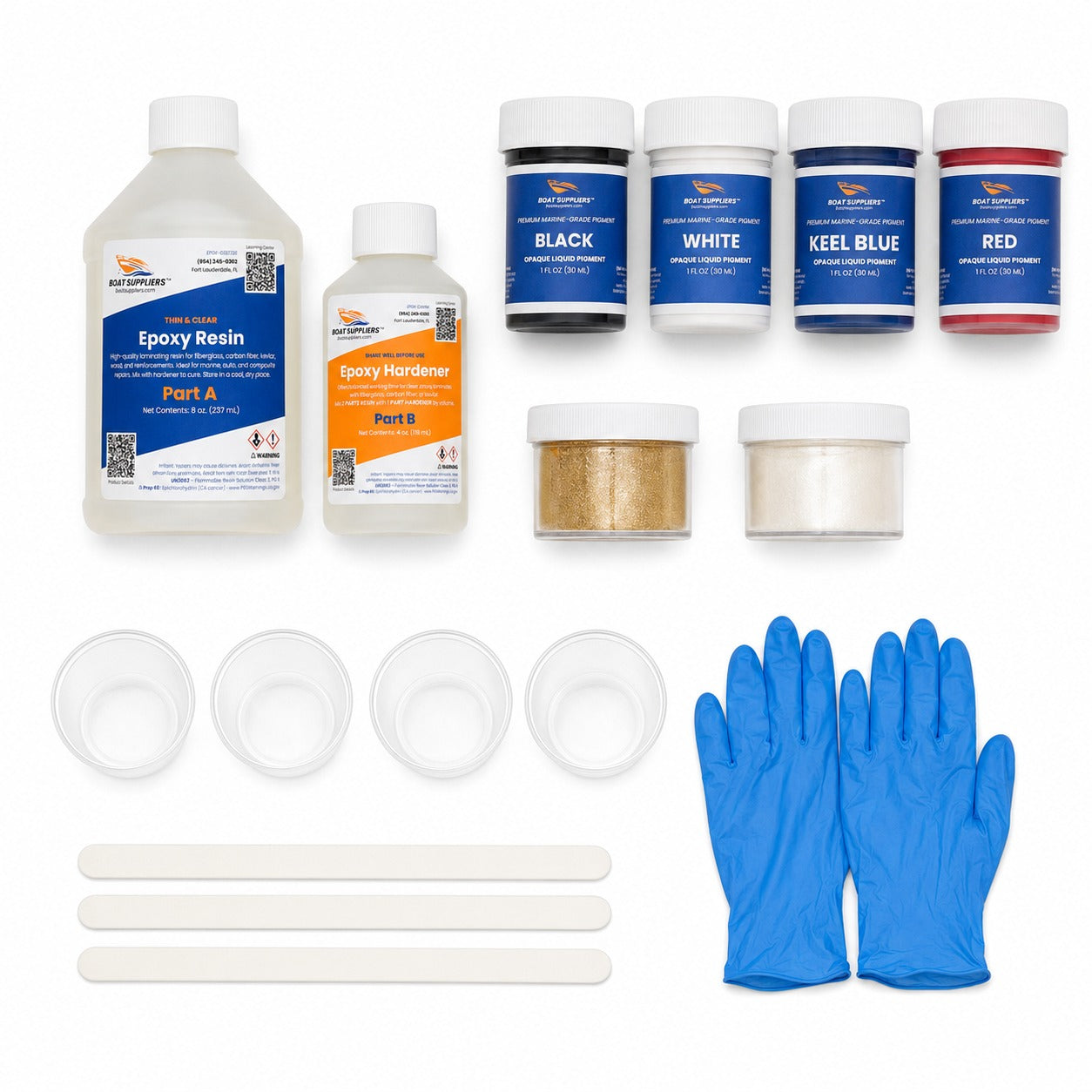
- 12oz two-part epoxy kit (8oz resin + 4oz hardener), thin, clear, and slow enough to work wet
- 4 opaque liquid pigments, 1oz each: Black, White, Keel Blue, and Red, highly concentrated, a few drops per cup
- 2 mica shimmer powders: Gold and Pearl White, 15g each
- 4 mixing cups, mixing sticks, nitrile gloves
Why marine pigments for art: these are the same colorants used to tint boat gelcoat, so they are UV stable and intensely concentrated. The Keel Blue plus White plus Pearl mica combination is the classic ocean-wave palette.
Mix small batches, layer colors, and experiment; the 12oz kit is enough for roughly a dozen coasters or several small pours. When you outgrow it, every color and resin in this kit is available in larger sizes.
Specifications
How to use this kit
Epoxy, marine pigments and mica powders for coasters, tumblers and pours. Every kit ships with this same sheet printed and in the box.
What is in the kit
- 12 oz Two-part epoxy kit8 oz resin plus 4 oz hardener, 2:1 by volume
- 4 x 1 oz Opaque liquid pigmentsblack, white, keel blue and red, highly concentrated
- 2 x 15 g Mica shimmer powdersgold and pearl white
- 4 / 1 set Mixing cups, mixing sticks
- 1 pr Nitrile gloves
You supply: molds or blanks, a heat gun or torch for bubbles, level work surface, plastic sheet, isopropyl alcohol and paper towels.
Mixing epoxy (2:1 by volume)
| Ratio | 2 parts resin to 1 part hardener |
| One coaster | 1 oz resin + 0.5 oz hardener |
| Full kit | 8 oz resin + 4 oz hardener |
Measure by volume in the cups. Off-ratio epoxy stays sticky forever, and no amount of waiting fixes it. Confirm the ratio on your hardener bottle.
Stir slowly for 2 minutes scraping sides and bottom, then re-pot and stir again. Fast stirring whips in bubbles you will fight later.
The job, start to finish
Set up level and warm
Work between 70 and 80 F on a surface you have checked with a level, and cover everything. Cold epoxy is thick and traps bubbles; a sloped table gives you a wedge-shaped coaster. Have molds released and ready before you mix, because the clock starts at mix.
Mix clear first
Mix your full batch of clear epoxy 2 to 1 and stir slowly, scraping the sides and bottom, then transfer to a second cup and stir again. Only once it is thoroughly mixed do you split it into smaller cups for coloring.
Tint small
These are marine pigments made to tint gelcoat, so they are far stronger than craft colorants: start with one or two drops per cup. Mica goes in as a pinch, stirred until the shimmer streaks. Keel blue plus white plus pearl mica is the classic ocean wave palette.
Pour and move it
Pour your base color, then add the others in ribbons or puddles and move them with a stick, a straw or by tilting the mold. Do not over-work it or the colors go muddy. Pass a heat gun or torch quickly across the surface to pop bubbles.
Cure and demold
Cover against dust and leave it fully alone for 24 hours. Demold gently, and expect full hardness at several days rather than one. Sand any sharp edge and, if you want gloss on a sanded face, finish with a thin flood coat rather than polishing.
If something goes wrong
Stayed sticky forever
Off-ratio or under-stirred. Nothing fixes it. Scrape it out and remix carefully by volume.
Colors went muddy
Over-worked. Move the colors two or three passes and then stop.
Bubbles everywhere
Stirred too fast, or it was too cold. Stir slowly, warm the room, and torch the surface.
Bendy soft edges
The pour was too thin at the edge or too cool. Give it several days for full hardness.
It got hot and cracked
Poured too deep. Keep single pours under about half an inch and build in layers.
Roughly a dozen coasters or several small pours. Every pigment and resin here is available in larger sizes at boatsuppliers.com.
Blog posts

Best Fiberglass Cutting Tools for Clean Edges...
Best Fiberglass Cutting Tools for Clean Edges...

Kevlar Fabric for Boats: A Fabricator's Guide...
Kevlar Fabric for Boats: A Fabricator's Guide...
